


추부길 whytimespen1@gmail.com
[Washington Enraged by Sino-Russian Surveillance; Military Pressure in the Caribbean Reaches Zenith]
Even while actively waging war against Iran, President Donald Trump is aggressively ramping up military pressure on Cuba. Consequently, discussions within Washington regarding scenarios for limited military action or high-intensity regime pressure targeting Havana are shifting into high gear. Excluding the Middle East, the United States has already amassed its largest naval presence globally in the Caribbean Sea, and is reportedly reviewing an array of military options ranging from precision airstrikes to operations aimed at regime change.
On May 28, the US political news outlet Politico reported, "The US Department of Defense has spent months deploying the troops and weaponry necessary for a strike on Cuba, evaluating diverse options from simple surgical airstrikes to ground intervention scenarios aimed at toppling the regime." The report added that the options available to President Trump span a wide spectrum—from limited military coercion designed to force concessions from Havana, to maximum-pressure operations intended to destabilize the leadership entirely.
Signs of this strategic pivot began surfacing as early as April. Zeteo, an independent investigative media outlet, reported that "Pentagon and administration officials received a direct directive from the White House to intensify readiness for potential military operations against Cuba." Sources noted that "Trump has grown increasingly frustrated with President Miguel Díaz-Canel's overt defiance and has begun evaluating regime-pressure scenarios akin to the template used against Nicolás Maduro in Venezuela."
Publicly, President Trump has maintained a stance that prioritizing the current conflict takes precedence. During a White House event on March 5, he stated, "I want to finish Iran first. But Cuba is just a matter of time."
However, his subsequent remarks have undergone a subtle but noticeable shift. On March 7, during a CNN interview discussing achievements in the Iran war, Trump abruptly remarked, "Cuba is going to crumble soon." Later, during a speech in Miami on March 28, he dropped a blunt hint: "Cuba is next. Pretend I didn't say that." He reiterated this sentiment directly in a subsequent interview with Politico, stating, "Cuba will collapse too."
Analyzing these statements, CNN observed, "While Trump’s exact intentions remain ambiguous, there appears to be a strong underlying desire to score a swift, strategic victory in Cuba before wrapping up the war in Iran."
[Sino-Russian Wiretapping Networks Embedded in Cuba: US Leverages Threats as National Security Justification]
To comprehend the Trump administration's hardline stance on Havana, one must examine the critical backdrop: Chinese and Russian military intelligence activities inside Cuba. Washington has ceased viewing this as a standard diplomatic dispute, reclassifying it instead as a direct, existential security threat aimed at the US homeland.
Citing US intelligence officials, The Wall Street Journal (WSJ) reported, "Since 2023, China and Russia have significantly expanded their intelligence personnel presence in Cuba and invested heavily in electronic eavesdropping facilities designed to monitor US military bases in Florida." Positioned a mere 160 kilometers off the US coast, these facilities possess the capability to directly surveil critical military command centers in Florida that oversee operations across the Middle East and Latin America—a factor that has triggered acute alarm bells in Washington.
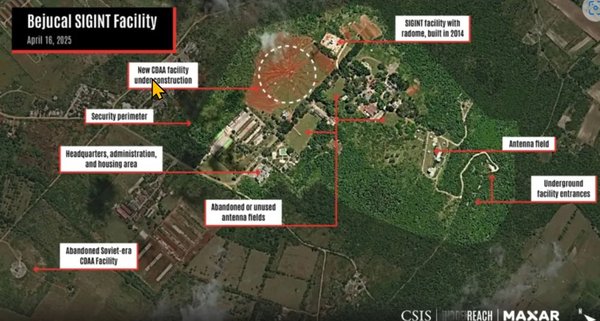
The Center for Strategic and International Studies (CSIS) revealed that "a December 2024 analysis of commercial satellite imagery identified at least 12 China-linked signals intelligence (SIGINT) facilities, including sites in Bejucal, El Wajay, and Calabazar near Havana, as well as El Salao near Santiago de Cuba."
The El Salao base, located just 113 kilometers from the US Naval Station at Guantanamo Bay, is assessed to possess wide-area surveillance capabilities. Once fully operational, it will be capable of tracking US warships and aircraft within a staggering radius of up to 14,500 kilometers.
Testifying before a House Homeland Security Committee hearing, Ryan Berg, a senior fellow at CSIS, emphasized, "Cuba's greatest asset is its geography. From Beijing's perspective, Cuba serves as the ultimate platform to surveil approximately 20 critical military installations clustered across Florida."
The history of the Bejucal base is deeply intertwined with the Cold War. The site originally served as a storage facility for Soviet nuclear weapons during the 1962 Cuban Missile Crisis. In 1999, following a visit to Cuba by Chinese Defense Minister Chi Haotian and the signing of an accord with Raúl Castro, it was repurposed into a central hub for Chinese intelligence gathering.
It is also noteworthy that during his 2016 presidential primary campaign, Secretary of State Antony Blinken—then a candidate—publicly demanded the dismantling of China's espionage base in Bejucal. Analysts note it is no coincidence that he is now spearheading the Trump administration's hawkish policy toward Cuba.
When the WSJ first broke the news in June 2023 regarding a secret agreement for a Chinese spy base in Cuba, the Pentagon initially dismissed the report as "inaccurate." However, just days later, White House National Security Council (NSC) spokesperson John Kirby effectively conceded the existence of the Chinese base, fueling further controversy. Observers interpret this flip-flop as an indication that the US government was internally calculating precisely when and how to weaponize this intelligence for strategic leverage.
Compounding Washington's anxieties over China's surveillance network is Russia's expanding military footprint. According to CSIS, "In June 2024, Russia deployed a naval detachment to the port of Havana, including the guided-missile frigate Admiral Gorshkov and the nuclear-powered submarine Kazan." The Kazan is known to carry Zircon hypersonic cruise missiles.
The docking of a Russian nuclear submarine in Cuba—effectively a first since the end of the Cold War—sent shockwaves through Washington. At the time, US National Security Advisor Jake Sullivan publicly aired his concerns, noting, "This time, the flotilla includes a submarine of a different class than we have seen previously."
Ultimately, China’s expansive SIGINT grid and Russia's nuclear submarine deployment have handed the Trump administration an ironclad national security justification. During a cabinet meeting, Secretary of State Blinken explicitly defined the situation: "Cuba is permitting Russian and Chinese intelligence operations on its sovereign territory, posing a direct and unacceptable threat to United States national security."
[Treating Cuba Like Venezuela: Washington Reactivates Its Old Playbook]
Analysts point out that within the Trump administration, Cuba is increasingly being openly discussed as "the next front after Iran."
CNBC reported that "just prior to launching military operations against Iran, Trump floated the possibility of a 'friendly takeover' of Cuba, while Senator Lindsey Graham echoed this sentiment immediately following joint US-Israeli airstrikes on Iran, declaring that 'Cuba is next.'"
Commenting on this trajectory, the Associated Press (AP) observed, "The Trump administration's strategy against Havana is almost line-by-line replicating the playbook utilized during the maximum-pressure campaign against Venezuela—characterized by oil embargoes, naval power projection, federal indictments, and repeated threats of military intervention."
However, AP injected a note of caution, highlighting structural differences: "The current scale of naval forces in the Caribbean is smaller than during the Venezuela pressure campaign, and indicting a 94-year-old former leader carries different symbolic and practical weight compared to attempting to arrest a sitting president."
[Aircraft Carrier Enters Caribbean on Day of Castro’s Indictment; Encirclement of Cuba Materializes]
The timing of the current military build-up appears meticulously coordinated with Washington’s legal maneuvers.
On May 20, the US Department of Justice unsealed an indictment against former President of the Council of State Raúl Castro, stemming from the 1996 shootdown of civilian aircraft operated by the "Brothers to the Rescue" organization. The charges allege that Castro, serving as Defense Minister at the time, personally ordered the military to fire on the unarmed planes, resulting in the deaths of four individuals, including three US citizens.
Immediately following the announcement of the indictment, US Southern Command made a public show of entering the USS Nimitz carrier strike group into the Caribbean Sea. Mark Cancian, a senior adviser at CSIS, assessed the move: "While the Nimitz deployment is primarily intended as a robust demonstration of deterrence, it stands ready to transition into executing actual kinetic operations if ordered."
Furthermore, aerial tracking data indicates that advanced US reconnaissance aircraft and high-altitude surveillance drones have maintained continuous, round-the-clock operations over airspace adjacent to Cuba for months. CNBC analyzed this pattern, noting it "closely mirrors the intensive intelligence-gathering activities witnessed immediately prior to US operations in Venezuela and Iran."
With reports surfacing that a Kearsarge-class amphibious assault ship—capable of transporting roughly 2,500 Marines—is undergoing preparations for additional deployment, geopolitical friction in the Caribbean is rapidly approaching a boiling point.
[Return of the Cold War: Cuba Emerges Anew as the Frontline of Superpower Collision]
Ultimately, the unfolding crisis in Cuba transcends a bilateral dispute between Washington and Havana. It represents a definitive strategic declaration by the United States that it will no longer tolerate the establishment of a Chinese electronic espionage grid and a Russian military staging platform directly on its doorstep. Treating this not as a mere diplomatic friction but as a mandatory "eradication of a national security threat," the Trump administration has begun openly putting military options on the table.
Nevertheless, some experts maintain that the probability of an all-out, full-scale invasion remains constrained. Given the burdens of a prolonged war in Iran, inevitable pushback from Beijing and Moscow, diplomatic blowback from Latin American neighbors, and the exorbitant post-conflict costs of occupation, Washington is widely expected to favor a strategy of calibrated military coercion paired with domestic regime-destabilization tactics.
Yet, one reality remains starkly clear: the "Cuban Missile Crisis," which seemed to have faded into the annals of history with the end of the Cold War, has returned as a pivotal variable in contemporary global politics. On the very island where Soviet nuclear missiles once targeted the United States in 1962, Chinese eavesdropping arrays and Russian nuclear submarines are now flexing their muscles against Washington.
Recognizing this as a coordinated, strategic penetration aimed at the core of American hegemony, Washington is responding forcefully. Cuba has once again been thrust onto the frontlines of a high-stakes strategic collision among the United States, China, and Russia.

- TAG