


추부길 whytimespen1@gmail.com
[Three Mountains for the White House to Climb: Congress, the 123 Agreement, and the NPT]
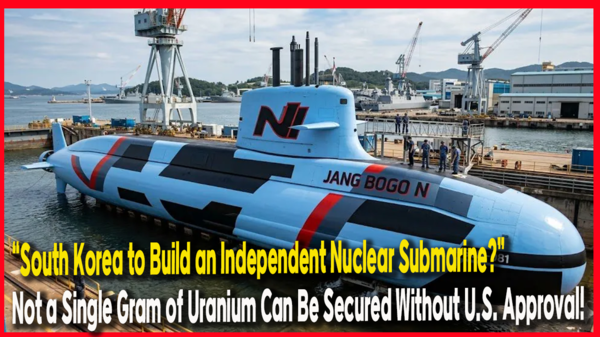
While the Lee Jae-myung administration has officially launched the ‘Changbogo-N Project’ to usher in the era of South Korean indigenous nuclear-powered submarines (SSNs), the wall of reality stands dauntingly high. Securing nuclear fuel is practically impossible without legal approval from the United States, and the project faces a multi-layered barrier consisting of congressional oversight and the international nuclear non-proliferation regime. Compounding the challenge, sensitive reactions from China, Russia, and Japan are elevating the nuclear submarine initiative from a mere weapons development project into a geopolitical issue capable of destabilizing the entire Northeast Asian balance of power. Concerns are mounting that a hasty declaration could trigger a severe diplomatic backlash.
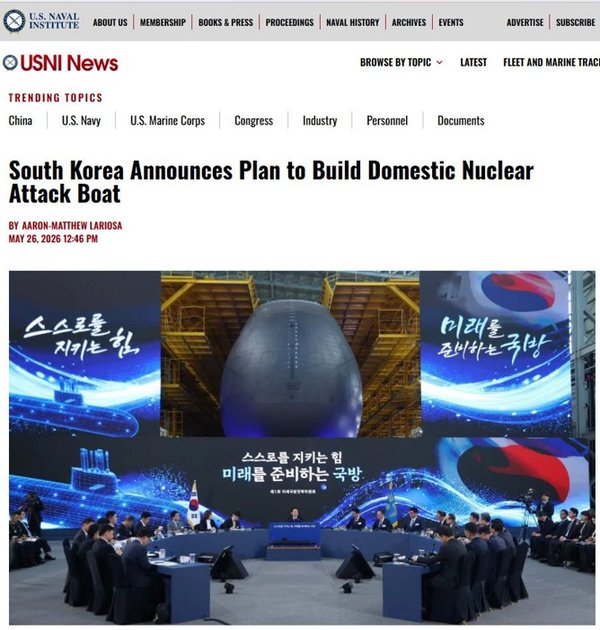
On May 27, USNI News, a media outlet specializing in the U.S. Navy, analyzed that "South Korea requires U.S. assistance to secure submarine fuel based on the 2015 U.S.-ROK Agreement for Peaceful Nuclear Cooperation." The outlet further noted that "while the U.S. might cooperate in supplying fuel, it is highly unlikely to share nuclear reactor technology with Seoul." The Changbogo-N Project maps out a timeline targeting the start of construction in the late 2020s, launching in the mid-2030s, and operational deployment by the late 2030s. However, this entire roadmap is predicated on the prerequisite of securing a fuel agreement. Crucially, the core of a nuclear submarine lies not in its hull, but in its fuel. Yet, under current conditions, South Korea has no viable means of acquiring highly enriched uranium for submarine propulsion without Washington's explicit endorsement.
Regarding this hurdle, Just Security, a legal and national security journal, assessed last December that "even the most basic details of the current plan remain deeply muddled between the U.S. and South Korea." It pointed out that "the joint fact sheet released by both sides following October's summit only offered principled remarks regarding the U.S. 'support' for South Korea's nuclear submarine program and a 'joint search for fuel procurement options,' without containing any concrete agreement terms." Just Security further emphasized that "President Trump's 'approval' remains confined to social media posts and fact sheets; transitioning this into a legally binding agreement will require considerable time and rigorous procedural steps."
In January, the foreign policy magazine Foreign Policy shed light on the legal barriers surrounding nuclear submarine fuel, stating, "The 2015 revision of the U.S.-ROK Atomic Energy Cooperation Agreement (the 123 Agreement) explicitly prohibits South Korea from enriching or reprocessing U.S.-origin nuclear material for military purposes, which encompasses nuclear submarine fuel." The magazine added, "For President Trump to amend this agreement, congressional consent is theoretically required. The White House attempted to bypass congressional approval in a fact sheet released two weeks after the summit by using language that supports 'peaceful, civilian-purpose uranium enrichment,' but experts analyze that this cannot be directly applied to the transfer of military fuel for nuclear submarines."
In line with this, a Korean Peninsula update report by the American Enterprise Institute (AEI) specified that "while amending Article 13 of the 123 Agreement does not require congressional ratification, it must undergo a mandatory 90-day congressional review period." If lawmakers pass a joint resolution of disapproval during this window, the amendment can be completely derailed. This highlights a significant gap between the South Korean government's expectation of 'immediate procurement' and the actual legal processes inside the U.S.
The obstacles do not end there. On January 30, shortly after Seoul announced its nuclear submarine plans, four U.S. senators sent a public letter to President Trump, directly challenging the move. Senators Edward Markey (D-MA), Jeff Merkley (D-OR), Chris Van Hollen (D-MD), and Ron Wyden (D-OR) stated in the letter, "Given the complex history of South Korea's nuclear weapons ambitions and President Trump’s own role, this policy shift is particularly concerning." They warned that "providing South Korea with potential nuclear capabilities would undermine U.S. non-proliferation goals" and could set a negative precedent for the nuclear agreement currently being negotiated with Saudi Arabia. They pointed out that overturning a nuclear non-proliferation policy maintained on a bipartisan basis for over 70 years to accommodate a single nation could trigger a dangerous domino effect.
[China Warns of a "Repeat of the THAAD Crisis" — A New Flashpoint in ROK-China Relations]
China's backlash against South Korea's nuclear submarine push has already begun to materialize. In fact, Seoul's pursuit of nuclear-powered submarines risks igniting a conflict in ROK-China relations akin to the 2016 THAAD crisis. At that time, when South Korea deployed the U.S. military’s Terminal High Altitude Area Defense (THAAD) missile system, Beijing retaliated with sweeping economic sanctions, including banning group tours to South Korea and squeezing Lotte Mart’s business operations within China.
An indicator of this stance can be found in a report by Global Times, an English-language mouthpiece of the Chinese Communist Party. On November 17 last year, the outlet quoted the Chinese Ambassador to South Korea warning that "efforts to modernize the ROK-U.S. alliance must not expand into a framework aimed at containing China," adding that "if the strategic purpose of the ROK-U.S. alliance changes, China’s perspective on the alliance will also shift."
Da Zhigang, a Chinese military expert, analyzed in the Global Times that "if South Korea’s nuclear submarines are ultimately utilized to contain China, it will introduce severe uncertainties into ROK-China relations, stimulate Japan or North Korea to pursue similar capabilities, and spark an arms race in Northeast Asia."
Chinese Foreign Ministry Spokesperson Lin Jian also urged during a regular briefing that "South Korea approach this issue with prudence," officially expressing concern that it "could undermine the Non-Proliferation Treaty (NPT) regime." As the precedent set by the U.S. supplying nuclear technology to Australia through AUKUS threatens to extend to South Korea, Beijing is dialing up its diplomatic pressure. This begs the question: Can the Lee Jae-myung administration, which has effectively pursued a China-friendly policy, withstand such a fierce backlash from Beijing?
Russia's stance further compounds the anxiety. On February 9, Georgy Zinoviev, the Russian Ambassador to South Korea, publicly warned that "South Korea’s attempt to import enriched uranium from the United States to build nuclear submarines could violate the Non-Proliferation Treaty (NPT)." He stated that Moscow "supports broad international discussions within the IAEA framework regarding the verification of nuclear materials used in submarine reactors." While noting that it is premature to definitively conclude an NPT violation since the U.S. has not released specific detailed plans, he made Russia's objection explicitly clear.
[Behind the Stalled Working-Level Talks: Pushed Down Washington’s Priority List]
Structurally, there are clear reasons why working-level negotiations between Seoul and Washington have stalled. Working-level officials at the U.S. State Department and Department of Energy—who handle nuclear energy, arms control, and non-proliferation—have been tied down by the Iran nuclear negotiations, while the White House has focused its energy on preparing for the U.S.-China summit between Trump and Xi Jinping. Furthermore, outstanding bilateral issues, such as delays in South Korea's investment projects in the U.S. and disputes involving Coupang, have sapped momentum from the talks. To make matters worse, reports that the South Korean government is internally reviewing a 'Plan B' to procure fuel from a third country (such as France) if the U.S. fails to deliver risk deeply fracturing Washington's trust.
Addressing these structural limitations, the military affairs journal Real Clear Defense provided a stark diagnosis on February 20 regarding South Korea's independent SSN development. The outlet asserted that "Seoul’s independent program must simultaneously overcome three interlocking barriers: domestic legal reforms, indigenous reactor development, and acquiring clearance under the international nuclear non-proliferation regime," concluding that "resolving these tasks simultaneously, when each is formidable on its own, is 'nearly impossible.'"
The Observer Research Foundation (ORF), a prominent Indian think tank, also analyzed South Korea's nuclear submarine push within the context of the shifting strategic landscape in Northeast Asia. While noting that "South Korea perceives the potential development of nuclear submarines by North Korea, backed by Russia, as a severe threat," ORF pointed out that "following the Lee Jae-myung administration's announcement of its nuclear submarine plan, a succession of cautious concerns raised within the region has left Seoul facing a dilemma between strengthening deterrence and fueling regional instability."
[Conclusion]
A nuclear-powered submarine is not just another weapons system. It is a highly sophisticated geopolitical project that simultaneously impacts the nuclear non-proliferation strategy of the U.S., China's regional hegemony ambitions, Russia's security interests, and shifts in Japan's military strategy. This is not an arena that can be swayed by a mere declaration. In other words, it is absolutely not a matter to be announced impulsively based on national sentiment. Such an uncoordinated push could ironically become the fastest shortcut to making the future of South Korea's nuclear submarines entirely opaque.
In this regard, the 'Changbogo-N Project,' launched with such high ambition by the Lee Jae-myung administration, has hit a massive reef right from the start. While the rationale of securing military deterrence sounds plausible, this reckless overspeeding—which ignores the cold realities of international politics and the foundational framework of the ROK-U.S. alliance—exposes the severe side effects of such policy choices. A nuclear submarine is a supreme geopolitical equation, not a mere weapon. Approaching this as a 'declaration' for domestic political achievements represents a textbook populist approach to national security, one that is morphing into an act of diplomatic self-harm.
Particularly damaging is the revelation that the Lee Jae-myung administration has been internally vetting a 'Plan B' to procure fuel via a third country if supplies from the U.S. fall through. This is a highly dangerous concept that shakes 'mutual trust'—the most valuable asset of the ROK-U.S. security alliance—to its very core. It signals a willingness to pursue an independent nuclear path while sidelining the U.S., a move that has predictably resulted in South Korea being pushed down the priority list of Washington's working-level policymakers. True security can never be achieved by eroding the value of the alliance.
On top of this, the prospect of economic and military retaliation from China, the regional heavyweight, is becoming tangible. This brings back grim memories of the severe economic toll exacted upon South Korean enterprises during the past THAAD crisis. Provoking China without a watertight economic security contingency plan or a calculated diplomatic strategy yields zero benefit to the national interest.
Furthermore, Japan, a core Asian ally of the U.S., has reportedly been rattled by Washington's perceived signs of support for South Korea's nuclear submarine ambitions. Consequently, Tokyo is showing signs of entering the arms race by reviewing its own acquisition of nuclear submarines. This serves as a self-defeating move that disrupts the balance of power in Northeast Asia and locks ROK-Japan relations into a worst-case adversarial competition.
As Real Clear Defense pointed out, clearing the three simultaneous hurdles of U.S. legislative amendments, indigenous reactor development, and international non-proliferation clearance borders on the impossible. To reiterate, national security stripped of meticulous preparation and flawless institutional coordination with the United States is nothing more than a castle built on sand. What South Korea needs right now is not a half-baked declaration of independent development, but the strategic wisdom to further solidify the ROK-U.S. alliance and institutionalize practical extended deterrence. Thus, one must ask the Lee Jae-myung administration: “Are you truly prepared to handle the fallout of this premature nuclear submarine announcement?”
- TAG