


추부길 whytimespen1@gmail.com
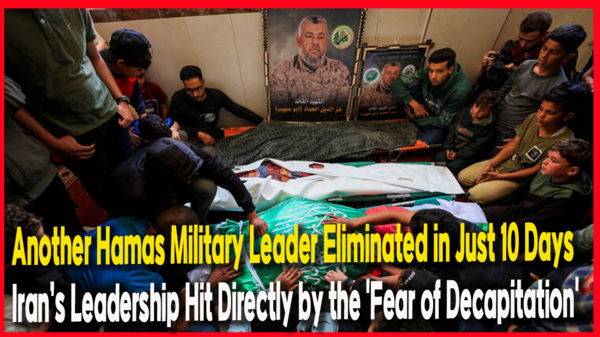
[The Message Behind the Sequential Elimination of Hamas Leaders: The Iranian Leadership’s 'Fear of Survival']
Israel has eliminated Mohamed Odeh, the newly appointed military leader of Hamas’s Al-Qassam Brigades. This latest decapitation strike, coming just ten days after the last, goes beyond a mere tactical achievement; it is interpreted as targeted pressure aimed squarely at the entire "Axis of Resistance" that Iran has built over forty years. In particular, as the proxy war network linking Hamas, Hezbollah, and the Houthis suffers a total collapse in communications, funding, and personal networks, signs of growing survival anxiety and internal power fractures are emerging within the Iranian leadership itself.
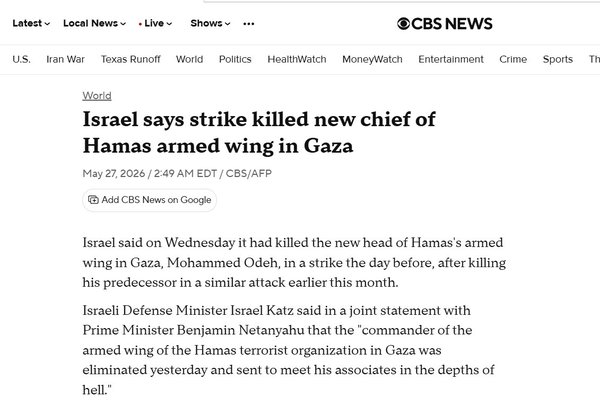
On the 27th, CBS News in the United States reported, "Israel announced today that it killed Mohamed Odeh, the newly appointed chief of Hamas’s Al-Qassam Brigades, in an airstrike in Gaza City the previous day." The report added, "Defense Minister Katz and Prime Minister Netanyahu declared in a joint statement: 'We pledged to eliminate everyone who led the October 7 massacre, and wherever they are, they are destined for death.'"
CBS News further noted, "Prior to assuming command of the Al-Qassam Brigades, Odeh served as the head of Hamas’s military intelligence branch and was assessed as one of the last remaining high-ranking figures within Hamas’s senior military leadership following months of Israeli decapitation strikes." The outlet highlighted that "he was a key figure who oversaw intelligence gathering on Israeli military bases near the Gaza border and identified vulnerabilities within Israel’s Gaza Division during the preparations for the October 7, 2023 attack."
[A 40-Year Investment in the 'Axis of Resistance': Its Structural Significance and the Weight of Its Collapse]
To understand the shock wave that Odeh’s elimination sends through the Iranian leadership, one must first confront how heavily Iran has wagered on this proxy warfare system. The Foundation for Defense of Democracies (FDD) in the U.S. stated, "Iran has provided $700 million annually to Hezbollah alone, and $100 million to $200 million to the Houthis—this entire financial pipeline served as the material foundation for sustaining the Axis of Resistance network." The FDD added, "This network is a structure into which more than $16 billion has been funneled over 40 years, designed as a strategic asset for Iran to absorb direct threats from the U.S. and Israel while projecting regional influence."
The Israel Policy Forum also analyzed that "following the October 7, 2023 attack, Iran attempted for the first time to operationalize the concept of a 'unified front' through the Gaza War." Elaborating on this, the Israel Policy Forum explained, "The blueprint was to pressure Israel from multiple fronts by simultaneously activating Lebanese Hezbollah, Iraqi militias, the Yemeni Houthis, and Gazan Hamas. Iran sought to pin Israel down utilizing its proxy network while avoiding direct intervention and its corresponding costs—but this ultimately failed, and Israel instead shifted to an offensive posture."
Iran’s investment in Hamas was never a matter of simple financial aid. The core of Iran’s proxy strategy was to forge a long-term war of attrition against Israel's regional dominance by arming and training various factions like Hamas and Hezbollah, thereby deterring potential direct attacks against Iran itself. The Gaza War and the consecutive strikes by Iranian proxies against Israel proved that this strategy had indeed been highly effective for a considerable period.
[Communications, Funding, and Personnel: The Three Vital Arteries of Proxy War Management Severed]
The shockwave laid bare by Odeh’s elimination stems from a structural disconnection occurring at a much deeper level. Iran's proxy management system has already had three of its core arteries completely severed.
First is the severing of the communications network. Immediately following the launch of "Operation Epic Fury" on February 28, 2026, Israeli strikes targeting Iran’s communication infrastructure cut off the encrypted communication channels that Iran’s Quds Force used to connect with proxy leaders in Beirut, Baghdad, and Sana'a.
Second is the choking of financial pipelines. According to Unit 42 of the cybersecurity firm Palo Alto Networks, the digital infrastructure of the Central Bank of Iran (CBI) was effectively neutralized within 72 hours of the outbreak of hostilities, and Iran’s internet connectivity was cut by 99% compared to pre-war levels. This dismantled the coordinated command structure through which Iran transferred funds to its overseas proxies.
Third is the erasure of personal networks. The deaths and injuries of senior IRGC commanders—including the head of the IRGC Intelligence Organization—on March 18 effectively wiped out the person-to-person relationship networks through which proxy management was actually executed. The Quds Force did not act as a mere financial broker; it synchronized proxies through human trust and relationships built over decades with individual faction leaders. That network has vanished.
[Proxies Initiate Autonomous Action Without 'Orders from Tehran']
The consequences of these three structural ruptures are staggering. In an analysis published last March titled "The Deafening Silence of Iran’s Proxies," the American Enterprise Institute (AEI) pointed out, "For the first time in their operational history, the individual factions making up Iran's proxy network find themselves in a position where they must make autonomous decisions." The AEI noted, "Some have overreached, taking actions far beyond what Tehran would have directed, while others have visibly refused to engage in combat."
The Global Terrorism Index 2026 Special Report delves deeper into the ideological implications of this phenomenon. The report observes, "With the centralized control traditionally exercised by the senior command of the Islamic Revolutionary Guard Corps (IRGC) gone, proxies have gained an unprecedented level of autonomy." It adds, "This carries severe theological implications. The doctrine of 'Velayat-e Faqih' (Guardianship of the Islamic Jurist), which ideologically bound various proxy organizations like Hezbollah to Iran's Supreme Leader, has fallen into uncertainty. Instead of operating under a unified command structure, Iran's proxies are increasingly acting independently."
In the case of Hamas, this shift toward autonomy is particularly pronounced. Unlike other proxies, Hamas—a Sunni organization—was never ideologically subservient to the Shia doctrine of Velayat-e Faqih; the essence of their relationship was strictly rooted in strategic and financial interests. HSToday, a monthly counterterrorism publication by the U.S. Department of Homeland Security, noted in an analysis, "In Hamas’s relationship with Iran, operational alignment was far more vital than ideological alignment, and Iran prioritized efficiency and loyalty over rigid ideological conformity." It analyzed that "now that the material foundation of that relationship—the supply of funds and weaponry—has been cut off, Hamas's structural incentive to follow Iran’s strategic directives has inevitably weakened."
[Mojtaba Khamenei Treats Injuries in Hiding… The IRGC Coalition Makes the Real Decisions]
Compounding all of this, the very nerve center of Iranian power is currently paralyzed. The Jerusalem Center for Public Affairs (JCFA) pointed out, "The new Supreme Leader, Mojtaba Khamenei, is currently in hiding at a secret location known only to a selective few, out of fear of becoming an Israeli target." The JCFA added, "While Iran issues statements in his name, it has completely refrained from releasing any photographs or video footage of him." In response, Israeli Defense Minister Katz directly warned that "Israel could target Mojtaba in the near future."
The New York Times (NYT) described the situation in late March as a "severe state of decision-making paralysis within the Iranian leadership," reporting that "paranoia resulting from damage to communication infrastructure and internal power struggles have also been documented."
Hamidreza Azizi, a visiting fellow at the German Institute for International and Security Affairs writing for TIME, analyzed: "Since the war, the Islamic Republic of Iran has not been operating as a hierarchy centered around a single ruler, but rather as a hardline coalition attempting to simultaneously manage war, diplomacy, and internal rivalry." TIME noted, "In this structure, the consecutive elimination of Hamas leaders is not merely military news; it is a shock wave that forces individual actors within this hardline coalition to reassess their own survival strategies."
Newsweek also reported, "The IRGC has suffered a series of consecutive blows, including the virtual decimation of Hezbollah in September 2024, the withdrawal from Syria during the collapse of the Assad regime, and the subsequent decapitation of the organization's senior leadership during Israel's 12-Day War." The report noted that expert Ali Alfoneh flatly concluded, "Today's IRGC is a mere shadow of its prime, with its influence severely diminished."
[The IRGC Elevated Mojtaba, but the Legitimacy Crisis Grinds On]
Reuters reported, "The IRGC forced the ascension of Mojtaba as Supreme Leader, viewing him as a 'malleable version' who would uphold his father's hardline stance while crushing opposition from pragmatists." Reuters added, "The IRGC, which already possessed immense power, expanded its influence even further after the war. Sources indicate that because he owes his appointment to the IRGC, he has essentially become a 'rubber stamp'."
However, the fact that the IRGC holds absolute military power does not resolve Iran’s deeper legitimacy crisis. The TRENDS Research & Advisory institute pointed out, "While Mojtaba's appointment provided an answer to the succession issue on paper, it has failed to resolve the legitimacy crisis in a practical sense." The institute emphasized, "Questions regarding whom he governs for, what independent religious or popular foundation he stands on, and whether an individual who has never held a formal government post can wield the authority required for the office cannot be answered simply by a military-backed appointment."
Amid this vacuum of legitimacy, the spectacle of Hamas leaders being replaced every ten days signals to both Iran’s domestic audience and its regional partners that Tehran has lost the capacity to protect its own allies.
["A Catastrophic Intelligence Failure"… Mossad's Penetration Exposes Iran’s Vulnerability]
There is a critical context that cannot be overlooked when analyzing Odeh’s elimination. The Hudson Institute in the U.S. analyzed, "The root cause enabling Israel’s consecutive decapitation operations is not just military might, but the deep penetration of its intelligence capabilities inside Iran and its proxy forces." The Hudson Institute pointed out, "Starting with the July 2024 assassination of Hamas political leader Ismail Haniyeh inside an IRGC guesthouse in Tehran, Iranian counterintelligence agencies have been forced to operate under the assumption that they do not know the extent to which their security has been compromised. This state of 'the unknown' is the most fatal condition an intelligence agency can face."
Ultimately, the elimination of Hamas leadership, repeating every ten days, transcends the bounds of mere military success. It stands as a clear signal that the proxy war strategy into which Iran has poured massive costs and resources over a long period is facing a fundamental upheaval.
Particularly as the core pillars of proxy operations—communications, funding, and human networks—falter simultaneously, the Iranian leadership now faces a dual crisis: external military pressure coupled with the degradation of internal control. The hiding of leadership, delays in decision-making, and the autonomy of proxy forces all point in the exact same direction.
What Israel is dismantling is not just individual Hamas commanders. Its ultimate target is the very structure of influence that Tehran has spent decades constructing. As communication networks, funding lifelines, and human assets shake all at once, Iran's proxy warfare system has arrived at a critical crucible. The Middle East is currently witnessing not a simple military clash, but the unraveling of the very structure that has underpinned the regional order.

- TAG