


추부길 whytimespen1@gmail.com
[Cornered Putin: Sense of Crisis Spreads Inside the Kremlin]
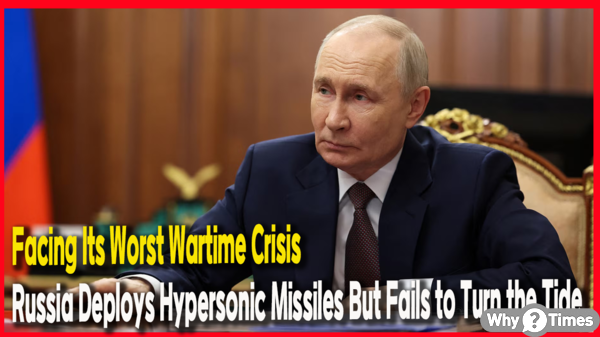
Russia is facing its most severe military pressure since the outbreak of the war. While President Vladimir Putin attempted to shift the momentum by deploying the 'Oreshnik'—a nuclear-capable hypersonic ballistic missile—it proved insufficient to reverse structural deficiencies, including cracks on the southern front and mounting pressure on rear logistics networks. Amid ongoing Ukrainian long-range drone strikes and territorial reclamation, even Western intelligence agencies are warning that "time is no longer on Russia's side."
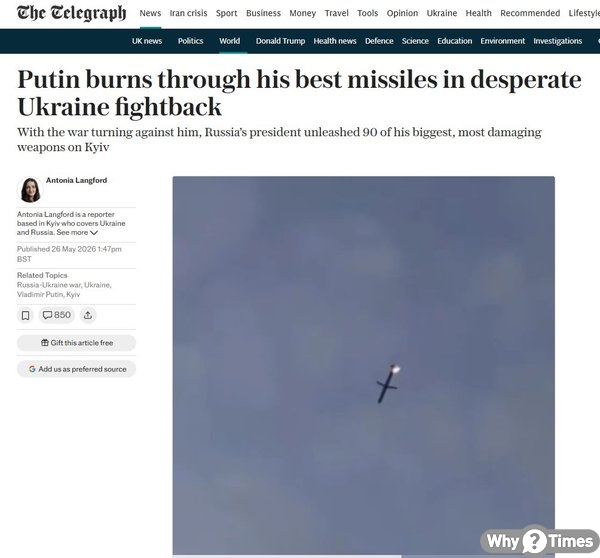
On May 26, the UK's Telegraph reported, "More than four years into the Russia-Ukraine war, the narrative of the conflict is shifting rapidly." It noted that "Ukrainian drones are striking within four miles of the Kremlin, forcing President Putin to spend significant periods in underground bunkers." The report added that "Putin ultimately resorted to deploying hypersonic missiles for a massive assault on Ukraine, but this only served as a powerful narrative demonstrating just how cornered he has become."
Kaupo Rosin, Director General of the Estonian Foreign Intelligence Service, also asserted in an interview with CNN on May 22: "Even inside the Kremlin, there is a growing realization that the situation on the Ukrainian front lines is not going well." He concluded, "Within the next four to five months, Putin may no longer be able to sit at a favorable negotiating table; time is not on Russia's side." This assessment by the head of Estonia's intelligence agency, which has long tracked Russian data, reflects the broader consensus within the Western intelligence community.
[ISW Confirms 'Negative Shift': First Structural Reversal in 3 Years]
Data from the battlefield precisely backs up these intelligence assessments. In its report dated May 20, the Institute for the Study of War (ISW), a US-based think tank, presented figures nearing a historic turning point: "Over the four-week period from April 21 to May 19, Russian forces recorded a net loss of approximately 69 square miles (about 179 km
2
) of Ukrainian territory." The institute noted, "This represents a rate of retreat 35 times faster than the net loss of 2 square miles recorded in the preceding four weeks."
The ISW stated, "The pace of the Russian military's advance has slowed by at least two-thirds over the past 18 months." It revealed that "from January to April this year, the average daily territorial gain was 2.9㎢ , a drop of roughly 70% compared to 9.76 ㎢ during the same period in 2025." The ISW also assessed that "in the month of April alone, Russian forces recorded a net territorial loss of 116 ㎢," marking the first time since August 2024 that Ukraine has reclaimed more territory than it lost.
Furthermore, in its May 10 report, the ISW analyzed that "the territory recaptured by Ukrainian forces during this winter and spring exceeded the area seized by Russia in the entire month of April." It added, "In particular, Ukraine's long-range strikes against Russia's rear logistics, military infrastructure, and oil facilities are eating away at Russia's capacity to sustain large-scale offensives."
[Cracks on the Southern Front: Crimea Supply Network Wavering]
The most direct flashpoint for the deteriorating war effort is the southern front. Even pro-Russian military analysts admit that "the rear logistics system connecting Russia’s southern front to the Crimean Peninsula is under the most intense pressure since the beginning of the war." They noted, "Since early May, the frequency of Ukrainian drone strikes targeting transport vehicles heading toward Kherson, Zaporizhzhia, and Crimea has risen noticeably, and fuel supplies have begun to face restrictions."
In relation to this, the Telegraph reported, "Russia is being forced to push its logistics supply lines further back due to Ukraine's medium-range strikes on rear areas, which is eroding overall operational capabilities in the south." The Telegraph continued, "Through May of this year, Ukrainian forces have concentrated their strength on access routes to Orikhiv, Tokmak, and the Sea of Azov coast, launching systematic strikes against overland supply routes leading to Crimea and Russian reserves moving from the Donetsk front." It pointed out that "this is the exact same front line where Ukraine's summer 2023 counteroffensive stalled." However, it noted, "The quality of the war has changed compared to three years ago. This year, an integrated intelligence-and-strike network is operational, consisting of high-resolution satellite imagery updated almost daily by commercial satellite companies, medium-altitude reconnaissance drones with a 200km range, and small attack drones densely deployed along the front lines."
If the Kamenske-Shcherbaky defensive line is breached, Russian forces could be forced to reroute their supply lines to much more distant rear hubs such as Vasylivka, and further back to Tokmak, Berdiansk, and Mariupol. This would simultaneously drive up both logistics costs and strategic risks.
The seismic shifts on the southern front are transcending mere tactical advantages and translating into strategic territorial reclamation. Al Jazeera reported, "Ukraine has succeeded in securing meaningful territorial gains for the first time since 2023." It noted, "President Zelensky announced the liberation of roughly 460㎢ across parts of Dnipropetrovsk Oblast and Zaporizhzhia Oblast, with a key commander going so far as to declare that Dnipropetrovsk Oblast has been 'almost entirely liberated'."
In an interview with the Italian daily Corriere della Sera, President Zelensky stated, "Russia is losing up to 35,000 men per month." He added, "Their losses have reached a level nearly equal to their newly mobilized forces. They are nearing a crisis."
[A Month's Worth of Missiles in a Single Day: The Oreshnik and a Desperate Attempt to Turn the Tide]
Faced with this compounding military disadvantage, President Putin unleashed one of his most aggressive moves in the early hours of May 25 (local time). The Telegraph reported, "Russia poured more missiles into this single bombardment than the 83 missiles it launched during the entire month of May 2025." It added, "Every district in Kyiv was hit, utilizing Kh-101 cruise missiles, Iskander-M/S-400 systems, Kh-47M2 Kinzhal, 3M22 Zircon, and even the hypersonic ballistic missile Oreshnik."
Regarding this, the Ukrainian Air Force stated, "The attack involved 600 drones and 90 missiles, and Ukrainian air defense forces succeeded in intercepting most of the drones and more than half of the missiles." They added, "This deployment of the Oreshnik marks the third time it has been used, following strikes on Dnipro in November 2024 and the Lviv region in January 2026. This time, it struck Bila Tserkva, a city of 200,000 residents located about 80km south of Kyiv." The Telegraph estimated that "a single Oreshnik missile costs approximately £37 million (about 68 billion KRW), and the total cost of that day's airstrikes reached roughly £268 million (about 492 billion KRW)."
The Russian Ministry of Defense stated that the strike was "retaliation for a Ukrainian drone attack on a student dormitory in Starobilsk, Luhansk Oblast." Russia's state-run TASS news agency reported that 18 people died in the dormitory attack, though Ukraine countered that it targeted only military infrastructure. The day after the airstrike, the Russian side warned that "this is just the beginning," foreshadowing systematic strikes against decision-making centers (government buildings) and command posts in Kyiv. Foreign Minister Sergey Lavrov went as far as calling US Secretary of State Antony Blinken directly to urge the evacuation of American diplomats and citizens from Kyiv.
['Political Blackmail'… European Backlash and the Failure to Shift Momentum]
However, Western experts take a cold, analytical view of whether this massive airstrike created a favorable psychological turning point for Russia. German Chancellor Friedrich Merz criticized the attack as a "reckless escalation," while French President Emmanuel Macron condemned the targeting of civilians, defining the use of the Oreshnik as "a sign that Russia’s war has reached a dead end." EU foreign policy chief Kaja Kallas slammed the deployment of the Oreshnik, calling it "political blackmail and reckless nuclear brinkmanship."
Keir Giles, a senior consulting fellow with the Russia and Eurasia Programme at Chatham House in the UK, told the Telegraph, "Russia is struggling to hide its embarrassment over the shifts in the war's momentum in recent weeks." He stated, "The gradual retreat of the front lines and Ukraine's deep strikes into the Russian homeland have exposed deep fractures in Russia's narrative of 'inevitable victory'." He analyzed that "Russia's recent warnings are highly likely attempts to alter the narrative rather than meaningful actions within a conventional military context."
The Telegraph assessed that "the Oreshnik did not inflict the level of damage that many had feared," but added, "However, its nuclear-capability remains a factor that continues to unsettle Western partners." Anatolii Khrapchynskyi, a Ukrainian defense industry expert, also asserted: "Much of this attack was aimed at psychological and media effects rather than achieving decisive military outcomes." He emphasized, "Signs are already appearing that Russia's strategic missile reserves are dwindling. This is why signs of depletion are surfacing behind the propaganda image of 'infinite capability'."
Ultimately, this deployment of the Oreshnik is being read not as the execution of a practical, tide-turning strategic weapon, but rather as a desperate attempt by the Kremlin to mask its deepening military disadvantages with a psychology of fear. Western analysts share a common diagnosis: in the face of the compounding realities of structural pressure on the southern front, the looming collapse of the supply network linked to Crimea, and a negative shift in the territorial ledger, the threat of hypersonic missiles alone cannot alter the course of the battlefield.
The current situation is a far cry from the early days of the war, when Russia's "inevitable victory" was taken for granted. A military that used to advance 70 meters a day while suffering 1,000 casualties daily has now ground to a halt and begun ceding territory. The scale of conscription cannot keep pace with losses, returning soldiers are driving up domestic crime rates, and rumors of a coup circulate within the Kremlin. As Chatham House fellow Keir Giles noted, the reason Russia feels embarrassed is not simply because the front lines are being pushed back; it is because the very narrative of "we will surely win" is crumbling. The Oreshnik could generate fear, but it could not change the tide of the war. With the simultaneous progression of cracks on the southern front, supply chain pressure, troop depletion, and territorial losses, the crisis Russia faces is less a shortage of weapons and more a case of structural exhaustion. Russia, which was once certain of an "inevitable victory" at the start of the war, now stands before the exact opposite question: "How much longer can we hold out?"

- TAG