


김정희 whytimes.newsroom@gmail.com
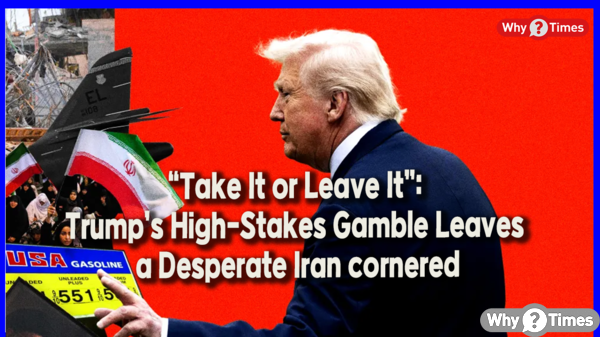
[Time is on Washington’s Side: The Longer Tehran Holds Out, the Worse It Gets]
As U.S. President Donald Trump publicly declared that he "will not rush" regarding the Iran nuclear negotiations, it is becoming increasingly clear which way the scales of leverage are tipping. Although both sides have already completed nearly 95% of the Memorandum of Understanding (MOU) text, the delay in the final signing stems from a much larger issue beyond simple textual adjustments: the structural intervention of the Islamic Revolutionary Guard Corps (IRGC). As time ticks away, it is Iran, not the United States, that is facing mounting pressure. With the economy faltering and internal power fractures widening, the hardliners' stubborn resistance is giving rise to a grim reality—a paradox where holding out only weakens Tehran's negotiating leverage.
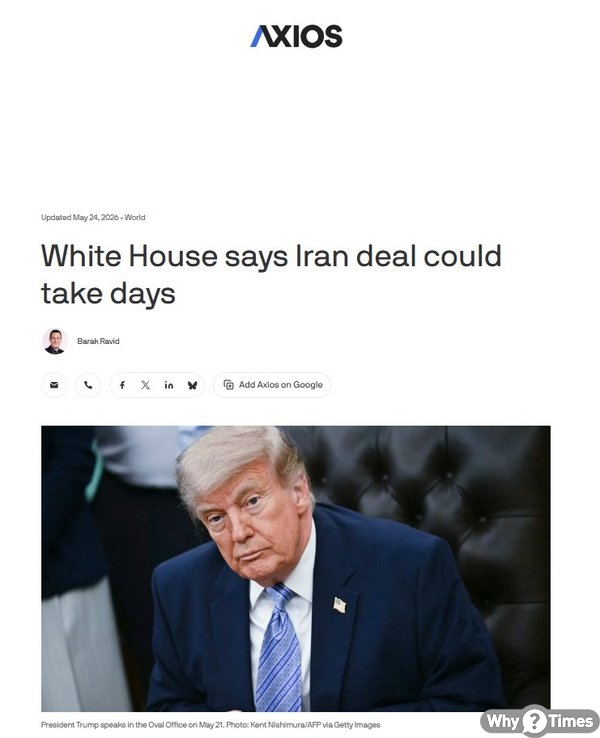
On May 26, the American news outlet Axios, citing sources close to the negotiations, reported that "the MOU is currently 95% complete, but the Trump administration's stance remains unusually unyielding." Axios further noted that "a prevailing sentiment within the White House suggests that if Iran intends to derail the agreement, the United States would rather not sign at all." This atmosphere—amounting to a "take it or leave it" ultimatum—signals that the Trump administration is truly under no illusion of urgency. In fact, President Trump directly instructed his negotiating team: "Do not rush. Time is on our side."
CNN also reported on May 26 that "while the U.S. and Iran are close to striking a deal, the process is stalled due to a linguistic dispute over the phrasing of Iran's nuclear program and the timeline for sanctions relief." During his visit to India, Secretary of State Marco Rubio drew a firm line, stating, "It's either going to be a good deal or no deal—we will only accept one of the two."
According to Axios, the MOU hinges on two core sticking points. First is the moratorium period for enriched uranium, where Iran demanded 5 years and the U.S. pushed for 20 years, with a compromise currently being hammered out at around 12 years. The agreement also dictates that the permissible enrichment level after the moratorium expires will be capped at 3.67% (low-enriched), alongside a "snapback" clause that automatically extends the moratorium in the event of a violation. Second is the specific phrasing regarding the removal of approximately 2,000 kilograms of highly enriched uranium—a stockpile President Trump himself bluntly refers to as "nuclear dust." The U.S. demands an explicit mandate in the MOU text to either ship this stockpile out of Iranian territory or destroy it on-site, but a powerful internal faction within Iran fiercely rejects this as an "infringement on national sovereignty."
[The Battle of Semantics: Decision-Making Trapped Under IRGC Influence]
The more fundamental reason negotiations have ground to a halt at the 95% mark is that Iran’s domestic decision-making structure is effectively paralyzed. Commenting on this gridlock, Iran International revealed that "the newly appointed Commander of the IRGC, Major General Ahmad Vahidi, publicly proclaimed that 'under wartime conditions, decisions on key strategic positions are directly overseen by the Revolutionary Guards.'" Under this rigid command structure, Parliament Speaker Mohammad Bagher Ghalibaf and Foreign Minister Abbas Araghchi find themselves in a precarious position, unable to implement any agreement without explicit approval from the IRGC.
Meanwhile, President Masoud Pezeshkian's political standing has grown increasingly fragile. Fox News noted that "Pezeshkian has fallen into a state of total political stalemate; his repeated requests for an audience with the new Supreme Leader, Mojtaba Khamenei, have been consistently rebuffed." The network added that "Pezeshkian’s public remark in early May that he 'finally met the Leader' paradoxically underscores just how extraordinarily rare such an audience actually is."
Holly Dagres, a senior fellow at the Washington Institute for Near East Policy (WINEP), analyzed the transition, stating that "the new Supreme Leader is moving in lockstep with the IRGC in a manner that is even more consolidated and uncompromising than his father."
As this architecture of "state capture" solidifies, the dual signals emanating from Tehran—conciliatory remarks from the moderate Foreign Minister countered by fierce pushback from IRGC-affiliated media—are no longer mere diplomatic tactics. Instead, they are the raw products of an existential power struggle. With an administration desperate for a deal and an IRGC dead set on sabotaging it pulling in opposite directions, Iran’s internal factional schism is systematically tearing the negotiations apart.
[The Hardliners' Self-Sabotage: Obstructionism Only Deepens Iran's Disadvantage]
The internal fractures within Iran have escalated far beyond routine political jockeying, showing early signs of regime destabilization. According to a report by the National Council of Resistance of Iran (NCRI), "Hardline lawmaker Mohammad Bagher Kharazi publicly threatened chief negotiator Araghchi, branding him a 'capitulator' and warning that if the current negotiations resemble the 2015 JCPOA, he would organize street protests to bring down the Ministry of Foreign Affairs and the Pezeshkian government." The NCRI further noted that "this post was initially circulated by an IRGC-affiliated news agency before being swiftly deleted." Meanwhile, ultra-hardline MP Ahmad Hossein Falahi (or Nabavian) demanded that "the JCPOA gang be completely purged from the negotiating team," while another lawmaker declared that "negotiating with the U.S. is an inherent disgrace," regardless of who sits across the table.
Particularly striking is the disinformation campaign orchestrated by IRGC hardliners. Axios reported that "rumors have recently circulated suggesting that the U.S. plans to lift sanctions ahead of schedule and transfer funds to Iran, which multiple sources believe is a deliberate fabrication spread by the IRGC to sabotage the talks."
This dual-track sabotage is designed to rattle confidence within the negotiating team and mislead Washington into believing that Iran is shifting its demands. However, this strategy is profoundly short-sighted. As the clock winds down, the party bearing the brunt of the delay is not the United States, but Iran.
[Tehran Holds Out, the Economy Sinks: The Desperation Exposed by Numbers]
While the hardliners focus on obstructing the talks, the Iranian economy is sinking deeper into an abyss by the day. The IMF forecasts that "in 2026, Iran’s economy will contract by 6.1%, with inflation skyrocketing to a staggering 68.9%." Commenting on this economic freefall, CNBC reported that "the Iranian rial has plummeted to an all-time low of approximately 1.32 million rials to the U.S. dollar." The network highlighted that "internal estimates cited by an Iranian government spokesperson place the direct and indirect damages since the conflict at roughly $270 billion, with senior economic officials warning the president that 'recovery will take more than a decade.'"
On May 18, President Pezeshkian issued a stark warning during a public address: "The greatest threat to the Iranian regime is not external military pressure, but internal collapse and a popular uprising." Faced with dire warnings from the World Bank and the IMF, the evaporation of 2 million jobs, and crushing inflation, the Iranian public's resentment is rapidly approaching its breaking point.
Furthermore, Iran International analyzed that "behind the regime's fierce rhetoric lies a deeply fractured leadership." It is a textbook paradox: the more the hardliners block a diplomatic breakthrough, the more the economic agony intensifies—and the arrows of that public fury will ultimately swing back toward the regime itself.
[The Two-Stage Trap: The Real Showdown Begins Post-Signing]
Even if both nations manage to sign the MOU, the true test of the negotiations will unfold only after the ink dries. Axios explained that "the MOU currently under discussion is structured as a two-stage process." Under this framework, "In the first stage, Iran must reopen the Strait of Hormuz and halt its enrichment activities; however, U.S. sanctions relief and the repatriation of frozen assets will not occur at this juncture. Only in the second stage—after the U.S. physically secures Iran's enriched uranium and its compliance is rigorously verified—will Iran finally reap any economic rewards."
The Times of Israel (TOI), quoting a senior U.S. official, reported that "Iran has agreed in principle, both verbally and in writing, to the 'disposition of all enriched uranium.'"
Yet, the Iranian Foreign Ministry’s official stance remains defiant: "Uranium negotiations can only commence after the conclusion of the prior agreement." Highlighting the precariousness of the deal, Axios reported that "even if an agreement is reached, if the U.S. determines that Iran is not engaging in the nuclear talks in good faith, Washington retains the right to invalidate the pact in less than 60 days." This serves as a dual-track pressure mechanism—simultaneously warning of a catastrophic collapse of talks while forcing Iran into a swifter, decisive corner.
Ultimately, the essence of these negotiations boils down to a war of attrition: who can hold out longer? While the United States can wield time as a strategic asset, Iran faces a compounding accumulation of crises across its economic, security, and political spheres with every passing day. Saddled with a triple burden of degraded military capability, economic stagnation, and internal regime fracturing, the hardliners' brinkmanship is not expanding their leverage—it is systematically suffocating their remaining options. Trump’s assertion that he "will not rush" is not mere bravado; it is a calculated strategic message born from the realization that his opponent is hurtling toward a breaking point at a much faster rate.
- TAG