


추부길 whytimespen1@gmail.com
[Military Pressure Against Sabotage: Washington’s Message Was Crystal Clear]
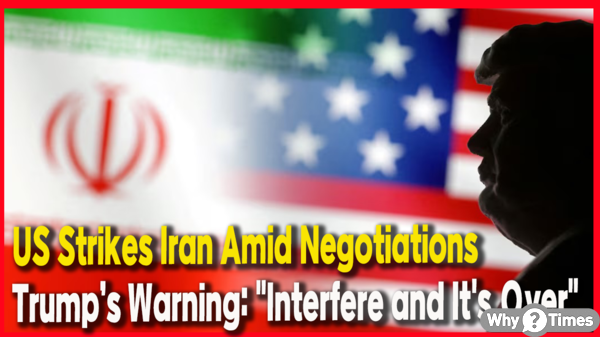
The United States launched a sudden airstrike on southern Iran in the final stages of negotiations. While ostensibly an exercise of the right to self-defense, analysts suggest it was a powerful warning targeted at hardliners within the Islamic Revolutionary Guard Corps (IRGC) who are attempting to derail the talks. Under the Trump administration's strategy of simultaneously leveraging military pressure and diplomatic negotiation cards, a consensus is growing that time works against Iran, not the United States.
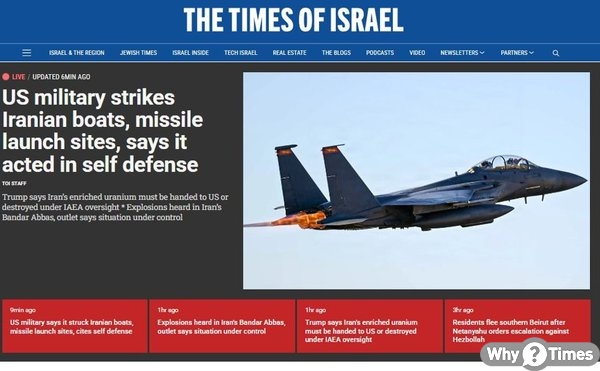
On May 26, The Times of Israel reported, “U.S. Central Command spokesperson Navy Capt. Timothy Hawkins said in a statement that ‘U.S. forces conducted self-defense strikes in southern Iran today to protect American forces from Iranian military threats,’ adding that ‘targeted assets included missile launch sites and Iranian vessels attempting to lay naval mines.’” The report further noted that Central Command emphasized it would maintain restraint during the ongoing ceasefire period while continuing to defend its forces.
Fox News reported that “U.S. forces eliminated two IRGC vessels after spotting them laying naval mines, and also struck surface-to-air missile (SAM) batteries in Bandar Abbas,” adding that “this airstrike was defensive in nature.”
Furthermore, Fox News cited two additional sources stating that “this strike does not mean the end of the ceasefire with Iran, and the U.S. airstrikes have concluded for now.” The network reiterated that “U.S. forces responded upon capturing the two IRGC vessels laying mines, and subsequently struck SAM missile sites that targeted U.S. fighter jets,” stressing that “this engagement was defensive and not an attempt to break the ceasefire.”
[Explosions Heard Around Bandar Abbas; Iran Claims "Situation Under Control"]
The IRGC issued a brief statement noting that “three explosions were heard in Bandar Abbas,” and later specified in a separate statement that “explosions were detected near the Bandar Abbas airport, prompting Iranian air defense systems to engage hostile targets.” Iran’s Mehr News Agency reported that “the situation in Bandar Abbas is under control, and there is no need for concern regarding the explosions detected east of the city.”
Commenting on the incident, ABC News pointed out, “This strike was centered around the Bandar Abbas region, where Iran’s largest naval base is located,” adding that “situated on the northern coast of the Strait of Hormuz, Bandar Abbas is a critical military and commercial port for Iran, and has been a focal point for maritime disputes between the U.S. and Iran.”
This is not the first U.S. airstrike to take place during the ceasefire period. Earlier in May, U.S. forces struck Iranian military installations following a series of "provocative" missile, drone, and small-boat attacks by Iran targeting U.S. Navy vessels navigating the Strait of Hormuz.
At the time, Central Command stated, “Iranian forces deployed multiple missiles, drones, and small boats to launch attacks as the USS Truxtun (DDG 103), USS Rafael Peralta (DDG 115), and USS Mason (DDG 87) were transiting the Strait of Hormuz, an international shipping lane,” adding that “no U.S. assets were hit.”
Regarding these developments, the United Kingdom Maritime Trade Operations (UKMTO) stated, “Three merchant vessels have been attacked by Iran even after President Trump declared an extension of the ceasefire,” noting that “a Liberian-flagged, Greek-owned vessel was attacked without warning by IRGC fast attack craft 15 nautical miles northeast of Oman, sustaining severe damage to its bridge.”
[Time is on Washington's Side: Tehran Faces Disadvantage the Longer It Holds Out]
On May 26, the U.S. news website Axios reported, “End-of-war negotiations between the U.S. and Iran have effectively entered their final watershed moment,” noting that “while the agreement is progressing in a very positive direction, ways for the talks to collapse still remain.”
Axios added, “The agreement is currently about 95% complete, but the Trump administration’s stance remains exceptionally hardline,” pointing out that “whispers within the administration suggest the U.S. would rather not sign at all if Iran attempts to torpedo the deal.”
These remarks expose the true calculations of the Trump administration, which superficially appeared in a rush to finalize the deal. Washington is not anxious. Rather, as time passes, Washington's leverage grows stronger, while Tehran is pushed closer to the precipice.
A senior White House official firmly drew the line on the core principle of the agreement: “If they do not surrender enriched uranium, they get nothing. They receive only as much as they give.” This means “there will be no immediate unfreezing of funds, nor any preemptive sanctions relief.” In this regard, Axios outlined, “The basic structure of the agreement consists of two phases: In the first phase, Iran must reopen the Strait of Hormuz and abandon uranium enrichment; in the second phase, the U.S. will physically retrieve Iran’s nuclear materials, and only after this process is fully completed will Iran receive sanctions waivers.”
The reason the agreement has not yet been officially signed comes down to "phrasing issues." Axios reported, “While Iran has agreed to the basic framework of the deal in principle, internal rifts within the regime persist over specific language,” citing a White House official who noted, “'There are words we care about, and words they care about,' pointing out that Iran’s decision-making structure is 'slow and opaque.'”
Of particular note are internal sabotage efforts within Iran. Rumors recently circulated that “the U.S. would lift sanctions earlier than scheduled and send money to Iran.” Multiple sources view this as deliberate disinformation spread by the IRGC to disrupt the negotiations—indicating that hardliners are conducting separate sabotage campaigns away from the negotiating table.
[Trump Declares "Iran Will Never Be Allowed Nuclear Weapons" in Memorial Day Address]
On the same day the airstrikes were carried out, President Trump visited Arlington National Cemetery for Memorial Day to honor American service members killed in 'Operation Epic Fury,' reiterating that “Iran will never be allowed to possess nuclear weapons.” President Trump stated, “In Operation Epic Fury, we lost 13 precious souls. These incredible, extraordinary individuals laid down their lives to ensure that the world’s largest state sponsor of terrorism never acquires a nuclear weapon.”
One final note: The most accurate metric for reading international affairs is not moral justification or flashy rhetoric, but cold, hard power dynamics and indicators. The composure shown by the Donald Trump administration regarding the currently deadlocked U.S.-Iran end-of-war negotiations is not mere psychological warfare. It is a manifestation of thoroughly calculated conservative realist diplomacy, and a victory for traditional American foreign strategy, which bends rivals to its will from a position of strength.
Furthermore, Iran’s military foundations have been hollowed out. As a senior U.S. official assessed, recent military strikes have degraded Iran’s power projection capabilities to a fraction of what they were two months ago. The industrial base for manufacturing ballistic missiles—the regime's primary tool of subversion—has been reduced to ashes, completely sealing off its strategic options. No matter how loudly the regime broadcasts its determination to fight to the bitter end, it cannot conceal a military reality melted away by precision strikes and a severely narrowed operational radius.
Ultimately, the crux of this negotiation is who holds more time. The United States can afford to wait, but the longer Iran waits, the more it stands to lose. Its military strength is depleted, its economy is faltering, and its internal fractures are widening. President Trump’s assertion that he “will not rush” is not idle confidence. It is a strategic message that can only be delivered by a leader who knows that the opponent’s clock is ticking against them.

- TAG