


추부길 whytimespen1@gmail.com

[The Double-Edged Strategy: Siphoning U.S. Technology While Sealing Off Domestic Outflow]
Is the meteoric rise of China's AI industry truly the fruit of independent innovation? A steady stream of evidence suggests otherwise, revealing a synchronized, state-controlled strategy: launching systematic distillation attacks against cutting-edge U.S. AI models, operating a multi-billion-dollar semiconductor smuggling ring, and physically barricading domestic technology and talent from leaving the country. While Beijing loudly trumpets "technological self-reliance," the paradoxical reality is that its growth architecture remains anchored to stolen American innovation. This unvarnished reality of China's AI ascent has emerged as a core variable in the global struggle for AI supremacy.
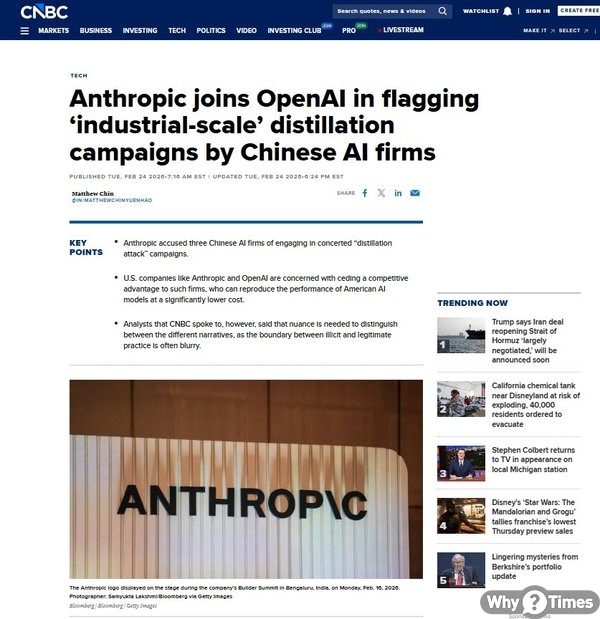
On February 24, 2026, CNBC drew widespread attention by reporting that "Anthropic publicly accused three Chinese AI labs—DeepSeek, Moonshot AI, and MiniMax—of executing a highly organized 'distillation attack' against its Claude models in February 2026." The network noted, "Following similar grievances raised by OpenAI, this marks a consecutive wave of formal accusations by major U.S. AI firms regarding China’s unauthorized expropriation of technology." In this context, a distillation attack refers to a method where actors bombard an AI model's API with massive volumes of prompts, harvest the responses, and weaponize that output as training data to clone a rival, highly sophisticated model.
CNBC further detailed that "these three entities bypassed service terms and regional geofences to harvest over 16 million source interactions via roughly 24,000 fraudulent accounts." The report emphasized that "all three firms are headquartered in China—a jurisdiction where Claude services are strictly prohibited due to legal, regulatory, and national security mandates."
According to CNBC, each firm pursued distinct, highly strategic objectives:
MiniMax amassed 13 million data points targeting agentic coding and tool orchestration.
Moonshot AI downloaded 3.4 million records focused on developing computer-use agents and reasoning capabilities.
DeepSeek exfiltrated over 150,000 interactions by prompting Claude to explain its step-by-step reasoning, successfully generating chain-of-thought (CoT) training data that can be fed directly into competing architectures.
"Their methodologies were strikingly uniform," CNBC reported. "They utilized proxy services and automated tools to spin up thousands of fake profiles, systematically circumventing Anthropic’s regional restrictions. A single proxy network alone was caught orchestrating over 20,000 fake accounts simultaneously, blending distillation traffic with legitimate queries to evade algorithmic detection."
Jacob Klein, Anthropic's Head of Threat Intelligence, stated, "We hold a high degree of confidence that these laboratories executed distillation attacks on an industrial scale."
CNBC qualified that, "Technically, knowledge distillation itself is a legitimate machine learning technique." Experts noted that Anthropic freely acknowledges frontier labs routinely use distillation to compress their own flagship models into smaller, more cost-effective iterations. "However, the crux of the controversy lies not in the methodology, but in the illicit access and breach of contract." CNBC pointed out that "for China, the ultimate goal is to clone the core capabilities of state-of-the-art models—which cost trillions of won to train—at a nominal cost and within an incredibly compressed timeframe."
The White House Office of Science and Technology Policy (OSTP) also sounded the alarm, issuing a memorandum warning that "foreign entities primarily based in China are waging an intentional, industrial-scale distillation campaign against advanced U.S. AI systems utilizing proxy accounts and other highly coordinated evasive maneuvers."
[$2.5 Billion Smuggling Ring: The Underground Chip Network Piercing Southeast Asia]
While systematically siphoning model capabilities via software distillation, China has simultaneously orchestrated a massive bypass of hardware restrictions. Although Washington has progressively tightened export controls on Nvidia’s high-performance AI semiconductors since 2022, an expansive smuggling network designed to neutralize these blockades has been unmasked.
NBC News reported on a major development: "An indictment unsealed by the U.S. Attorney's Office for the Southern District of New York charged Supermicro Computer co-founder Wally Liaw, along with Steven Chang and Willy Sun, for conspiring to divert $2.5 billion worth of high-performance servers to an entity in Southeast Asia. This pass-through company then repackaged and forwarded servers containing $510 million worth of restricted chips to final destinations within China."
According to NBC News, "The indictment reveals that while the functional servers had already been routed to China, the defendants staged 'dummy'—non-working replica—servers inside a Southeast Asian warehouse to deceive the manufacturer’s internal compliance teams. They even deployed these fake units during on-site inspections by U.S. export control enforcement officers." The scale of the operation was staggering: acting as the broker for this illicit pipeline was a Thailand-based firm known as OBON Corp. During a mere six-week window spanning from early April to mid-May 2025, this single network funneled over half a billion dollars' worth of restricted servers into China via Southeast Asian transshipment routes.
Commenting on the bust, U.S. wire service UPI reported that Jay Clayton, the U.S. Attorney for the Southern District of New York, stated:
"The defendants participated in a systematic scheme to divert massive quantities of servers housing U.S. artificial intelligence technology to customers in China through a tangled web of lies, obfuscation, and concealment. These diversion schemes generate billions of dollars in ill-gotten gains and pose a direct threat to U.S. national security."
The Supermicro scandal is part of a much larger, systemic crackdown. The Department of Justice unsealed a separate indictment charging four individuals with illegally exporting Nvidia chips by utilizing a Florida-based front company to receive $4 million in wire transfers from Chinese entities. A month later, prosecutors unveiled another indictment targeting a domestic smuggling ring that illicitly funneled $160 million worth of Nvidia silicon to China between October 2024 and May 2025. While these enforcement actions are piling up, U.S. authorities openly concede that the intercepted shipments represent merely the tip of the iceberg.
[The Manus Affair: "What Is Born in China Stays in China"]
While aggressively acquiring foreign intellectual property, Beijing simultaneously deploys a draconian containment strategy to prevent domestic AI innovations from slipping into Western hands. This protectionist double standard was starkly illuminated by the Manus affair.
Manus, an AI agent startup founded by Chinese engineers in Beijing, became the darling of Silicon Valley after debuting a groundbreaking general-purpose AI agent. The company shattered tech growth records by eclipsing $100 million in annual recurring revenue (ARR) just eight months post-launch. Recognizing its immense value, Meta announced an agreement to acquire the startup for approximately $2 billion, and Manus personnel had already begun migrating to Meta's Singapore corporate campus.
The transaction ground to a sudden halt when China's National Development and Reform Commission (NDRC) issued a terse, single-sentence directive: "Pursuant to relevant statutes, a prohibition order has been levied against foreign capital's acquisition of the Manus project, and the involved parties are ordered to immediately unwind the transaction." No further legal rationale or classified findings were disclosed. The Financial Times (FT) later reported that "Chinese authorities summoned Manus co-founders Xiaohong and Ji Yichao back to Beijing, placing them under an exit ban while an official investigation is carried out."
The FT noted that Beijing took an exceptionally aggressive stance, "demanding not only the complete repatriation of Meta’s acquisition funds but ordering that all data and technical assets already integrated into Meta’s infrastructure be completely purged, restoring Manus' domestic assets to their original status quo." The Global Times, a state-run media mouthpiece, staunchly defended the intervention, declaring: "The core issue is not where a corporate entity is legally registered, but where its technology and data originated."
Following a $75 million funding round led by U.S. venture capital firm Benchmark, Manus had shuttered its Beijing office and transferred its global headquarters to Singapore—a corporate maneuver widely referred to as "Singapore-washing." However, Beijing effectively demolished this loophole, enforcing the doctrine that if an innovation’s roots are Chinese, it remains a sovereign Chinese asset in perpetuity, regardless of offshore corporate structuring.
Bloomberg analyzed that the crisis centers on two geopolitical flashpoints: "First, deep-seated national security anxieties that agentic AI technology pioneered by Chinese citizens could be absorbed by a U.S. Big Tech titan (Meta), thereby eroding China's 'technological sovereignty.' Second, a deliberate, regulatory strike against the 'Singapore-washing' framework used by domestic founders to bypass mainland oversight via offshore entities."
[DeepSeek's Smoke and Mirrors: The Grim Reality of Huawei's Silicon]
DeepSeek, often paraded as the crowning achievement of Chinese AI prowess, perfectly illustrates the structural bottlenecks paralyzing China's domestic ecosystem. The debut of DeepSeek-R1 stunned Western tech circles by matching the capabilities of frontier American models at a fraction of the operational cost. However, the sequence of events that followed laid bare severe underlying architectural fractures.
The Financial Times reported that "following the rollout of the R1 model, DeepSeek bowed to intense pressure from state regulators to abandon its reliance on Nvidia accelerators and train its next-generation successor, R2, exclusively on Huawei's Ascend chips." What followed was a technical disaster. The training initiative was plagued by systemic hardware instability, catastrophic latency drops in chip-to-chip interconnect speeds, and severe architectural roadblocks within Huawei’s CANN software toolkit.
The FT further revealed that "although Huawei deployed an elite unit of on-site engineers to embed within DeepSeek’s offices, the combined team failed to complete a single successful, uninterrupted training run." Ultimately forced into a humiliating retreat, DeepSeek opted for a compromised hybrid model: executing heavy training compute on smuggled or legacy Nvidia silicon, while relegating Huawei's Ascend chips to less-demanding inference workloads. Consequently, the highly anticipated debut of R2 was postponed indefinitely due to these severe hardware bottlenecks and compounding bottlenecks in training-data preparation.
Market intelligence firm Counterpoint Research provided a sobering assessment of the domestic hardware landscape: "Even Huawei’s most advanced alternative, the Ascend 910C, yields only about 76% of the raw computing throughput of an Nvidia H200. Furthermore, even if raw hardware performance parity is eventually achieved, China's compounding deficit in software ecosystems, developer tooling, and compiler optimization cannot be remedied overnight."
[Congressional Warnings: "AI Is Mutating into a Weapon for Data Hegemony"]
The geopolitical anxieties surrounding China's AI maneuvers have triggered high-level alarms in Washington. The US-China Economic and Security Review Commission (USCC) convened a high-level hearing to meticulously scrutinize Beijing's aggressive, multi-layered data harvesting campaigns. The commission detailed how China uses a spectrum of legal, illegal, and extrajudicial channels to siphon massive troves of American data across critical sectors, including aerospace, biotechnology, frontier AI, and foundational digital infrastructure.
Concurrently, the U.S. House Homeland Security Committee issued its own stark assessment during a dedicated hearing: "Technologies incubated or controlled within the Chinese digital ecosystem harbor profound espionage liabilities, including the covert exposure of sensitive operational data and the establishment of persistent backdoors into critical infrastructure systems." Congressional leaders warned that "passively relying on Chinese-engineered AI models is no longer a neutral, commercial business decision; it is a profound national security gamble whose ramifications extend far beyond the balance sheets of individual corporations."
[Conclusion]
This matrix of state-directed maneuvers culminates in a glaring geopolitical paradox. Beijing aggressively siphons American intellectual property through industrial-scale software distillation and black-market hardware smuggling, while simultaneously enforcing an iron curtain to prevent its own AI innovations and human capital from leaking abroad.
The triad underpinning China's AI trajectory—illicit distillation of U.S. models, systemic semiconductor smuggling networks, and total state dominance over data and talent—stands in direct contradiction to its official narrative of organic "technological self-reliance." While presenting the facade of a hyper-advanced industry competing on equal footing with the West, the interior scaffolding reveals an ecosystem structurally tethered to foreign innovation. As these systemic frictions intensify, global skepticism regarding the long-term viability of China's AI miracle continues to mount.

- TAG