


추부길 whytimespen1@gmail.com
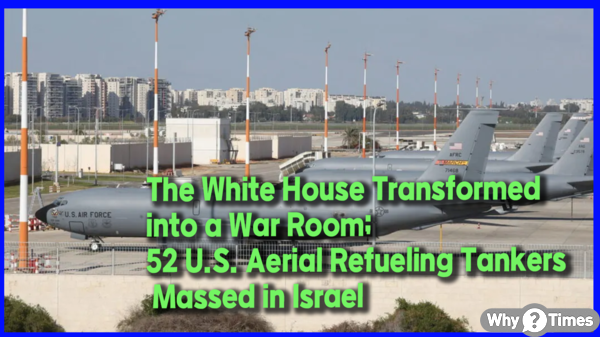
[Military Leaves Cancelled, 52 Tankers Massed… White House Security Meetings Running Around the Clock]
The White House is functionally transforming into a wartime command center. U.S. President Donald Trump has returned to Washington, even bypassing attendance at his son's wedding, to hold a series of continuous emergency meetings with his core national security team regarding potential follow-on strikes against Iran. Simultaneously, the U.S. military has cancelled Memorial Day holiday plans to ramp up its readiness posture in the Middle East, while 52 U.S. aerial refueling tankers have massed at Israel's Ben Gurion International Airport. Although negotiations remain ongoing, the machinery of war has clearly begun to move.
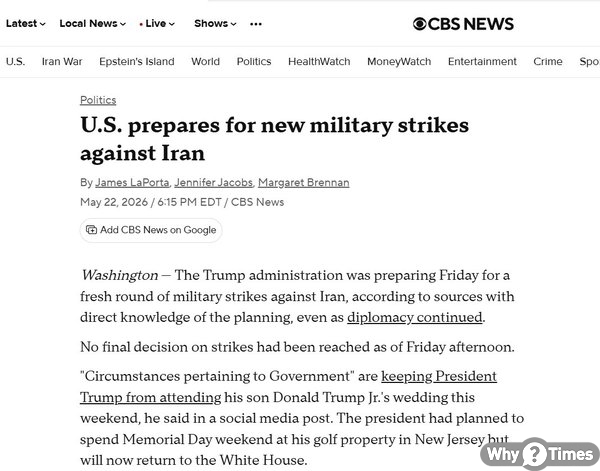
On May 23, CBS News drew significant attention by reporting, "President Trump announced on social media that 'circumstances related to government business' would prevent him from attending his son Donald Trump Jr.’s wedding in the Bahamas this weekend." The network added, "He was originally scheduled to spend the Memorial Day holiday weekend at his New Jersey golf club but abruptly cancelled those plans to return to the White House. The 'government business' cited by President Trump is understood to be directly linked to preparing military response options against Iran." Analysts note that the president’s abrupt cancellation of a deeply personal family event underscores the extreme urgency of the current situation.
In a related report, Axios stated, "Inside the White House, President Trump held intense discussions focused on the possibility of additional strikes against Iran alongside his entire core national security team, including Vice President J.D. Vance, Secretary of Defense Pete Hegseth, CIA Director John Ratcliffe, and White House Chief of Staff Susie Wiles."
Citing multiple sources, CBS News noted that "as of today, no final decision has been made." However, local media reported that military authorities have already entered a substantive combat-ready phase. Leave plans for certain U.S. military and intelligence personnel ahead of the Memorial Day holiday have been revoked in anticipation of potential airstrikes, and both the Pentagon and intelligence agencies have begun updating their recall rosters.
[War Preparations Caught on Satellite: 52 Tankers Massed at Ben Gurion Airport]
In stark contrast to the rhetoric at the negotiating table, physical evidence on the ground demonstrates that military preparations are moving forward seamlessly. On May 22, the British Financial Times (FT) reported, based on satellite imagery analysis, that "52 U.S. military aerial refueling tankers are currently parked at Tel Aviv’s Ben Gurion International Airport, Israel’s largest civilian aviation hub." The FT highlighted that "this buildup began just before the joint U.S.-Israeli strikes on Iran in late February, starting at around 36 tankers. The number grew to 47 following the early April ceasefire declaration and broke a new record this week, reaching 52." This indicates that despite being officially under a ceasefire, actual combat power has instead intensified.
The FT added that "the concentration of U.S. tankers did not diminish after active combat with Iran paused; rather, it expanded." Military experts cited by the publication analyzed that this deployment is designed to maintain rapid-response options should regional tensions reignite. According to the report, "the dark grey U.S. Air Force aircraft have tightly packed the tarmac, making them clearly visible to commercial passengers as well as drivers on the nearby highway."
Aerial refueling tankers are critical assets for long-range airstrikes. By allowing fighter jets to replenish fuel directly in mid-air, they exponentially expand operational range and loiter time (the duration an aircraft can remain airborne over a target). During the February airstrikes against Iran, codenamed Operation Epic Fury, the U.S. forward-deployed KC-135 and KC-46 fleets across the Middle East to support deep-penetration strikes by U.S. and Israeli fighter jets. These deep strikes are designed to bypass forward defenses and neutralize core capabilities—such as command centers, logistics, and communications—deep within enemy territory to paralyze command and control. During that campaign, KC-46A and KC-135R tankers played an indispensable role enabling Israeli F-15I, F-16I, and F-35I fighters to conduct prolonged, deep-territory missions, transferring over 2.5 million kilograms of fuel in mid-air during peak operations.
[Three Months After 'Operation Epic Fury': A Vicious Cycle of Airstrikes and Talks]
Understanding the current crisis requires tracing the events of the past three months. On February 28, the U.S. and Israel launched massive coordinated airstrikes against Iran—a campaign President Trump characterized as a "large-scale, sustained operation." Codenamed Operation Epic Fury by the Trump administration, the operation resulted in U.S. military casualties. Iranian Supreme Leader Ali Khamenei was also killed during the campaign, prompting Iran to fire waves of retaliatory missiles at Israel and U.S. military bases in the region.
Since then, the two sides have locked into a volatile cycle of dramatic negotiations and military clashes. On April 8, mediated by Pakistan, the U.S. and Iran agreed to a two-week truce, leading to direct talks in Islamabad. However, despite 21 hours of marathon negotiations, the Islamabad summit ended without an agreement due to irreconcilable differences over the Strait of Hormuz and Iran's nuclear program. Truce violations followed, prompting the U.S. to enforce a naval blockade against Iran.
Tensions remained unresolved into May. President Trump initially paused scheduled military strikes, stating that negotiations with Iran were proceeding "seriously." However, this pause was primarily the result of lobbying by Gulf Arab nations, including Saudi Arabia, who urged Washington to hold off on military action on the grounds that a peace deal was imminent. While Trump remarked that he would "be glad if this could be solved without bombing," observers emphasize that the administration has previously extended diplomatic openings only to execute sudden airstrikes, making the final decision highly unpredictable.
[Core Flashpoints: The Strait of Hormuz and Enriched Uranium]
The primary hurdles to an agreement remain control over the Strait of Hormuz and Iran's nuclear ambitions. Since the outbreak of the war with Iran in 2026, shipping through the Strait of Hormuz has ground to a functional halt. The strait is an irreplaceable artery for global trade, carrying roughly 20% of the world's petroleum and liquefied natural gas (LNG). Its closure has thrown global energy markets into deep disarray.
On May 21, U.S. Secretary of State Antony Blinken (or Marco Rubio, depending on the updated administration personnel) told reporters that while there are "positive signals toward a deal," any agreement would be "impossible" if Iran attempts to permanently impose transit tolls on the Strait of Hormuz. He underscored that "no one in the world supports a toll system" for the international waterway.
The nuclear issue is equally deadlocked. Remarks by Iranian Foreign Ministry Spokesperson Esmaeil Baghaei illustrate the scale of the impasse: "We cannot say that we will definitely reach a conclusion in a matter of weeks or months, or through a few visits and rounds of talks," he stated. "Diplomacy requires time, and all parties utilize every opportunity to convey their perspectives." By reiterating that Iran refuses to even discuss its nuclear dossier, Baghaei effectively ruled out an immediate breakthrough.
Concurrently, Axios reported that the U.S. and Iran have been reviewing a draft one-page Memorandum of Understanding (MOU). The framework proposes an official end to the war, the reopening of the Strait of Hormuz, limits on Iran’s nuclear program, and the lifting of U.S. sanctions—all to be negotiated within a 30-day window. Axios added that Trump’s special envoys, Steve Witkoff and Jared Kushner, have been engaged in direct and indirect talks with Iranian officials, with the White House viewing this as the closest the two sides have come to an agreement since the war began. However, Baghaei’s rhetoric signals that Tehran may not be ready to accept this framework.
[GOP Hawks Demand to "Finish It," While Iran Warns of Retaliation]
Republican hawks are putting intense pressure on President Trump to break off negotiations and resume the military offensive. Senator Roger Wicker (R-MS), Chairman of the Senate Armed Services Committee, issued a blunt statement: "We are at a moment that will define President Trump’s legacy. His instinct was to finish what started in Iran, but he is currently receiving flawed advice to pursue a one-page deal that isn't worth the paper it's written on." Wicker urged, "The Commander-in-Chief must allow America's highly skilled military to completely dismantle Iran's conventional military capabilities and permanently reopen the strait," warning that current diplomatic maneuvers risk projecting "a perception of weakness."
Senator Tom Cotton (R-AR) echoed this hardline stance: "While airstrikes last summer crippled their nuclear infrastructure, it is glaringly obvious they have not abandoned their nuclear ambitions. We must finish the job and make it clear that we will never tolerate threats to the freedom of navigation on the high seas."
In response, Iran has vowed unyielding retaliation. Citing an Iranian military source, Iran’s semi-official Tasnim News Agency warned: "The United States knows that any path to military superiority is blocked. If the U.S. resorts to excessive demands, pretext-manufacturing, or military action, it will pay a third price within a year—and this time, it will be exacted in a far more tangible and unprecedented manner." Iran further claimed to possess "new hardware, new targets, and an entirely new wartime strategy."
[The Broader Shadow of War: Global Economy and Diplomatic Realignment]
The war with Iran has bypassed purely military and diplomatic spheres to deal a severe blow to the global economy. Up to 30% of the world's fertilizer trade is transported via the Strait of Hormuz, meaning energy market volatility is directly feeding into global inflationary pressures. Pakistan, which shares a volatile 900-kilometer border with Iran, has borne the brunt of the compounding energy crisis. The international diplomatic landscape is growing increasingly chaotic, marked by deep disappointment over fractured mediation efforts and a lukewarm response from Iran's ally, Russia.
President Trump has repeatedly signaled his intent to resume airstrikes if Iran fails to agree to terms within the weekend. The images currently defining Washington and the Middle East—52 tankers packing the tarmac at Ben Gurion, military personnel seeing their holiday leave abruptly cancelled, and a president isolated in the Oval Office after skipping his son’s wedding—strongly indicate that a strike order is imminent. With the ball back in Tehran's court, the world holds its breath for the White House's final directive.

- TAG