


추부길 whytimespen1@gmail.com
[Failure to Secure Commitment for Putin’s Flagship Project, "Power of Siberia 2"]
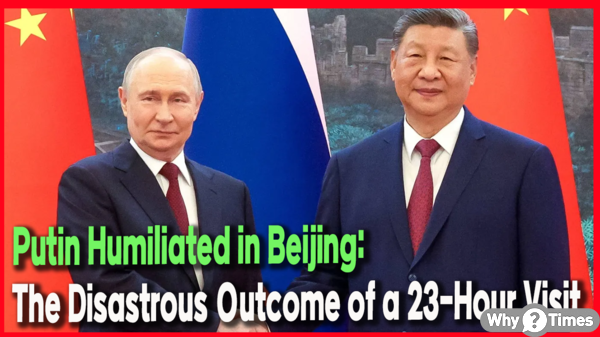
Russian President Vladimir Putin made an urgent visit to Beijing immediately after US President Donald Trump’s trip, but failed to secure the economic breakthrough he desperately needed. The "Power of Siberia 2" pipeline—a mega energy project central to the future of the Russian economy—was deferred once again without resolution. While China emphasized its strategic alliance with Russia, it drew a firm line regarding tangible assistance. Rather than projecting a tight Sino-Russian alignment, this 23-hour visit laid bare the stark structural asymmetry between the two nations.
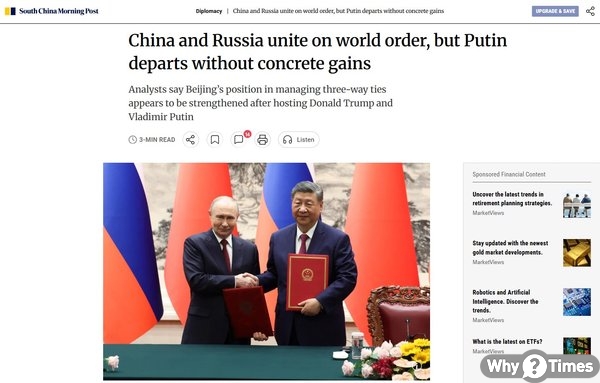
On May 22, Hong Kong's South China Morning Post (SCMP) reported, "President Putin arrived in Beijing with hopes that global energy market disruptions caused by the Iran war would finally grant him leverage, but he was forced to leave the Chinese capital empty-handed." The outlet added, "Although this marked his 25th visit to China, the atmosphere was noticeably different. Putin, who flew into Beijing just four days after US President Trump departed, was received at the airport by Foreign Minister Wang Yi rather than President Xi Jinping. This stood in stark contrast to Trump’s three-day visit, during which he was accorded the highest level of hospitality, including a private tea meeting inside Zhongnanhai."
Timothy Ash, a research fellow with the Russia and Eurasia Programme at Chatham House, assessed that the visit was "largely about maintaining the status quo." Similarly, Temur Umarov of the Carnegie Russia Eurasia Center noted, "Putin wasn’t trying to achieve anything groundbreaking with this trip; it is simply part of the diplomatic tradition between Beijing and Moscow."
Diplomatic circles largely view the visit as an intelligence-gathering mission rather than a show of solidarity. Following the agreement between Trump and Xi to build a "constructive strategic stability relationship," Moscow felt a pressing need to directly ascertain the nature of the strategic alignment taking shape between the US and China.
In particular, despite Putin’s pre-summit announcement that he would discuss the "Power of Siberia 2" pipeline "in great detail," the summit concluded without any breakthrough in the energy sector. CNBC commented, "This is a clear blow to Moscow," adding, "The project is a massive $15 billion, 1,600-mile (approximately 2,575 km) venture designed to supply up to 50 billion cubic meters of natural gas annually from Russia’s Yamal Peninsula to northern China via Mongolia. It was expected to play a critical role in recovering the revenue Russia lost from European gas sales following its invasion of Ukraine."
The core sticking point in the negotiations remains pricing. Following the summit, Kremlin spokesperson Dmitry Peskov stated that "a consensus on key terms has been reached." However, CNBC countered that "China wants extremely low prices for Russian gas, which Russia is reluctant to accept," and that "many details still require extensive further discussion," signaling that negotiations have effectively stalled.
CNBC further noted, "The Power of Siberia 1 took over 20 years to complete, and China is not backing down an inch in price negotiations. The situation will be no different for the second pipeline; China holds all the cards."
Furthermore, some analyses suggest that the Iran war could paradoxically kill off the Power of Siberia 2 project permanently. Driven by concerns over energy security, Beijing is actively accelerating its efforts to secure diversified supply sources. In other words, the "energy instability stemming from Iran" that Russia hoped to use as leverage could trigger a backlash, accelerating China's energy diversification instead.
["No Equal Partnership": A Stark Structural Asymmetry Laid Bare]
The SCMP reported, "The two countries signed over 40 agreements covering broad areas such as trade, education, technology, and nuclear security to showcase their strategic unity, but no public breakthrough emerged regarding the crucial pipeline." The report added, "More than half of the 40 agreements are non-binding Memorandums of Understanding (MOUs), which amount to mere declarations with no practical obligations. The MOU signed between Gazprom and Chinese entities regarding Power of Siberia 2 in September 2025 was packaged by Russian officials as a 'major breakthrough,' but it was not a binding final agreement, and negotiations have remained in limbo ever since."
Ultimately, the most distinct footprint left by this visit is the power imbalance between the two countries. CNBC noted, "Experts analyze that as Russia deepens its reliance on Chinese trade, technology, and finance, the relationship the Kremlin once called an 'equal partnership' has mutated into a far more asymmetric structure. China is Russia's largest trading partner, but Russia accounts for only about 4% of China's total trade. With the relationship heavily tilted in China's favor, Beijing would face limited shocks even if it lost Russia, whereas the Russian economy would be instantly choked off without China."
CNBC continued, "The fundamental asymmetry lies in Russia's sheer inability to assist China in the economic and technological spheres. Given the potential risk of secondary sanctions, the Russian market is not attractive enough for Chinese enterprises, and Moscow can do little to help Beijing bypass Western export controls."
In fact, since 2022, Russia has relied heavily on Chinese technology for everything from automobiles to 5G networks. Meanwhile, sentiments viewing China as a potential threat persist within Russia. In recent years, several Russian scientists involved in military programs have been imprisoned on charges of spying for China, indicating that the Russian government is well aware of its deepening asymmetric dependence on Beijing.
Regarding this dynamic, Chatham House, a world-leading foreign policy and security think tank in the UK, clearly drew the line, stating, "Strategic alignment does not mean that asymmetry and mistrust are erased." On the other hand, Al Jazeera introduced a perspective suggesting the relationship is not entirely one-sided. "Russia offers something increasingly valuable in a turbulent world: secure overland access to vast energy resources at a time when maritime trade routes are vulnerable," the outlet noted. However, because the pricing power that dictates that value remains firmly in China's hands, Russia's structural inferiority remains unchanged.
[Internal and External Woes: Putin's Approval Rating Plummets to Post-War Low]
This visit to Ch
ina came at a time when Putin is facing severe domestic pressure. The Kyiv Independent reported, "According to the Russian state-run pollster VTsIOM, Putin's approval rating dropped for seven consecutive weeks, falling from 77.8% at the beginning of this year to 65.6% at the end of April, marking its lowest point since the 2022 full-scale invasion." The outlet noted that following this sharp decline, VTsIOM announced that starting in May, it would change its methodology from telephone interviews to a combined telephone and in-person format—a move critics interpret as an attempt to manipulate the numbers.
While an approval rating in the mid-60s would be considered very high in a democratic society, such a decline is catastrophic in a de facto one-party state where critical media is non-existent and an atmosphere of coercion prevails.
Commenting on the situation, Fortune magazine wrote, "Amid Ukraine’s fierce onslaught and an economic reverse-gear, Putin is losing the Russian people." The magazine highlighted that Putin himself admitted Russia's GDP growth turned negative in January and February, and the Russian military suffered net losses on the front lines last month for the first time since 2024. Fortune concluded, "With falling approval ratings, a stalemated front line, and an contracting economy all happening simultaneously, returning empty-handed from Beijing is a deeply embarrassing outcome for Putin both domestically and internationally."
[The Cold Eyes of Foreign Media: The Gravity Has Already Shifted to Beijing]
Major global economic media outlets and foreign press reported the results of the Sino-Russian summit with cynical and objective tones, clearly pointing out who holds the upper hand in the bilateral relationship. Bloomberg focused its coverage on the fact that Russia has repeatedly failed to make any meaningful progress for years on the Power of Siberia 2 pipeline negotiations—the very key needed to more than double its gas exports to China and achieve an economic leap.
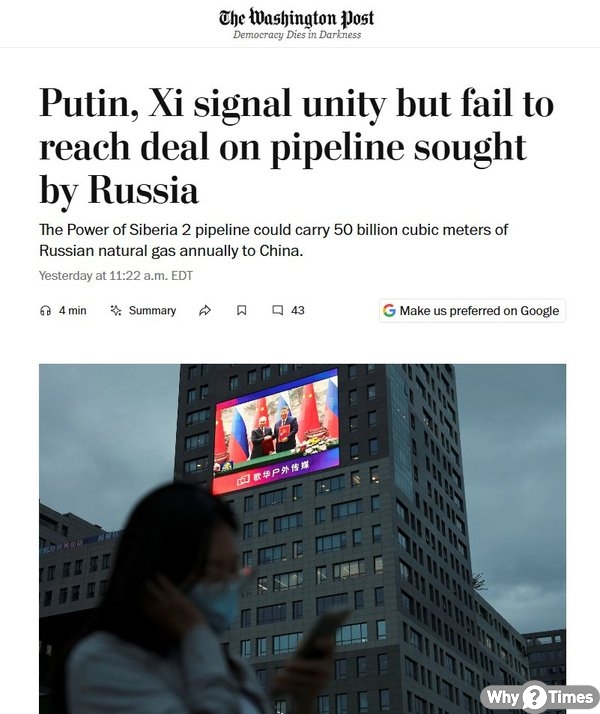
The Washington Post (WP) also ran a blunt headline immediately following the summit: "Putin Fails to Secure Xi's Approval on Power of Siberia 2 Pipeline." The article pointedly noted that the stalling of this pipeline has derailed Russia's plan to dump up to 50 billion cubic meters of natural gas into the Chinese market. Both media outlets consistently emphasized that all leverage and control in the relationship belong to Beijing, which controls the market, rather than Russia, the mere supplier.
The final conclusion left by this brief and humiliating 23-hour visit is starkly simple. For a cornered Russia, China is an irreplaceable lifeline and anchor for regime survival. However, for China—which must balance its relationship with the West based on its massive economic scale—Russia is merely one of many diplomatic and economic cards it can play.
The meager and limited outcomes of the Beijing summit signify a cold 'status quo' rather than a dramatic strategic transformation. It reaffirms that the center of gravity in the relationship shifted entirely from Moscow to Beijing long ago. President Putin returned to Moscow lonely, holding nothing but the flowery "language of friendship" written in joint statements and a stack of meaningless MOUs, having failed to secure the tangible economic breakthrough he so desperately required to maintain his grip on power.

- TAG