


추부길 whytimespen1@gmail.com
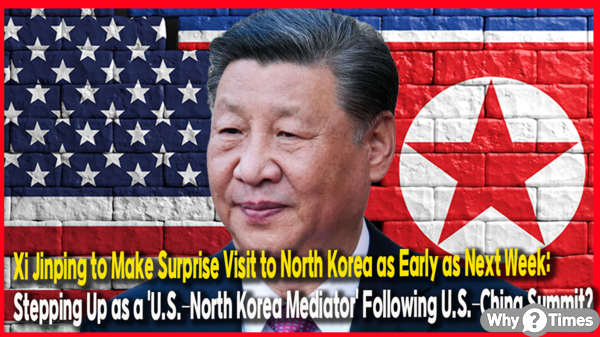
[Pushing for Pyongyang Trip Immediately After Trump’s China Visit: Shaking Up the Peninsula’s Diplomatic Landscape]
The possibility of Chinese President Xi Jinping visiting Pyongyang as early as next week is rapidly coming to the fore. Coming immediately after he reaffirmed the shared goal of North Korean denuclearization during his summit with U.S. President Donald Trump, analysts suggest this is not a mere routine goodwill visit between Beijing and Pyongyang, but a strategic move designed to jumpstart U.S.–North Korea dialogue. In particular, concerns are mounting in South Korea that Seoul could find itself sidelined from the diplomatic landscape if China successfully returns to the center of Korean Peninsula diplomacy and orchestrates a Trump–Kim summit.
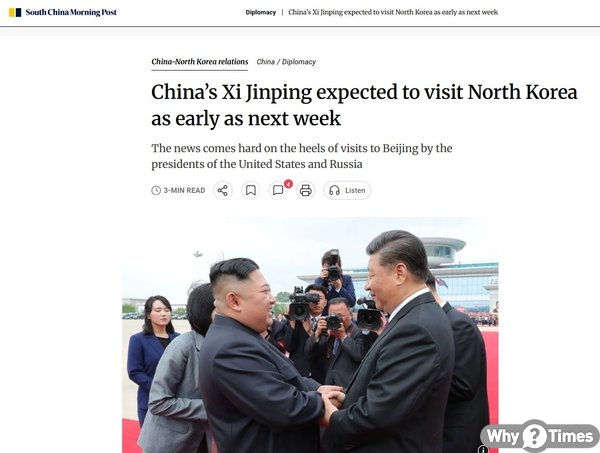
Hong Kong’s South China Morning Post (SCMP) reported on May 21, “The South Korean government has confirmed through multiple channels intelligence indicating that Chinese President Xi Jinping’s visit to North Korea is imminent.” The report quoted a South Korean government source as saying, “We have obtained intelligence that President Xi Jinping will visit North Korea in the near future,” while another government official noted that the visit is highly likely to take place late this month or in early June.
This development was reported simultaneously by major foreign media outlets, including the UK’s Financial Times (FT), SCMP, and America’s TIME magazine, which provided in-depth analyses of the background and objectives of the trip. Citing an anonymous source, TIME reported that “plans for President Xi’s state visit are underway, and China and North Korea will cooperate more closely to counter Japan’s renewed militarism.”
If realized, this will mark the first visit by a Chinese president to North Korea in seven years, since June 2019. Visits by a Chinese head of state to North Korea are historically rare, and given the recent shifts in the Northeast Asian diplomatic landscape, the ramifications are expected to be substantial.
Foreign media also noted advance preparations that have been detected over several months. South Korean government officials pointed to the fact that Chinese Foreign Minister Wang Yi visited North Korea last month, followed recently by the arrival of President Xi’s security and protocol personnel in Pyongyang, as strong evidence that the visit is imminent. South Korean analytical channels also assessed at the time of Wang Yi's visit that his trip might have been a preparatory step for a U.S.–North Korea summit rather than a simple bilateral effort to improve Beijing–Pyongyang ties.
In relation to this, SCMP previously reported, “During Minister Wang Yi’s visit, North Korean leader Kim Jong Un expressed his willingness to ‘strengthen high-level exchanges and enhance strategic communication with China,’ explicitly referencing his own visit to China last year.” Diplomatic circles interpreted this statement as effectively issuing a public call for a reciprocal visit by Xi Jinping.
The foreign policy publication The Diplomat evaluated Wang Yi’s trip as “one of the most significant diplomatic moves in China’s strategic positioning.” Looking at historical precedents, Kim Jong Un also visited China in 2018 to coordinate positions with Beijing ahead of his first summit with Donald Trump in Singapore. Experts analyze that Beijing is clearly signaling its intention to maintain a leading role at the heart of U.S.–North Korea diplomacy this time around as well.
['Follow-up Diplomacy' to U.S.–China Summit: The U.S.–North Korea Mediator Hypothesis Gains Rapid Traction]
The international community's primary focus is whether Xi Jinping’s visit holds a strategic purpose that goes beyond a simple goodwill gesture—specifically, whether he intends to directly broker talks between Washington and Pyongyang. A separate South Korean government source observed that Xi might attempt to mediate relations between North Korea and the United States during this upcoming trip.
Concrete grounds for this hypothesis can be found in the recent diplomatic calendar. The U.S. news agency UPI pointed out, “President Trump and President Xi Jinping reaffirmed their shared goal of North Korean denuclearization during their Beijing summit on May 14–15, a point explicitly stated in the subsequent factsheet released by the White House.” It added, “However, since both sides did not disclose specific details regarding agreements on North Korea immediately after the summit, interpretations regarding the underlying nuances remain varied.”
CNN also reported, “Returning home on Air Force One after concluding his trip to China, President Trump was asked if he had discussed North Korea with President Xi. He replied in the affirmative, adding, ‘As you know, I have a very good relationship with Kim Jong Un. And he’s been pretty quiet lately.’ This remark is read as an indication that the Trump administration desires a resumption of U.S.–North Korea dialogue, while subtly noting North Korea’s passive stance.”
[“Arranging a Meeting Between Trump and Kim Jong Un to Solidify Hegemony Over the Korean Peninsula”]
From this perspective, the purpose of Xi Jinping’s visit can be viewed as moving beyond mere mediation toward actually engineering a direct summit between Trump and Kim Jong Un. In this scenario, China would position itself as the behind-the-scenes architect of a major diplomatic breakthrough. Immediately following the 2018 U.S.–North Korea summit in Singapore, Deng Yuwen, then-editor of the CCP’s Study Times, accurately anticipated this dynamic. He stated, “If Kim Jong Un remains reluctant to completely abandon his nuclear weapons, China will willingly act as an intermediary between Pyongyang and the United States,” adding, “This is precisely the moment to play the North Korea card when Trump places tariffs on China.” Foreign media outlets generally agree that this past analysis is playing out verbatim in 2026.
The Diplomat analyzed, “Beijing is seeking to coordinate parallel initiatives across multiple sectors—including security, economics, and diplomacy—to maintain flexibility while strengthening its leverage in Korean Peninsula negotiations.” If a Trump–Kim summit materializes, having China highlighted as the vital facilitator behind the curtain is the best-case scenario for Beijing. Analysts suggest that even if limited progress is made in U.S.–North Korea relations, China’s continued supporting role in the process will structurally reinforce Beijing’s influence over the peninsula.
[Kim Jong Un’s Choice: Sidelining South Korea, Trusting Only China]
Another critical variable to watch in this phase is Kim Jong Un’s own strategic calculations. Euronews reported, “Kim Jong Un has already formalized his intent to completely exclude South Korea from the framework of U.S.–North Korea dialogue.” It noted, “In his concluding speech at the 9th Party Congress of the Workers' Party of Korea in February this year, Kim declared that North Korea would have ‘zero dealings’ with South Korea, labeling it the ‘primary hostile state,’ and announced that he would ‘permanently exclude South Korea from the category of compatriots.’”
In the same speech, Kim explicitly shut down any possibility of negotiations with Seoul, emphasizing that “inter-Korean relations have been completely severed and nothing remains.” Conversely, regarding the United States, he left the door open for direct Washington–Pyongyang dialogue, stating, “If they recognize our status as a nuclear-armed state and withdraw their hostile policy, there is no reason we cannot get along.”
Analyzing North Korea’s grand strategy for 2026, The Diplomat projected, “Pyongyang will structurally freeze out Seoul while leaving room open for high-level talks with Washington.” This points to a reality where all Korean Peninsula diplomacy bypasses South Korea, realigning entirely around the U.S.–North Korea and North Korea–China axes.
38 North observed, “In this context, Kim Yo Jong publicly denounced President Lee Jae-myung’s dialogue overtures as a ‘deceptive charade.’ She cited South Korea–U.S. joint military exercises, the operation of the Nuclear Consultative Group (NCG), and constitutional clauses defining sovereignty over the entire Korean Peninsula as clear evidence of South Korea’s true hostile intent.” The publication noted, “This explains the structural reasons why North Korea remains deaf to South Korea’s repeated calls for dialogue.”
Commenting on this, Responsible Statecraft analyzed, “The reality that any South Korean diplomatic initiative cannot bypass policy coordination with the United States structurally restricts the prospects for inter-Korean dialogue,” adding that, “more fundamentally, North Korea simply does not trust South Korea’s expressions of good faith.”
Ultimately, from Kim Jong Un’s perspective, China represents the sole safe channel through which he can communicate with the United States while bypassing South Korea. Having Beijing act as the intermediary for U.S.–North Korea talks satisfies Xi Jinping’s strategic ambitions, but it is also a framework that Kim Jong Un is actively seeking. This is the exact intersection where the interests of both sides align perfectly.
Foreign media repeatedly point out that the diplomatic landscape of 2026 shares strong structural similarities with that of 2019. In June 2019, President Xi visited Pyongyang just ten days before meeting Trump at the G20 summit. Analysts at the time viewed the trip as leverage for negotiations with the U.S., noting that Beijing wanted to pre-coordinate its stance with North Korea before the U.S.–China meeting.
At the time, the state-run Xinhua News Agency asserted in a commentary that “China can play a unique and constructive role in breaking the vicious cycle of mistrust between North Korea and the United States.” Similarly, Lu Chao, director of the Korean Peninsula Research Center at the Liaoning Academy of Social Sciences, stated, “China is a critically important major power for the stability of the Korean Peninsula and takes its role as a mediator very seriously.”
Fox News reported, “Seven years later, the sequence of summit diplomacy—moving from Trump’s visit to China, to Putin’s visit to China, and now to Xi Jinping’s anticipated visit to North Korea—mirrors the diplomatic momentum seen just before the 2019 G20 summit, drawing strong parallels to Xi’s past trip to Pyongyang.”
[China’s Strategic Calculus: Countering Japan’s Militarization and Restoring Dominance Over the Peninsula]
Beyond the objective of mediating between the U.S. and North Korea, Xi Jinping’s visit carries an additional strategic layer: reshaping the security architecture of Northeast Asia. TIME magazine analyzed, “This move is also Beijing’s geopolitical response to Japan significantly strengthening its military posture under Prime Minister Sanae Takaichi, who has overseen Japan's relaxation of its 60-year-old lethal weapons export restrictions and its push for constitutional revision.”
The Diplomat also reported, “While Beijing’s leverage over Pyongyang had weakened during the pandemic and during the period of North Korea’s rapid alignment with Russia, the resumption of air and rail routes in early 2026 is interpreted as an effort to prevent the diplomatic flow on the Korean Peninsula from moving forward without China’s participation.”
The sequential summit diplomacy involving Trump’s visit to China, Putin’s visit to China, and Xi’s upcoming trip to North Korea is being read as a concerted effort by major powers to recalibrate order in the Korean Peninsula and Northeast Asia. What message Xi Jinping delivers to Kim Jong Un in Pyongyang, and whether it culminates in a Trump–Kim summit, has emerged as the pivotal variable for Northeast Asian diplomacy going forward. Concerns are rising that if the future of the Korean Peninsula is once again determined on the bargaining tables of major powers, South Korea—despite being the primary stakeholder—could find itself the last country to be notified of the outcome.

- TAG