


추부길 whytimespen1@gmail.com
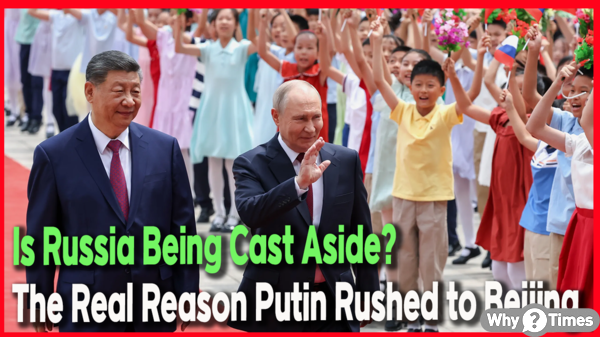
[Putin Hurries to Beijing on the Heels of Trump’s Visit: Shaken by the Fear of G2 Exclusion]
On May 19, close to midn
ight, Russian President Vladimir Putin landed at Beijing Capital International Airport. The airport was filled with a military honor guard and hundreds of youths waving flags and shouting "Welcome!" Yet, despite the grand display, the rank of the welcoming officials paled in comparison to the treatment accorded to U.S. President Donald Trump during his recent visit. While Trump’s visit featured state-guest-level invitations and highly focused, exclusive welcome ceremonies, Putin’s arrival bore the distinct, business-like hallmarks of a routine strategic partnership. Notably, a protective canopy had been installed over the steps of the presidential aircraft—a reflection of Russia’s heightened security demands regarding drone threats as the war in Ukraine drags on. Amidst the lavish protocol, the subtle and shifting dynamics of China-Russia relations were laid bare from the very first scene.
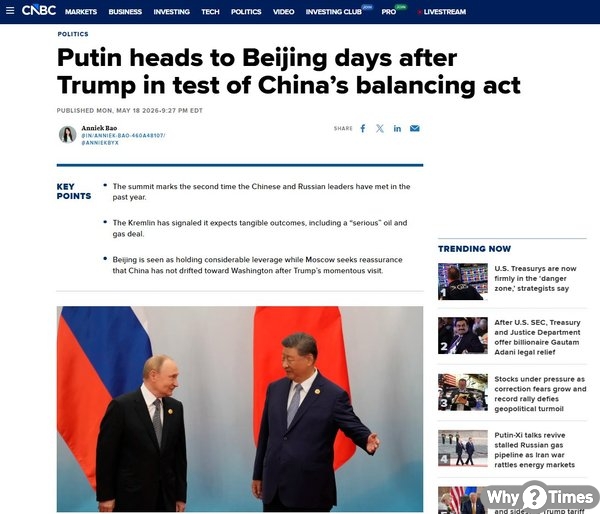
On May 20, CNBC reported that "Beijing entered this summit holding a much stronger hand," noting that "Moscow urgently needed to ensure that China had not tilted toward Washington following Trump’s visit." CNBC analyzed that Putin's anxieties stem from three specific structural crises.
The first is the ongoing quagmire of the war. As the conflict in Ukraine becomes increasingly intractable, rare signs of public discontent are emerging within Russia. For Putin, reconfirming ties with China during this visit was of paramount importance.
The second is economic stagnation. Russia drastically downgraded its economic growth forecast for this year from 1.3% to a mere 0.4%. This downgrade is the combined result of Ukraine's strikes on Russian oil infrastructure and export terminals, alongside persistent uncertainties over whether U.S. sanctions exemptions will remain in place.
The third and most piercing anxiety is the fear of being marginalized by the "G2" powers. When Xi Jinping declared the establishment of a "constructive, strategic stability" with the U.S. during the recent U.S.-China summit, the Kremlin immediately went on high alert. This fear is rooted in history—specifically, the enduring nightmare of the 1972 "reverse alliance," where Mao Zedong’s China and Richard Nixon’s United States joined hands to isolate the Soviet Union.
Commenting on this, Mathieu Duchâtel, a resident senior fellow at the Institut Montaigne in Paris, observed: "This tightly packed schedule actually exposes Putin’s anxiety. The Kremlin is hyper-focused on whether Xi Jinping prioritizes his meetings with Trump, and whether a G2 dynamic is taking shape that effectively pushes Russia to the periphery."
The most critical revelation came from an exclusive report by the Financial Times (FT). The FT reported that "Xi Jinping personally told Trump during their meeting in Beijing last week that Putin might ultimately regret his invasion of Ukraine." This remark was made during broad discussions between the U.S. and Chinese leaders covering various global issues, including the Ukraine war. This marks the first known instance of the Chinese leader offering such a candid assessment of Putin’s decision. Although China's Ministry of Foreign Affairs dismissed the report as "pure fiction," the Kremlin's sense of unease had already been amplified—just a single day before Putin set off for Beijing.
[China's Upper Hand: A Position of Strength or Crisis Management?]
American current affairs weekly TIME magazine noted: "On the surface, Xi Jinping appears at ease. Both Trump and Putin have rushed to Beijing, but China is also grappling with severe internal crises of its own." TIME pointed out that "the Chinese economy is suffering from a prolonged real estate crisis, weak domestic demand, and entrenched deflation; GDP growth has slowed to around 5%, and youth unemployment is hovering near 19%."
In line with this, the European Union Institute for Security Studies (EUISS) warned: "If the war involving Iran drags on and keeps energy prices high, China's growth rate could fall significantly below its official target of 4.5% to 5%."
It is precisely at this juncture that the significance of Trump's visit to China becomes clear. According to the EUISS, "For Xi Jinping, the meeting with Trump was an inevitable choice to salvage his country’s economy. In October 2025, in Busan, South Korea, the U.S. and China had agreed to a form of tactical truce. Washington lowered fentanyl-related tariffs by 10 percentage points and deferred reciprocal retaliatory tariffs until November 2026, while Beijing agreed to a one-year suspension on rare earth export controls and pledged to increase purchases of U.S. agricultural products. The recent U.S.-China summit was a move to solidify this very truce."
The Washington Post (WP) clearly delineated the framework: "While Trump’s state visit was an exercise in managing the world’s most critical bilateral relationship, Putin’s visit is aimed at reassuring a long-standing strategic partner." If the U.S.-China meeting was about managing tensions between two equal superpowers, the China-Russia meeting clearly underscored a master-and-guest dynamic.
TIME magazine added: "While China's display of strength may seem impressive, its practical challenges are substantial." Xi Jinping is attempting to project an image of a "global mediator" by handling two rival superpowers simultaneously, but beneath the surface lies a cutthroat calculation focused entirely on China's economic survival.
[The U.S.-China vs. China-Russia Dynamics: Gaps in Protocol, Gaps in Leverage]
The discrepancy between the two summits was also starkly visible in their protocol. NBC News characterized Trump’s visit as one that created a warm atmosphere despite yielding relatively modest agreements, whereas Putin’s visit was framed as a highly functional, business-as-usual working meeting. Al Jazeera put it more bluntly, stating that "China holds all the cards."
CNBC cited Central and Eastern Europe expert Andrius Tursa, who remarked: "China's support is becoming increasingly vital for Putin amid mounting economic pressure and military setbacks on the battlefields of Ukraine." NATO has already explicitly labeled China as a "decisive enabler" of Russia's war in Ukraine.
The economic imbalance between China and Russia is starkly illustrated by the numbers. CNBC pointed out that "China serves as an economic lifeline for Russia, accounting for 30% of its export revenues and 40% of its total imports." In stark contrast, "Russia accounts for a mere 3% of China's total exports and only 5% of its imports."
Sergei Guriev, Dean of the London Business School (LBS), told CNBC: "For Russia, this visit is absolutely critical. Russia is heavily reliant on China for technology, consumer goods, and manufacturing." He added, "Due to the war in Ukraine, Russia has lost the EU and its trade has been completely realigned toward China, with bilateral trade volume doubling over the past four years."
['Power of Siberia 2'—Putin’s Most Critical Agenda, While Beijing Weighs the Odds]
Guriev emphasized that "the core deal Putin wants to negotiate with Xi Jinping is, of course, the gas pipeline." He explained that "once the 'Power of Siberia 2' pipeline is completed, Russia’s pipeline exports to China will double. China has dragged its feet on this discussion precisely because it feels secure in having already diversified its energy supply sources."
However, the tone of negotiations has shifted following the outbreak of war involving Iran, which triggered heightened anxieties over a potential blockade of the Strait of Hormuz. Earlier this month, Putin personally noted: "We have agreed to achieve very substantial progress in cooperation within the oil and gas sector. I would be delighted to finalize this during the visit." CNN also analyzed that "Middle East instability and risks of future volatility are now pushing Beijing to rely more heavily on Russia for its energy security."
Nevertheless, Guriev maintained a sober perspective: "China has built up sufficient energy reserves, meaning it can afford to wait out the conflict in the Middle East." This implies that China firmly retains the upper hand in negotiations.
There are clear reasons for Guriev's cautious outlook. Driven by a strategic calculus to diversify its energy supply lines, Beijing remains reluctant to become overly dependent on Russia and notably omitted the pipeline project from its latest five-year plan. Furthermore, chronic internal corruption and volatile legal regulations within Russia have stifled substantive Chinese investment. This has triggered self-deprecating criticism and grievances among Russian nationalist factions, who lament that their country is being degraded into China's "junior partner" or a mere economic appendage.
[China's Calculus: The Two Tracks Are Not Mutually Exclusive]
Wang Zichen, Deputy Secretary-General of the Beijing-based think tank Center for China and Globalization (CCG), explained: "Trump's visit was intended to stabilize the world's most critical bilateral relationship, while Putin's visit was aimed at reassuring a long-standing strategic partner. For China, these two tracks are not mutually exclusive."
China’s state-run Global Times boasted in an editorial that "welcoming the leaders of both the United States and Russia within a single week is an exceedingly rare event since the Cold War, serving as clear proof that Beijing is rapidly emerging as the center of global diplomacy."
However, the issue remains that Xi Jinping's diplomatic poise cannot fully conceal China's internal fractures. Beset by a complex crisis involving collapsing domestic demand, deflation, 19% youth unemployment, and a real estate meltdown, China is in desperate need of stabilizing relations with Trump to protect its export-driven economy. Xi, who had rolled out a lavish welcome for Trump at the Great Hall of the People, had to turn around and welcome Putin before the remnants of that banquet could even be cleared away. Amidst this intricate equation, China has entered a high-stakes tightrope walk, attempting to manage strategic stability with the U.S. while simultaneously maintaining its geopolitical alignment with Russia.
Ultimately, the imperial hospitality and extended private audience granted to Trump during his stay in Beijing sounded an ominous alarm for Putin. China’s absolute priority is to stabilize relations with an unpredictable U.S. president to revive its own ailing economy—not to assume indefinite responsibility for a Russia isolated by a war of aggression. Despite the grand welcome in Beijing, Putin—a dictator who turned a reckless blade against the Western world—cannot shake off a profound sense of marginalization and anxiety as he confronts the cold reality of his alliance.
The red carpet in Beijing was brilliant, but the reality of international politics remains ruthless. China, treating the management of its relationship with Trump as a matter of life and death, can no longer afford to look exclusively toward Russia. Meanwhile, a Russia weakened by war and sanctions is steadily being sidelined into the role of a dependent "junior partner." What Putin ultimately confirmed in Beijing was not an unshakeable alliance, but a cold, transactional global order governed strictly by self-interest and power dynamics.

- TAG