


추부길 whytimespen1@gmail.com
[South Korean Media is Too Rash: “Xi Jinping Warned Trump to His Face?”]
During the U.S.-China summit held at the Great Hall of the People in Beijing on the 14th, President Xi Jinping raised the concept of the 'Thucydides Trap' from the very beginning of his opening remarks. He delivered a direct message to President Trump, urging the U.S. not to view China’s rise as a threat leading to conflict, but rather to open a path for coexistence as equal partners. Domestic media outlets, citing reports from China’s CCTV, reported extensively that “Xi warned Trump to his face regarding the Taiwan issue, stating that 'mishandling it could lead to a clash between the two nations.'” This is, quite frankly, a China-biased misinterpretation. Why is that?
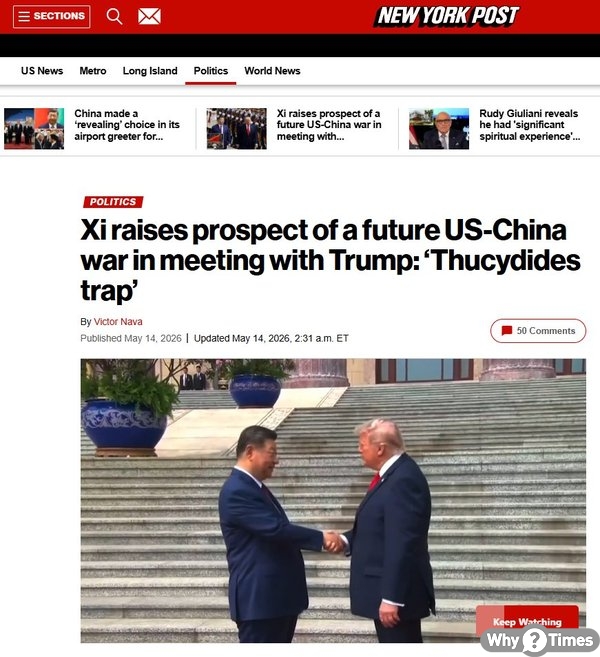
On the 14th, the New York Post reported that “Chinese President Xi Jinping effectively defined U.S.-China relations as being at a ‘historical crossroads’ during his opening remarks at the summit with U.S. President Donald Trump.” It noted that “In particular, President Xi directly mentioned the ‘Thucydides Trap’—named after the ancient Greek historian—referring to the risk of conflict between a global superpower and a rising power.”
The ‘Thucydides Trap’ is a concept rooted in the historical interpretation that the rise of ancient Athens alarmed the existing hegemon, Sparta, eventually leading to war. It became widely known after Harvard Professor Graham Allison applied it to modern U.S.-China relations. While Xi has repeatedly mentioned this concept since 2014, analysts say that bringing it up again in a public forum directly in front of the U.S. President signals that the U.S.-China strategic competition has entered a new stage.
What is clear is that Xi did not raise this concept to warn of a risk of conflict or to threaten the U.S. in front of Trump, as South Korean media suggested. Rather, it was a call for the U.S. to move away from the mindset of viewing China’s rise as something to be feared and contained, and instead to design a new major-country relationship as partners rather than rivals.
Xi stated, “Whether China and the U.S. can overcome the so-called 'Thucydides Trap' and pioneer a new paradigm of major-country relations; whether we can jointly address global challenges and inject greater stability into the world; and whether we can respond together to the welfare of our peoples and the future destiny of mankind to create a bright future for bilateral relations—these are the questions of history, the questions of the world, and the questions of humanity.” He added, “As leaders of major nations, the two of us must find the answers together.”
Expert interpretations of these remarks align with this context. Helen-Ann Smith, Asia Correspondent for Sky News, explained, “What Xi Jinping said in that remark is that we can transcend the Thucydides Trap. His core message was: ‘We are a rising power, and you should not perceive us as a threat.’”
Xi emphasized, “We should be partners, not enemies, and we must help each other succeed and prosper together. we must create a path for major powers to coexist correctly in the new era.” He added, “The stability of China-U.S. relations is good for the world,” and “I have always believed that the common interests between China and the U.S. are greater than our differences.”
This is interpreted as a demand to be recognized as an 'equal superpower' leading the world order alongside the U.S., while simultaneously checking U.S. pressure on China. In particular, by directly mentioning the Taiwan issue, Xi made it clear that the U.S. should refrain from extreme actions that infringe upon China’s core interests, such as supporting Taiwan's independence. Xi’s mention of the Thucydides Trap should be read not as a warning to the U.S., but as a structural message that both sides must maintain their respective boundaries to avoid spiraling into unnecessary conflict.
Xi also imbued the summit with historical significance, saying, “Let us make 2026 a historical and symbolic year that inherits the past and opens the future for China-U.S. relations.” He expressed hope to “exchange views with the President on issues of grave impact to both countries and the world, and to take the helm together so that the great ship of China-U.S. relations can maintain a steady course.” He even offered congratulatory remarks for the 250th anniversary of the founding of the United States, creating a soft atmosphere for cooperation.
[Trump’s Response: “The Best U.S.-China Relationship in History”]
President Trump responded to Xi’s proposal for coexistence with an active reciprocation. Trump stated, “The relationship between China and the United States will be at the best level we have ever experienced,” adding, “It is an honor to be with you, and it is an honor to be your friend.” While his tone differed from Xi’s structural and philosophical remarks, he shared the common direction of putting optimism for the restoration of bilateral relations at the forefront.
President Trump referred to Xi as a ‘great leader’ and highlighted the personal chemistry between the two. He stated, “I have built the longest and best relationship between U.S. and Chinese leaders in history,” and expressed his desire to “strengthen communication and cooperation with President Xi, resolve differences appropriately, and open the best U.S.-China relationship in history.”
Major cabinet members and a large delegation of CEOs from U.S. Big Tech and manufacturing companies accompanied Trump on this visit. Mentioning them directly, Trump emphasized, “They are looking forward to trade and business with China.” This was an expression of his will to return the economic relationship, which had deteriorated due to an intense trade war, back to a trajectory of pragmatic cooperation.
[The War in Iran and the U.S. Strategic Edge: The Negotiating Chips in Trump’s Hands]
Behind the amicable diplomatic rhetoric lies a shift in the strategic landscape that goes beyond simple protocol. By the time President Trump arrived in Beijing, the U.S. had quietly but decisively accumulated geopolitical leverage over China on multiple fronts.
In this regard, VOA (Voice of America) reported, “On February 28, the U.S. and its allies launched a large-scale military strike against the Iranian regime, titled 'Operation Epic Fury.'” It noted that “This operation was carried out as a multi-pronged strategy using military force, economic sanctions, and the strengthening of alliances, directly targeting the support structure from China that has sustained Iran.”
VOA further pointed out, “Iran was not merely an energy trading partner for China. Chinese companies continued to supply dual-use technologies utilized in Iran's weapon development despite international sanctions. In 2021, analysis showed that China substantially increased the Iranian military's precision strike capabilities by allowing access to its BeiDou satellite navigation system. This relationship was a structural cooperation spanning finance, technology, and diplomacy.”
Operation Epic Fury directly rattled that structure. The U.S. Treasury imposed sanctions on major Chinese refining companies like Hengli Petrochemical, so-called 'teapot' refiners, and over 40 shadow fleet operators. The U.S. State Department publicly designated several Chinese companies for providing satellite information on U.S. and allied troop movements to Iran, documenting Beijing's complicity in official international records. Although Xi invoked extra-territoriality laws to instruct his companies to ignore U.S. sanctions, those instructions rang hollow for companies whose survival depends on the dollar payment system.
The ripples in the Gulf region were also significant. Beijing’s status as a key external actor in the Middle East, which it had claimed after brokering the 2023 Iran-Saudi normalization, was rapidly undermined while the U.S. conducted continuous military operations against its partner. Gulf nations witnessed the limitations of China firsthand.
[Beyond the Middle East, Stretching to the Indo-Pacific and Europe: The Expanding U.S. Encirclement]
The U.S. strategic positioning did not stop in the Middle East. While the Iran operation was underway, Washington accelerated the securing of bases targeting China’s strategic strongpoints.
In the Indo-Pacific, the U.S. signed a major defense cooperation agreement with Indonesia, which sits on the Malacca, Sunda, and Lombok Straits. These three straits are strategic arteries through which most of China's energy imports pass. In the Philippines, a 4,000-acre economic security zone under U.S. jurisdiction was established in the Luzon Strait, placing a permanent U.S. foothold at the entrance to the South China Sea.
The U.S. also made decisive progress in Europe. At the 'Three Seas Initiative' summit held in Dubrovnik, the Western Balkans, the U.S. finalized a package including a $1.5 billion gas interconnector project between Croatia and Bosnia, a $6 billion Albania LNG framework, and a $58 billion investment agreement for AI data centers. This was a strategic package effectively blocking Chinese capital from the Adriatic Sea region.
President Trump arrived in Beijing with all these pieces in place. This is why observers speculate that any easing of sanctions on Chinese companies might be predicated on the dismantling of the Iranian military procurement network that Beijing has painstakingly built over the past decade.
[The Reality of ‘Same Bed, Different Dreams’: Tariffs, Semiconductors, and Taiwan]
Despite the diplomatic language emphasizing coexistence, the structural tensions between the two nations remain ongoing. While the two leaders publicly exchanged pleasantries like ‘great leader’ and ‘partner,’ a tense tug-of-war continued in the negotiation room over tariffs, semiconductors, Iran, and Taiwan.
President Trump, in desperate need of visible achievements ahead of the November midterm elections, likely expected Chinese purchase commitments for key items such as soybeans, beef, and Boeing aircraft. Conversely, President Xi was expected to demand a U.S. commitment to opposing Taiwan independence while putting tariff reductions and the easing of high-tech export controls on the bargaining table.
In this context, Secretary of State Marco Rubio made it clear before the meeting that while he accepts China’s rise as a fait accompli, he has no intention of compromising U.S. interests. Rubio stated, “We know China is trying to become the most powerful country in the world and overtake the U.S., and they are executing that plan. I don’t blame them,” but added a firm line: “We cannot allow China to rise at the expense of America’s decline. Their rise must not lead to our fall.” He emphasized that “This issue will be the core point of contention in bilateral relations not just during this visit, but over the long term.”
[Redefining as a ‘Constructive Strategic Stability Relationship’]
Through this summit, the two nations agreed to newly define the U.S.-China relationship as a 'Constructive Strategic Stability Relationship.' This is a conceptual agreement beyond mere rhetoric, expressing a joint will to manage bilateral relations—previously marked by trade wars and technological hegemony competition—within a diplomatic framework.
For their afternoon schedule, the two leaders visited the Temple of Heaven in Beijing together. Their stroll through this historical space, where emperors of the Ming and Qing dynasties offered sacrifices to heaven, symbolically showed that this summit was a venue for setting the long-term direction of bilateral relations, beyond just a ceremonial event.
Ultimately, Xi Jinping’s 'Thucydides Trap' remark was not a warning toward the U.S., but a proposal to consciously change the flow of G2 relations that could otherwise head toward a structural clash. His core message was to accept China’s rise as an opportunity rather than a threat, and to write a new grammar of coexistence based on mutual respect for core interests, such as the Taiwan issue. However, since structural conflict factors like tariffs, semiconductors, and Taiwan remain unresolved, whether the Beijing settlement will become a true turning point will be determined by the implementation process of both sides.

- TAG