


추부길 whytimespen1@gmail.com
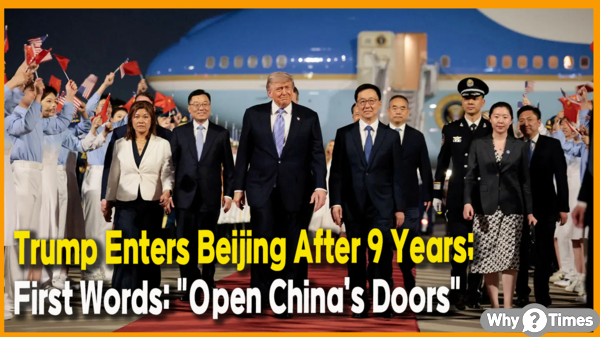
U.S. President Donald Trump visited Beijing for the first time in nine years since 2017, entering high-intensity trade negotiations with Chinese President Xi Jinping. Accompanied by the largest-ever economic delegation, Trump set the removal of market entry barriers for U.S. companies as his top priority. Notably, the attendance of Defense Secretary Pete Hegseth has drawn significant attention, as it signals a potential restoration of military channels between the two nations.
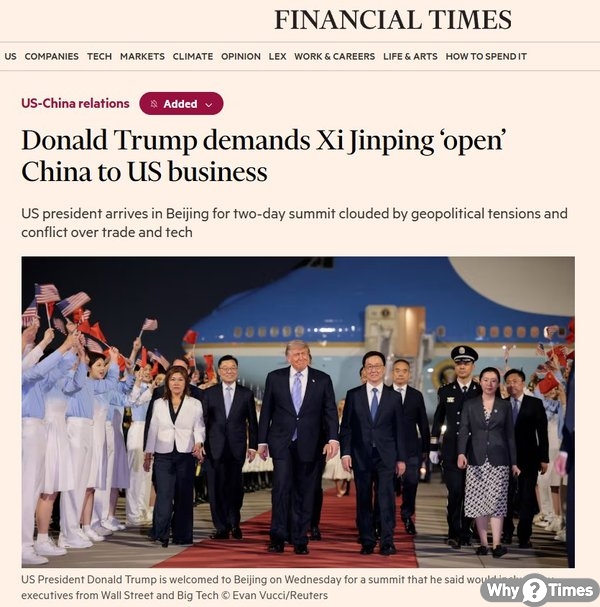
The Financial Times (FT) reported on the 14th, “U.S. President Donald Trump arrived in Beijing for a two-day summit amid uncertainty clouded by geopolitical tensions and trade and technology conflicts.” The report noted, “Upon arrival, Trump demanded that President Xi Jinping ‘open China to U.S. companies,’ aiming to make strengthening corporate cooperation a core task during his two-day visit.”
In fact, before arriving in Beijing, President Trump posted on Truth Social from Air Force One, praising President Xi as a “leader of extraordinary brilliance” while simultaneously pinning the opening of the Chinese market as his primary demand. Trump stated, “I will ask President Xi to open the doors of China so that these incredible people [the CEOs] can perform there, and I promise that will be my very first request.” This made it clear that the visit is not merely diplomatic but possesses the character of an "economic battle" to expand U.S. corporate access to China.
Economic organizations, including the U.S. Chamber of Commerce, have warned that Beijing has consistently expanded state-led industrial intervention favoring its own companies. Consequently, frustration is mounting among U.S. firms finding it increasingly difficult to compete fairly in the Chinese market. Trump’s move to place market opening at the forefront of the talks directly reflects these accumulated grievances from the U.S. business community.
[First Beijing Visit in 9 Years, Record-Breaking CEO Delegation]
Regarding this, Fox News reported, “The visit includes 17 top U.S. CEOs, including Elon Musk of Tesla and SpaceX, Tim Cook of Apple, Larry Fink of BlackRock, Stephen Schwarzman of Blackstone, Kelly Ortberg of Boeing, David Solomon of Goldman Sachs, and Jane Fraser of Citigroup.” It added, “Nvidia CEO Jensen Huang, who was initially expected to be absent, joined Air Force One in Alaska, adding further weight to the delegation, which also includes Meta Vice Chair Dina Powell McCormick.”
Analysts evaluated that this CEO lineup symbolizes pragmatic momentum for deals in the aviation, agriculture, and financial sectors, demonstrating a strategy to prioritize areas where quick wins in bilateral trade can be achieved despite ongoing tensions.
Fox News interpreted this as a setup where “Trump acts as the lead negotiator, using CEOs to smooth negotiations with Xi and testing reciprocity following China’s tariffs.” Arthur Kroeber, head of research at Gavekal Dragonomics, analyzed that “the financial giants in attendance are likely eyeing further liberalization of China’s closed financial sector.” Conversely, prospects for high-tech and semiconductor companies like Micron remain challenging amid China’s regulatory barriers.
['5B vs. 3T', The Negotiation Framework for Trade and Tech Hegemony]
The New York Times (NYT) reported, “The agenda for this summit is condensed into the so-called '5B vs. 3T' frame.” According to the report, the core agenda presented by the U.S. consists of five major items related to large-scale purchase agreements: Boeing aircraft, Beans (soybeans and agricultural products), Barrels (energy), and Barriers (opening of financial markets). In response, China is countering with the "3T": Taiwan, Tariffs, and Technology.
The NYT further noted, “High tariffs imposed by the U.S. on strategic industries reach 100% for electric vehicles and 50% for semiconductors and solar power, while exports of high-performance AI chips to China are strictly restricted.” China is using the easing of these barriers as a bargaining chip, leading to observations that a 'quid pro quo' structure could form against the purchase agreements proposed by the U.S.
The NYT also raised the analysis that “China’s goal is to buy time to revitalize its economy while solidifying its technological and industrial competitiveness, whereas the U.S. goal is closer to achieving visible results rather than structural reforms.” The prevailing view is that Beijing is likely to agree to buy Boeing aircraft and U.S. soybeans to maintain stable relations, but broad structural reforms are unlikely.
The Council on Foreign Relations (CFR), which publishes Foreign Affairs, noted, “The $250 billion West Virginia MOU signed during Trump’s first visit in 2017 exceeded the state’s entire GDP but was ultimately never implemented,” expressing skepticism over the feasibility of large-scale investment pledges this time as well.
[Rare Earths, China’s Card to Shake the Negotiation Table]
One of the most notable variables in this summit is undoubtedly rare earths. In response to U.S. tariff pressure, China has pulled the card of restricting the supply of rare earths and key magnets; China currently accounts for approximately 85-90% of the global rare earth refining market.
In particular, the U.S., having exhausted a significant amount of advanced weaponry in the war with Iran, is in a more desperate position regarding the supply of rare earths required for arms manufacturing. Consequently, evaluations suggest that a favorable negotiation structure has been formed for China, allowing it to use the rare earth supply as leverage to extract various concessions. The CFR analyzed that “China may use Trump’s priority of stabilizing rare earth supplies to draw concessions related to Taiwan.” Indeed, at last year’s Busan summit, the two sides agreed to a one-year trade truce, and whether to extend this moratorium is a key issue in the current talks.
[Defense Secretary Hegseth’s Attendance: A Signal for Restoring Military Communication]
The accompaniment of Defense Secretary Pete Hegseth is particularly striking. It is an unusual case for a sitting U.S. Defense Secretary to join a president on a state visit to China for the first time in decades. Experts interpret this not as a mere diplomatic gesture, but as a signal that both nations possess a practical will to restore military crisis management and communication channels.
Zhu Feng, Dean of the School of International Studies at Nanjing University, predicted, “Hegseth’s presence is highly likely to contribute to the establishment of a military communication mechanism and crisis management.” He added, “Since fundamental differences are hard to resolve, the immediate task is to prevent miscalculation and stabilize the relationship. Given Hegseth’s attendance, China will at least involve Defense Minister Dong Jun in the talks.” Compared to the 2017 summit where only Li Zuocheng, Chief of the PLA Joint Staff Department, was present, the weight of military personnel participation has increased.
Former PLA Colonel Zhou Bo stated, “Hegseth’s joining may suggest substantive progress in restoring military communication channels.” He noted that because both sides value crisis management and neither wants conflict, the reactivation of the Joint Staff-level channel—installed in 2017 but suspended in recent years—as well as the creation of new channels, cannot be ruled out. The last activation of said channel was a video call between U.S. Joint Chiefs Chairman Charles Brown and PLA Chief of the Joint Staff Liu Zhenli in 2023.
The issue of Taiwan arms sales is also being mentioned as a core agenda item for military negotiations. Zhou Bo said, “As China’s military capabilities strengthen, its means of response have increased, and the U.S. will now recognize that Taiwan arms sales could pose a greater risk.”
Shi Yinhong, a professor of international relations at Renmin University, projected, “If talks go smoothly, large-scale Taiwan arms sales planned by the U.S. in the near future could be temporarily suspended,” though he added, “Even if such an agreement is reached, it will not be made public, nor will specific conditions be announced.”
The nuclear issue is also surfacing. Zhao Tong, a senior fellow at the Carnegie Endowment for International Peace’s Nuclear Policy Program, pointed out, “China’s nuclear expansion has emerged as a major concern in U.S. strategic calculations, rivaling or exceeding the nuclear threat from Russia.” He analyzed that if both sides take a pragmatic approach, this dialogue could create space for initial formal exchanges regarding nuclear issues.
[Taiwan and Iran, Geopolitical Shadows Over the Conference Room]
Geopolitical issues are acting as key variables just as much as trade. The Taiwan issue remains one of the most sensitive subjects, with China repeatedly emphasizing that Taiwan is the most significant source of tension in U.S.-China relations. President Trump mentioned he would include Taiwan arms sales as an agenda item, which is expected to address China’s concerns by emphasizing that the weapons are defensive, not offensive.
The war in Iran is another variable weighing down the summit. The U.S. is currently facing difficulties in ceasefire negotiations with Iran. Treasury Secretary Scott Bessent urged that “China’s role is crucial for resolving the Strait of Hormuz situation,” and Secretary of State Marco Rubio stated, “China must apply direct pressure on Iran.” However, Professor Shi Yinhong of Renmin University explained, “It will be difficult for Iran to become a central agenda item,” noting that “Neither the U.S. nor Israel has succeeded in completely subduing Iran militarily, and China possesses neither the military intervention capability nor the influence to effectively mediate this conflict.”
[The Limits of 'Transactional Diplomacy' and the Persistence of Structural Conflict]
In this regard, CNBC analyzed, “Experts agree that even if the Beijing summit produces visible results, it will be insufficient to resolve the structural conflict between the U.S. and China.” It added, “As both sides have incentives to ease tension and prevent international incidents, they are expected to focus on reaffirming the relationship between the leaders and maintaining a stable tone.”
This summit is evaluated as a symbolic moment where the U.S. is adjusting its direction toward supply chain stability and managed competition rather than a complete decoupling from China. However, the Taiwan issue, the AI hegemony race, high-tech controls, and military tensions remain unresolved.
The full-scale summit between President Trump and President Xi began on the morning of the 14th at the Great Hall of the People in Beijing, with a state dinner scheduled for the evening. Following additional meetings and a working lunch on the morning of the 15th, President Trump is scheduled to return to Washington.

- TAG