


추부길 whytimespen1@gmail.com
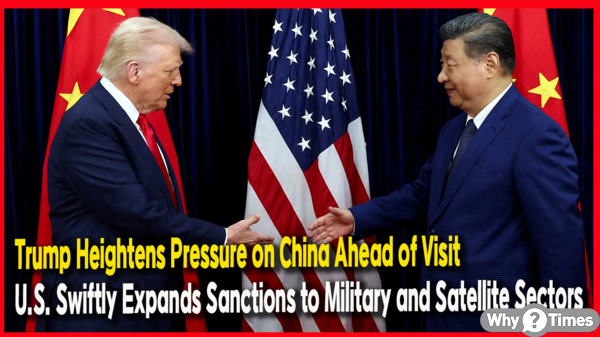
[U.S. Targets China's Military Supply Chain with "Economic Fury" Before Trump's Visit]
Just one week before President Donald Trump’s visit to China, the U.S. government has significantly expanded the scope of its sanctions. Moving beyond the traditional sectors of trade, technology, and energy, the U.S. is now tightening its grip by including military supply chains and satellite imagery intelligence. Amidst this, projections suggest that the Taiwan issue will be a major topic during the upcoming U.S.-China summit, with a firm policy expected to be delivered that may "shock" President Xi Jinping.
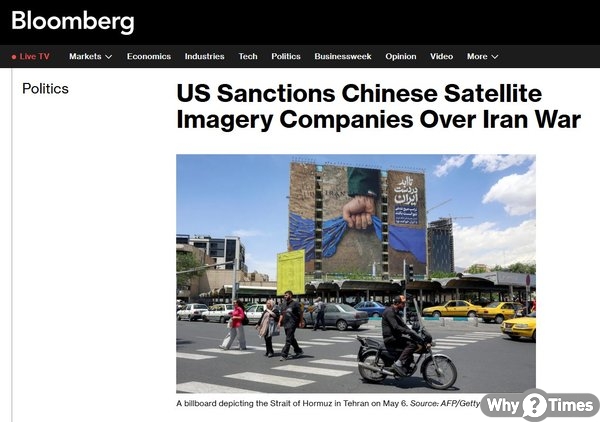
Bloomberg reported on the 10th that "President Donald Trump is scheduled to visit Beijing on the 14th and 15th for a summit with Chinese President Xi Jinping. Ahead of this, the U.S. imposed sanctions on three Chinese companies that provided satellite imagery to Iran, enabling military attacks on U.S. troops stationed in the Middle East." The report added, "This is a measure to strengthen Washington's efforts to limit technical support to Tehran during the Middle East conflict."
Bloomberg continued, quoting U.S. Secretary of State Marco Rubio’s statement on the 9th: "Companies such as Hangzhou MizarVision Technology, Beijing The Earth Eye, and Chang Guang Satellite Technology have been added to the list of entities and individuals supporting Iran, with some based in Belarus and the UAE." The three companies did not provide immediate responses, and the Chinese Ministry of Foreign Affairs did not respond to requests for comment.
The report also noted, "Chang Guang Satellite Technology, China’s first private commercial satellite company, is not being sanctioned for the first time; it is suspected of collecting satellite imagery of U.S. and allied military facilities at Iran's request." It pointed out that Beijing-based The Earth Eye provided imagery directly to Iran, while MizarVision had posted public videos on the internet containing military movements related to the U.S. 'Operation Epic Fury.'
This summit was rescheduled after being postponed from its original late March date due to the prolonged war with Iran. Treasury Secretary Scott Bessent stated, "The Iran issue will be a core agenda item for the meeting between President Trump and President Xi." Observers find it unusual that the U.S. is intensifying all-out pressure on China so close to the summit. Analysts suggest this is a strategic move to maximize leverage before sitting down at the negotiating table.
Secretary Rubio also stated, "Several Chinese companies included in today’s action provided satellite imagery for Iranian strikes against U.S. forces in the Middle East. The U.S. will mobilize all available means to target third-country companies and individuals supporting Iran’s military supply chain." The State Department’s data also included a warning: "Attacks targeting U.S. forces and allied partners will inevitably meet a response."
On the same day, the Treasury’s Office of Foreign Assets Control (OFAC) separately sanctioned 10 Chinese and Hong Kong entities and individuals linked to Iran’s procurement network. These sanctions were based on allegations of supporting Iran in securing weapons and raw materials for Shahed drones and ballistic missiles.
Evidence of supplying raw materials for ballistic missiles also emerged. The Chinese firm Hitech Insulation Ningbo was identified as a supplier of carbon fiber, honeycomb structures, and aerospace-grade materials used in ballistic missile production. U.S. authorities also sanctioned Li Gengping, the representative of the firm who oversees sales, procurement, and financial operations.
Treasury Secretary Bessent declared, "While the surviving IRGC leadership remains trapped like rats in a sinking ship, the Treasury’s 'Economic Fury' operation will not stop." The International Energy Agency (IEA) defined the current situation caused by the blockade of the Strait of Hormuz as "the greatest energy security threat in history."
[Sanctions on Chinese Refiners and Secondary Sanction Warnings: Pressuring Iran’s Oil Funding]
Aside from blocking the military supply chain, the U.S. is further tightening pressure on crude oil export routes, Iran’s key source of foreign currency. Fortune reported, "On April 24, the U.S. Treasury sanctioned Hengli Petrochemical Dalian Refinery, one of the largest buyers of Iranian oil, and approximately 40 shipping companies and tankers making up Iran's 'shadow fleet.'" These sanctions cut off these firms from the U.S. financial system and penalize those who deal with them.
CNBC reported, citing 2025 data from Kpler, that while China buys over 80% of Iran’s exported crude, sanctions experts have noted that independent refiners have less exposure to the U.S. financial system, making them somewhat "immune" to the full effects. However, experts argue that sanctions on Chinese banks facilitating these transactions would be much more effective.
Consequently, the U.S. has brought out the "secondary sanctions" card. On April 28, OFAC warned financial institutions of secondary sanction risks related to China’s independent 'teapot' refiners. OFAC warned that "the Treasury is prepared to use all available tools, including secondary sanctions, against foreign financial institutions that continue to support Iran’s activities."
If applied, secondary sanctions could lead to freezing dollar assets, expulsion from dollar clearing networks, bans on transactions with U.S. companies, and exclusion from the SWIFT system. In 2012, OFAC previously expelled China’s Bank of Kunlun from the SWIFT system for involvement in Iranian oil transactions.
[China Invokes Anti-Foreign Sanctions Law for the First Time… But Banking Sector Moves Otherwise]
In response to U.S. pressure, Chinese authorities countered legally. On the 2nd, the Ministry of Commerce (MOFCOM) issued a prohibition order based on "Blocking Rules," directing five refiners, including Hengli Petrochemical and Shandong Jincheng Petrochemical, not to recognize or comply with U.S. sanctions. This marks the first actual invocation of the "Blocking Rules" since their introduction in January 2021.
Under these rules, counterparties like banks, insurers, and logistics firms face a "legal dilemma": they face U.S. sanctions if they don't comply with the U.S., and Chinese penalties if they do. The law also allows Chinese parties to file civil lawsuits against those who follow foreign sanction directives.
However, despite Beijing’s public hardline stance, cracks are appearing in the financial sector. Bloomberg noted, "The National Financial Regulatory Administration (NFRA) gave verbal instructions to major domestic banks to temporarily suspend new RMB loans to the five sanctioned refiners." This instruction reportedly focuses on withholding new credit rather than recalling existing loans.
Bloomberg added, "This instruction, which includes reviewing ties with major private refiners like Hengli, directly contradicts MOFCOM’s official ban on complying with U.S. sanctions. This suggests that the Chinese financial sector is practically conscious of U.S. secondary sanction threats."
[Taiwan Agenda Surfaces… Rubio: "Taiwan Strait Must Remain Stable"]
The summit's friction extends beyond Iran and economic issues. The Taiwan issue is emerging as a core agenda item, forming another axis of diplomatic tension.
Secretary Rubio stated, "It is certain that Taiwan will be on the agenda," adding that "maintaining stability in the Taiwan Strait is in the interest of both nations." When asked if Trump would pressure Beijing’s Taiwan policy, Rubio replied, "Taiwan has always been a topic of discussion, and it certainly will be this time." Following his trip to the Vatican and Italy on the 8th, he reaffirmed that "there is no change in U.S. policy, and we do not want any change to the status quo by coercion or force."
He emphasized, "No events causing instability should occur in Taiwan or anywhere in the Indo-Pacific. This benefits both the U.S. and China." Previously, Rubio urged China to actively engage in the Hormuz blockade issue, reminding Beijing that its export-led economy would suffer greatly from the blockade.
China is also prepared to raise the Taiwan issue. Prior to Trump’s visit, Beijing reiterated that "adhering to the One China Principle is a prerequisite for stable and healthy U.S.-China relations." Foreign Minister Wang Yi also urged Secretary Rubio during a call to "make the right choice" regarding Taiwan.
Last December, the Trump administration approved a record $11.1 billion arms sale to Taiwan, including HIMARS missiles and M109A7 Paladin howitzers. Beijing strongly protested this as a violation of the One China Principle. Discussions on AI are also rumored to be on the table for the summit.
[The Intersection of Trump’s Visit and Iran Negotiations: The Hormuz Variable]
The timing of these sanctions is diplomatically significant. Reuters noted, "These measures come as Trump is set to visit China while U.S.-Iran peace talks have stalled again due to skirmishes in the Strait of Hormuz." Before the visit, Trump hinted at a potential deal with Iran, with reports of a draft MOU containing 14 clauses, including a halt to enrichment and unfreezing assets. However, renewed combat in the Strait has destabilized the environment.
The Trump administration acknowledges China’s role in bringing Iran to the table but maintains that Beijing must be more active in reopening the vital waterway. Rubio publicly called on Beijing to deliver a clear message to Tehran during the Iranian Foreign Minister's visit to China.
Ultimately, this sanction offensive is a product of complex diplomatic strategy. It sends a strong pressure message to China to stop supporting Iran before the visit, applies simultaneous economic and military pressure on Iran’s procurement, and maximizes leverage by making Taiwan a public agenda item. With the Taiwan issue, Middle East situation, and export controls rising as key topics, the trajectory of the U.S.-Iran war remains a final variable for the summit’s success.
In conclusion, America’s "Economic Fury" is a precision strike through Chinese hypocrisy. The "gift" for Xi Jinping upon Trump’s arrival is a powerful warning regarding the stability of the Taiwan Strait and the severance of military supply chains. This encapsulates the true significance of the upcoming U.S.-China summit.
- TAG