


추부길 whytimespen1@gmail.com
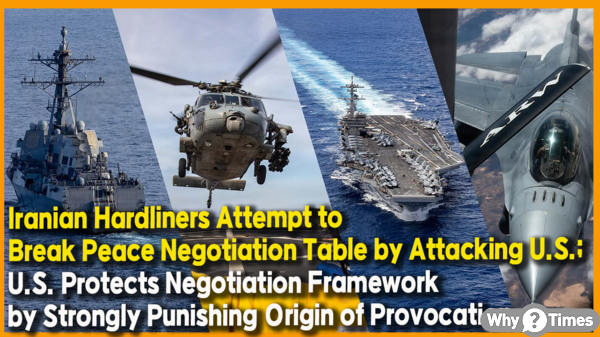
[Iranian Missile and Drone Attacks on U.S. Destroyers; U.S. Conducts Precision Strikes on Iranian Military Facilities]
While ceasefire negotiations between the United States and Iran were underway, hardliners within the Islamic Revolutionary Guard Corps (IRGC) carried out an armed provocation in the Strait of Hormuz. In response, the U.S. military launched an overwhelming retaliation, conducting precision strikes on major military strongholds such as Tehran and Bandar Abbas. In short, while the IRGC hardliners attempted to nullify the ongoing ceasefire negotiations by launching an armed provocation in the Strait of Hormuz, the United States maintained the framework for peace through a restrained response that accurately targeted only the origin of the provocation.
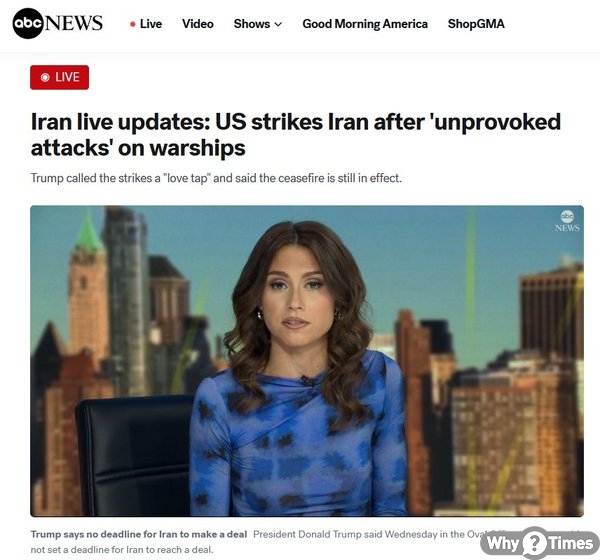
On the 8th, America's ABC News reported, “While Iranian Foreign Minister Abbas Araghchi reaffirmed his willingness to negotiate after meeting with Chinese Foreign Minister Wang Yi in Beijing, and the atmosphere for ending the war is ripening within Iran, the exact opposite occurred in the Strait of Hormuz.” It continued, “The IRGC Navy mobilized missiles, drones, and small boats to attack three U.S. Navy destroyers transiting the strait.”
U.S. Central Command (CENTCOM) also stated, “The USS Truxtun (DDG 103), USS Rafael Peralta (DDG 115), and USS Mason (DDG 87) were attacked by Iranian forces using multiple missiles, drones, and small boats while passing through international waterways.”
At the very moment the IRGC was provoking the U.S. military, Iranian Foreign Minister Abbas Araghchi reaffirmed his intent to negotiate after meeting with Chinese Foreign Minister Wang Yi in Beijing, stating the negotiation principle: “We will only accept a fair and comprehensive agreement.”
Furthermore, it was understood that Iran is taking a significant step toward ending the war, as Iranian President Masoud Pezeshkian, a member of the negotiation faction, revealed for the first time that he had met with the new Supreme Leader, Ayatollah Mojtaba Khamenei. The fact that President Pezeshkian publicly disclosed his meeting with the Supreme Leader is interpreted as him having reported the details regarding the end of the war to the Supreme Leader and having received a sign of approval.
As the internal atmosphere in Iran flowed toward accepting ceasefire negotiations, the IRGC hardliners directly attacked the U.S. Navy with missiles and drones to shake up the negotiation table. Therefore, it can be said that the timing of the provocation was not a coincidence. The interpretation that the IRGC hardliners tried to cut off the flow of negotiations just as expectations for a peace agreement mediated by Pakistan were rising is gaining traction. This aligns with the repeated behavioral pattern of IRGC hardliners seizing the initiative of negotiations away from diplomatic channels.
[The Restraint of the U.S.: Retaliation "Only to That Extent"]
Regarding these aggressive actions by the IRGC, the U.S. military's response was swift, yet thoroughly calculated. Fox News stated, “U.S. Central Command immediately launched a counterattack, striking Iran’s missile and drone launch sites, command and control facilities, and intelligence, surveillance, and reconnaissance hubs.” It added, “The U.S. military struck the port of Qeshm, Bandar Abbas, and the Bandar Kargan naval checkpoint in Minab.” Fox News further reported that a senior U.S. official stated, “This counterattack does not mean a resumption of war or the end of the ceasefire.”
ABC News also pointed out, “The American message was as clear as its actions.” In a statement, CENTCOM clarified, “The U.S. military does not seek escalation, but remains prepared to protect U.S. forces.” They clearly drew a line: they would retaliate because they were attacked, but would not go beyond that.
Defense Secretary Pete Hegseth defined the U.S. response as being "defensive in nature, limited in scope, and temporary in duration," focusing on a single mission: protecting innocent merchant ships from Iranian aggression. Secretary of State Marco Rubio also repeatedly emphasized, “This engagement is merely a defensive operation,” and that “the U.S. priority is not the expansion of war, but the reopening of the Strait of Hormuz.”
Immediately after the engagement, President Trump drew a line during a phone call with ABC News, saying, “The ceasefire continues. It remains in effect.” This was an expression of will that he would not allow the Iranian hardliners' provocation to change the negotiation structure itself.
[Why Did the IRGC Hardliners Choose This Moment?]
To understand the provocation by the IRGC hardliners, one must look at the shifts in Iran's internal power landscape. Following the death of Supreme Leader Ali Khamenei in a joint U.S.-Israeli airstrike on February 28, Iran’s decision-making structure began to fundamentally shake. Saeid Golkar, an Iran expert at the University of Tennessee at Chattanooga, analyzed, “With the ultimate mediator gone, a fight between different factions has begun.”
The successor, Mojtaba Khamenei, is in a state where public activity is virtually impossible due to injuries from the airstrike. According to reports, only high-ranking IRGC commanders are communicating directly with him, and they are obstructing direct contact with civilian leadership, including the President and the Foreign Ministry. This situation is deepening the lack of coordination between diplomatic and military institutions and complicating the negotiation process with the United States.
The Washington-based Institute for the Study of War (ISW) stated, “The IRGC appears to be leading Iran’s decision-making instead of the political officials involved in negotiations with the U.S., particularly Foreign Minister Araghchi.” It added, “The IRGC’s disruption of international maritime navigation and actions contrary to Araghchi’s statements reflect a broad division within the Iranian system.” Amidst this, President Pezeshkian’s official announcement that he had met and spoken with the Supreme Leader appears to have completely shaken the firm status of the hardliners within Iran.
In relation to this, Fortune magazine noted, “The calculation of the IRGC hardliners is simple.” It pointed out, “Analysis suggests that surviving IRGC commanders view control of Hormuz as key leverage against the U.S. and are leading Iran toward preferring continued combat instead of a ceasefire agreement that agrees to open the strait.” If a negotiation is reached, the IRGC loses its most powerful pressure card. The provocation was an intentional disruption aimed at blocking the negotiations themselves.
[The Chain Reaction Triggered by the Iranian Hardliners' Attack on the UAE]
Even before the May 7 engagement, the IRGC had already been shaking the negotiation environment. Three days earlier, on May 4, the IRGC launched missile and drone attacks toward the UAE. The UAE Ministry of Defense stated that it intercepted 15 missiles and 4 drones launched by Iran with its air defense system, and that one drone collided with the Fujairah oil industrial complex, causing a fire and injuring three Indian nationals.
Regarding this, The Times of Israel (TOI) pointed out, “The repercussions of this attack were significant.” It noted, “When the U.S. Department of Defense treated this as a 'low-level attack' and did not define it as a ceasefire violation, the anger of the Gulf oil-producing nations exploded.” TOI continued, “Saudi Arabia and Kuwait suddenly withdrew permission for the use of bases and airspace for the U.S. military’s 'Project Freedom' operation, only to later reverse this decision.” It stated that a single provocation by the IRGC created a rift between the U.S. and its Gulf allies.
Even in this situation, President Trump emphasized progress in indirect negotiations, saying, “Iran is showing a much more flexible appearance than in the past.” This was an attitude of intentionally separating the hardliners' military provocations from the diplomatic signals of negotiation.
[Suspension of Project Freedom: A Negotiation Strategy Not Led by Provocations]
American patience was not limited to military responses. The Trump administration made the decision to temporarily suspend 'Project Freedom'—the U.S. Navy's mission to escort merchant ships in the Strait of Hormuz. Trump stated, “Based on requests from Pakistan and others, we are making great progress in negotiations,” and added, “Therefore, we will temporarily suspend Project Freedom for a short period to see if a complete and final agreement can be reached.” However, the maritime blockade was maintained.
This decision was a double-layered move to respond militarily to the IRGC's provocation while simultaneously securing diplomatic space so that the door to negotiations would not close. By making the concession of stopping military operations, it gives the Iranian diplomatic line a justification to continue negotiations, creating a structure that prevents the hardliners' provocation from cutting off the dialogue itself.
Even amidst the smoke of the engagement, the Pakistani mediation channel did not stop operating. An Iranian Foreign Ministry spokesperson stated, “The U.S. proposal is under review, and once the review is finished, our position will be delivered through Pakistan.” Pakistan's Foreign Ministry spokesperson, Tahir Andrabi, told NPR, “We hope to reach an agreement as soon as possible.”
The U.S. is also publicly keeping the possibility of reaching a deal open. Trump warned, “If Iran agrees to a deal, the Strait of Hormuz will be open to everyone, including Iran,” but added, “If they do not agree, bombing at a much higher level and intensity than before will begin.” While this is Trump's characteristic negotiation tactic of showing the carrot and the stick simultaneously, the core lies in the message that he is not giving up on the negotiation itself.
In the end, the engagement on May 7 was a day when the IRGC hardliners' attempt to flip the table was blocked by America's restrained patience. The hardliners fired missiles, the U.S. military retaliated but did not cross the line, and the negotiation channels remain open. Ultimately, the key question is 'who controls the Strait of Hormuz and under what conditions,' and the negotiations to find that answer are continuing even at this moment, despite the interference of the hardliners. With approximately 2,000 ships waiting on both sides of the strait, the narrow tightrope walk between diplomacy and military force has not yet ended.

- TAG