


추부길 whytimespen1@gmail.com
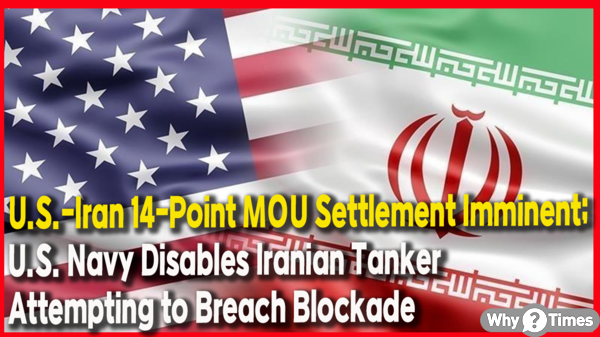
[14-Point MOU… A Surrender-Style Memorandum of Understanding Extracted by ‘Maximum Pressure’]
As the war, which began on February 28 with a pre-emptive strike by the U.S. and Israel against Iran, enters its 68th day, the U.S. and Iran are staging an extreme dual structure—approaching the closest end-of-war agreement in history while simultaneously maintaining military tensions involving live ammunition. Currently, the U.S. has delivered a draft of a 14-point Memorandum of Understanding (MOU), which combines a permanent end to the war with a nuclear negotiation plan, to the Iranian side, demanding a final response within a maximum of 48 hours. The core of this agreement is the total suspension of Iran's uranium enrichment for 12 years, the transfer of highly enriched uranium stockpiles to the U.S., and reciprocal measures including the lifting of U.S. economic sanctions and the return of frozen assets.
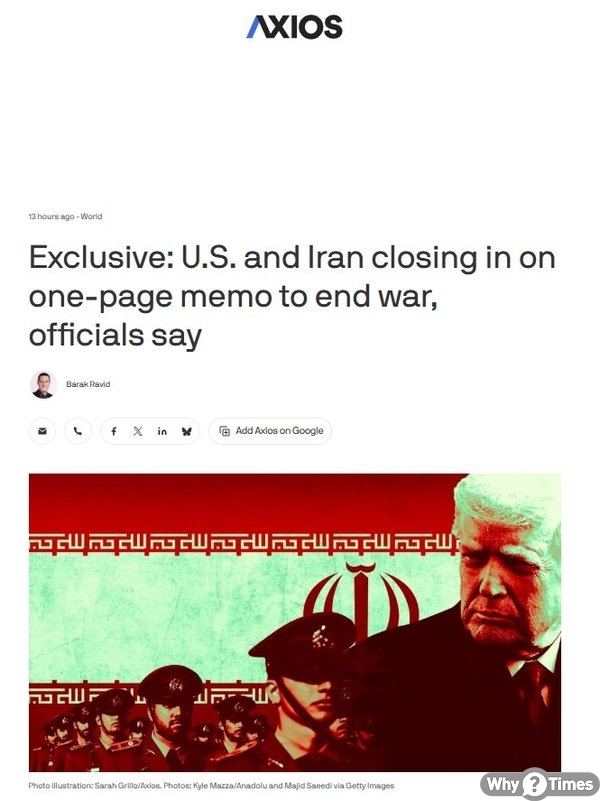
AXIOS, a U.S. internet media outlet, reported late on the 6th (Eastern Time): “The White House is close to signing a one-page memorandum of understanding with Iran to end the war and establish a framework for more detailed nuclear negotiations.” It added, “The U.S. expects responses from Iran on several key issues within the next 48 hours. While nothing has been agreed upon yet, sources say this is the closest the two sides have been to an agreement since the outbreak of the war.”
AXIOS further stated, “The agreement will include Iran stopping nuclear enrichment, the U.S. lifting sanctions and releasing billions of dollars in frozen Iranian funds, and both sides lifting restrictions on passage through the Strait of Hormuz.” However, it noted, “Since many conditions specified in the memo can only take effect once a final agreement is reached, there remains a possibility that the war could resume, or a long period of uncertainty could persist where the actual fighting stops but nothing is fully resolved.”
In relation to this, Reuters quoted a source from the Pakistani mediation side saying, “Negotiations will be finalized soon. It is close.” The source added, “The document is being drafted directly by President Trump’s close aides and special envoys, Steve Witkoff and Jared Kushner, together with Iranian officials.”
The structure of the agreement involves activating 30 days of intensive follow-up negotiations upon the signing of the MOU.
President Donald Trump, in an interview with PBS News, reaffirmed that “the U.S. directly taking over the approximately 408 kilograms (900 pounds) of highly enriched uranium possessed by Iran is a prerequisite for the agreement.”
Israeli media Channel 12 reported that “Iran is showing ‘surprising flexibility’ regarding the transfer of uranium stockpiles to a third country,” but stated that “the selection of a host country remains undecided.” Regarding this, Trump firmly stated, “If this issue is not resolved, there is no deal.”
The difference in positions between the U.S. and Iran regarding the nuclear enrichment period has narrowed significantly. From an initial framework where the U.S. demanded a 20-year moratorium and Iran counter-proposed a 5-year reprieve, negotiations are currently underway for a period between 12 and 15 years. After the expiration of the agreement period, only enrichment at the civilian level of 3.67% will be permitted, accompanied by an enhanced inspection system including snap inspections by the UN and a declaration to abandon nuclear weapons development. If Iran accepts these conditions, it would be no different from a declaration of surrender and would signify a rapid weakening of anti-American forces in the Middle East.
[U.S. Navy Disables Iranian Tanker Attempting to Breach Blockade]
While negotiations are progressing rapidly, a U.S. F/A-18 Super Hornet fighter jet opened fire on and disabled an Iranian oil tanker that was trying to break through the blockade of the Strait of Hormuz.
The New York Post reported on the 7th: “U.S. Central Command (CENTCOM) announced the previous day that it intercepted the Iranian-flagged oil tanker M/T Hasna as it attempted to sail toward an Iranian port in the Gulf of Oman.” It stated, “When the Hasna's crew failed to respond to repeated warnings, a U.S. Navy F/A-18 Super Hornet launched from the aircraft carrier USS Abraham Lincoln (CVN 72) fired several rounds from its 20mm cannon, neutralizing the ship's rudder.” It added, “The Hasna is no longer sailing toward Iran.” This engagement occurred just hours after President Trump publicly expressed his expectations for an end-of-war agreement.
What is noteworthy is that this destruction of the tanker occurred at a time when negotiations for ending the war were being exchanged between the two sides. Of course, the U.S. and Iran had also engaged in combat in the Strait of Hormuz two days prior. At that time, the U.S. military sank six Iranian fast attack craft patrolling the strait. Just one hour after the interception of the Hasna, CENTCOM announced, “Since the blockade took effect last month, the U.S. military has intercepted a total of 52 merchant ships and turned them back.” In response to Iran’s forced closure of the Strait of Hormuz, the U.S. has established a counter-blockade targeting Iranian ports, tightening the economic lifeline of Iran.
From this perspective, the tanker disabling incident is not a simple military engagement. It is an event that has imprinted on the world the fact that Iran’s blockade strategy—which has threatened the global economy by holding the Strait of Hormuz hostage—is useless against the overwhelming naval and air power of the United States. Having already intercepted 52 vessels and holding Iran’s economic lifeline, the U.S. is demonstrating through action that if Iran does not give up its nuclear weapons, even its remaining distribution networks will be decimated.
[Lebanon Clause and Missile Restrictions Omitted… Israel Shocked by Exclusion from Negotiations]
A point of interest in follow-up reporting by AXIOS is the inclusion of a clause in the MOU to “end the war in the entire region, including Lebanon.” Compared to the U.S.-Iran ceasefire agreed upon last month, which excluded Lebanon, this is a significant shift that could shake the existing framework where Israel has separated the front line with Hezbollah from negotiations with Iran.
It was also confirmed that the Israeli government was not notified in advance of the final progress of the negotiations. Israeli military radio reported that “an Israeli official said they were instead preparing for a worsening situation.” Prime Minister Netanyahu’s office immediately denied this, stating, “The Prime Minister was not blindsided and is in constant communication with Trump,” but the controversy over Israel being effectively excluded from the negotiation structure is not easily subsiding. Eyal Zamir, Chief of Staff of the Israel Defense Forces, stated that “units are maintaining a high state of alert, ready to return immediately to intensive and extensive operations.”
Israel is deeply concerned, above all, that the restriction clause for the range of Iran's ballistic missiles was omitted from this negotiation document. Israel's consistent position is that the means to guarantee substantial implementation are unclear, and that even if any clause is included, there is a lack of means to force Iran’s compliance. If Israel reacts strongly against the final agreement, the possibility that tensions on the Lebanon front will escalate again cannot be ruled out.
[Internal Confusion in Iran… IRGC Conciliatory Signals vs. Hardline Remarks from Parliament]
Within Iran, mixed signals of acceptance and rejection of the negotiations are emerging. The Islamic Revolutionary Guard Corps (IRGC) Navy released a conciliatory statement via social media X, saying, “Safe and sustainable navigation of the strait will become possible under the condition that the threats of the aggressors end and a new procedure is established.” This is interpreted as the first time the IRGC—which has emerged as the practical ruling entity in Iran following the assassination of Supreme Leader Khamenei—has hinted at the possibility of accepting the negotiations.
On the other hand, the Parliament is raising its hardline voice. Ebrahim Rezaei, spokesperson for the Parliamentary Foreign Affairs and Security Committee, said regarding the U.S. proposal, “It is nothing more than a U.S. wish list,” and asserted, “The U.S. cannot obtain through negotiations what they could not obtain through a war they are losing.” Speaker of the Parliament Ghalibaf also criticized, saying, “The enemies are trying to make us surrender through a naval blockade, economic pressure, and media manipulation.”
Meanwhile, Foreign Ministry spokesperson Esmaeil Baghaei officially confirmed that “Iran will deliver its final position through Pakistan as soon as it is finalized,” but openly expressed dissatisfaction with the U.S. pressure tactics, saying, “Negotiation is neither dictatorship, nor coercion, nor deception.”
[Trump Employs Carrot and Stick… “Agreement Possible Within One Week”]
In a telephone interview with Fox News that day, President Trump expressed cautious optimism that “an agreement is possible within a week.” On Truth Social, he stated, “If Iran implements the agreement, I will end the 'Epic Fury' military operation and fully lift the blockade of Hormuz,” but pressured them by saying, “If an agreement is not reached, bombing will resume, and it will be at a much more powerful level and intensity than before.”
While waiting for Iran's response, the diplomatic stage is moving busily. While Iranian Foreign Minister Araghchi visited Beijing and met with Chinese Foreign Minister Wang Yi, Wang expressed the position that “an immediate and total ceasefire is urgent, and the resumption of war is unacceptable.” French President Macron spoke directly with Iranian President Pezeshkian, urging an unconditional lifting of the blockade, and deployed the aircraft carrier Charles de Gaulle to the Red Sea, stating, “The UK-France joint escort task force is ready to be activated as soon as the agreement is signed.” President Trump is scheduled for a summit with China next week, making it highly likely that the Iran issue will emerge as a key agenda item.
Expectations for the negotiations were also reflected in the market. Brent crude fell 1.2% to $108.60 per barrel following reports of a possible agreement, and WTI futures also dropped 1.2% to trade at $101.06. This is a further decline following a 4% plunge the previous day, indicating that expectations for the reopening of Hormuz are spreading throughout the energy market.
The situation on this day—where the F/A-18's cannon fire and the draft of the 14-point MOU surfaced simultaneously—vividly revealed a cross-section of the U.S. strategy to pressure a settlement while maintaining military superiority. As the 48-hour countdown has begun, Iran's internal decision-making is becoming the final key to determining the direction of a historical agreement that will change the regional order.
Ultimately, the ball has been passed to Iran. In a situation where the 48-hour ultimatum clock is ticking, there is only one way for Iran to survive. It must realize that completely abandoning its nuclear program and returning as a normal member of the international community is the only path to preserving its collapsing regime.
The U.S. strategy also sends a powerful message to other rogue states like North Korea. This is because it reaffirms the principle that provocations will be met with overwhelming force, and that there will be no reward in negotiations without clear denuclearization. The time remaining for dictatorial regimes that threaten the world order does not seem to be very long.

- TAG