


추부길 whytimespen1@gmail.com
[China Mocks U.S. Sanctions, Supplying Parts to Iranian and Russian Drone Factories]
Despite strong U.S. export controls and financial sanctions, private companies under the Chinese Communist Party (CCP) are threatening international security by supplying large quantities of dual-use materials and core components necessary for the production of "suicide drones" in Iran and Russia. This highlights the stark vulnerability of non-proliferation policies in the era of drone warfare. It once again confirms that China stands behind the "Axis of Evil" nations, forcing a realization of the true nature of the CCP.
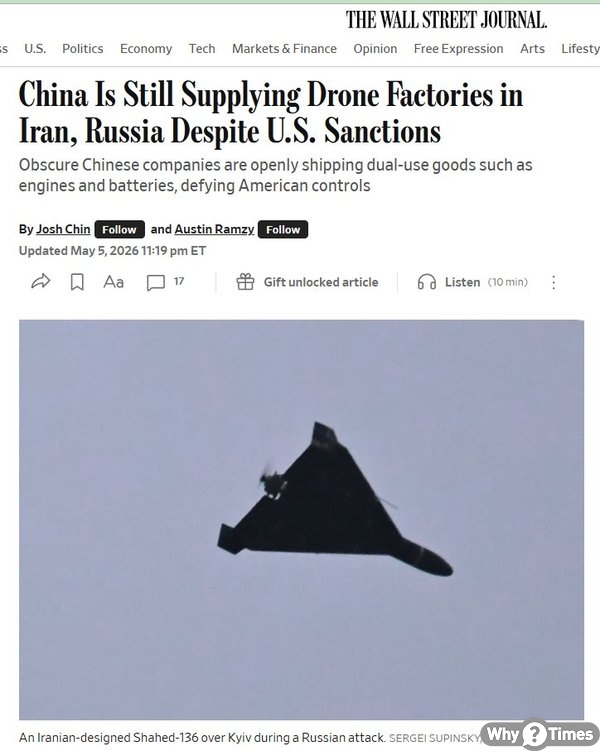
On May 6th, The Wall Street Journal (WSJ) reported, “Despite U.S. sanctions, China continues to supply drone parts to Iranian and Russian drone factories.” The report noted that obscure Chinese firms are openly exporting dual-use items like engines and batteries, ignoring U.S. controls.
According to the WSJ, on March 5th of this year—the very day the U.S. and Israel struck Iranian targets and Iran retaliated against Tel Aviv and U.S. bases in the Gulf—an email was sent from a server in China. The sender was a small Chinese firm named ‘Xiamen Victory Technology.’ The email expressed “shock and indignation at the aggression against Iran” and offered to sell German-designed engines used as power sources for one-way attack drones.
The engine in question is the German-designed Limbach L550, an item the U.S. has prohibited for sale to Iran and Russia. This engine is a core component of Iran’s flagship suicide drone, the Shahed-136, which Russia has also extensively utilized in the Ukraine war. The website of Victory Technology brazenly features images of Shahed-style drones alongside the slogan, “Innovation in Aero-Engine Solutions.”
[A New Non-proliferation Dilemma in the Age of Drone Warfare]
This incident symbolizes a new structural problem facing the U.S. For decades, non-proliferation policies focused on nuclear weapons and ballistic missiles—high-tech weapons of mass destruction that are relatively easy to track. Drones, however, present a different challenge. As low-tech, expendable weapons, they are assembled almost entirely from mundane components that circulate easily within global trade flows, evading detection.
Chinese customs data shows that firms are shipping containers filled with engines, computer chips, fiber-optic cables, and gyroscopes to Russia and Iran. While exporters previously falsified cargo documents to avoid sanctions, many firms no longer even bother with such efforts. Miad Maleki, a former senior official at the U.S. Treasury’s Office of Foreign Assets Control (OFAC), stated, “China has turned a blind eye despite this flow being repeatedly exposed... China has chosen not to care or intervene.”
In response, the Chinese Ministry of Foreign Affairs issued a statement claiming it consistently implements export controls on dual-use items. This is widely seen as the same evasive rhetoric the Chinese authorities use whenever they are in an embarrassing position.
[Traces of War Read Through Export Data and the CCP]
Chinese customs data reveals a startling correlation with specific battlefield developments. Exports of fiber-optic cables surged in the fall of 2024, immediately after Russia successfully used fiber-optic-controlled drones to counter Ukrainian jamming and retake parts of the Kursk region. Following a Ukrainian strike in April 2025 on Russia’s primary domestic fiber-optic supplier, Chinese exports to Russia climbed even more steeply.
Joseph Webster, a senior fellow at the Atlantic Council’s Global Energy Center, commented, “There is no other plausible explanation besides military purposes... This attitude from China is extremely blatant.”
The WSJ also noted that Russian imports of lithium-ion batteries spiked as the Russian military expanded production of battery-powered quadcopter drones. Similar patterns were observed in Iran following the 12-day war between Iran and Israel last July and August.
[Chinese Drone Parts Aiming at the Heart of the Enemy; Passive Observation is a Betrayal of the Free World]
It has been confirmed once again that China is providing a material foundation beyond a mere military alliance to the 'Axis of Evil.' The fact that parts like the Limbach L550 engine—already on U.S. sanction lists—are flowing into conflict zones with "Made in China" labels is a strategic connivance by China that directly threatens the security of the free democratic camp.
The recent case of Xiamen Victory Technology openly emailing Iran to sell engines under the guise of "anger over aggression" reveals the true face of the CCP. These companies mock sanctions, using their status as small firms that do not utilize the U.S. financial system as a shield. While the Chinese government claims to follow international obligations, it consistently "looks the other way" to strengthen anti-Western alliances and satisfy corporate greed.
Drones have completely changed the nature of modern warfare. A Shahed drone, which can be produced for $20,000 to $50,000, performs the role of a missile costing millions. If core components for these low-cost, high-efficiency systems are supplied limitlessly from China, Western precision weapon systems may struggle against such sheer volume. This is clearly a "proxy war" supported by China from behind the scenes.
The U.S. must now consider a comprehensive technological blockade of China as a whole, rather than just individual corporate sanctions. We cannot win a war of speed by tracking "ghost companies" that pop up in Hong Kong every other day. If the Chinese government cannot control the illegal outflow of dual-use materials from its own companies, it must be held nationally responsible.
The reality of Chinese parts sustaining the invasion of Ukraine and pouring oil on the Middle East powderkeg cannot be overlooked. This is a gathering of totalitarian forces intent on destroying the global order. China hides behind the excuse of "civilian use," but the "Made in China" stamps found in drone wreckage on the battlefield do not lie.
Ultimately, this issue touches the core of the U.S.-China hegemony struggle. If left unchecked, these technologies and materials will inevitably flow not only to Iran and Russia but also to North Korea, dealing a profound blow to the security of the Korean Peninsula. Strong pressure on China is the only way to sever the "drone connection" of these dictatorial regimes. Washington must move beyond the illusion of "pinpoint sanctions" and implement a wide-ranging secondary boycott that can deliver a real economic blow to China’s pervasive evasion network.

- TAG