


추부길 whytimespen1@gmail.com
[Oil Well All-Stop Imminent: Countdown to the Collapse of Iran’s Energy Economy]
As President Trump declared he would never lift the maritime blockade without Iran’s total abandonment of its nuclear program, Iran, trapped within the U.S. encirclement, faces its worst existential crisis since the establishment of the Islamic Republic. Its oil exports have collapsed by more than 75%, and its economic foundation is disintegrating in real-time. Amidst this, the U.S. Central Command (CENTCOM) announced that it has already finalized a "swift and decisive strike plan," stating that military options are ready for immediate execution.
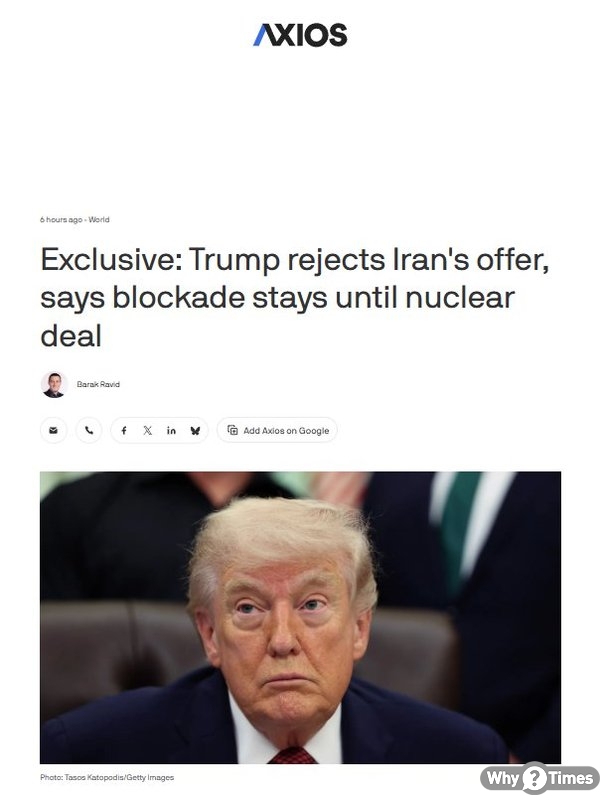
On the 30th, the U.S. internet media outlet AXIOS reported, “President Donald Trump has further ratcheted up the pressure by publicly rejecting a negotiation proposal for the reopening of the Strait of Hormuz delivered by Iran through Pakistan.” The report noted, “The core of Iran’s proposal was to first open the Strait of Hormuz and lift the U.S. blockade while postponing nuclear negotiations until after the cessation of hostilities. However, Trump decided to reject it based on the judgment that the moment nuclear issues are sidelined, the U.S.’s primary negotiating leverage could vanish entirely.”
AXIOS continued, “Regarding the effectiveness of the blockade, President Trump bluntly expressed, ‘A blockade is somewhat more effective than a bombing. They are suffocating like pigs. It’s going to get worse. They cannot have nuclear weapons.’ This expression is not mere rhetoric; Iran’s economic reality is rapidly approaching that description.”
In fact, the statistical analysis firm Kpler stated in its latest report, “Iran’s oil export volume has plummeted from an average of 2 million barrels per day to approximately 567,000 barrels since the U.S. maritime blockade began in earnest on April 13. This means more than 70% of exports evaporated in just two weeks. As exports are blocked, produced crude oil has nowhere to go, causing storage tanks to fill at an exponential rate.”
Regarding this, the Columbia University Center on Global Energy Policy (CGEP), citing satellite data, pointed out, “Between April 13 and April 21, Iran’s oil storage increased by more than 6 million barrels. Tanks at Kharg Island, the key hub handling about 90% of Iran’s crude exports, reached 74% saturation as of April 20. Generally, oil-producing countries maintain a principle of not exceeding 80% capacity for safety and operational flexibility.” In short, that limit is already right in front of them.
Homayoun Falakshahi, lead oil analyst at Kpler, explained, “Due to decades of underinvestment and poor field management, Iran’s oil sector has an average recovery rate of only 25%. Once a well is shut down, restarting it is extremely difficult and could cost millions of dollars to restore production to previous levels.” This is why the Trump administration views the blockade as a "slowly tightening noose." Bloomberg, citing Kpler’s analysis, warned that “if the blockade continues, Iran’s crude storage space could be completely exhausted within 12 to 22 days.”
In response, CNBC stated, “Given that over 90% of Iran’s exports pass through the Strait, the economic impact of the blockade has already crossed the threshold. In fact, Iran’s non-oil trade has also plummeted by 30% month-on-month and 50% year-on-year, and exports of steel and petrochemicals, which used to earn up to $20 billion annually, have been completely suspended.”
The outlook from the International Monetary Fund (IMF) is even harsher. The IMF predicted that “in 2026, the Iranian economy will contract by 6.1% and inflation will reach 68.9%.” The value of the Iranian Rial has crashed to approximately 1.32 million Rial per dollar, and the Governor of the Central Bank of Iran has urged the President to take emergency measures for economic stability and pursue peace negotiations. Local media reports also indicated that senior Iranian economic officials warned the President that it could take more than a decade to recover the economy devastated by the conflict.
[‘Operation Economic Fury’ and Financial Severance: Dual Pressure Beyond the Blockade]
The Trump administration went a step further than the maritime blockade by simultaneously launching operations targeting Iran’s financial arteries. The U.S. Treasury’s Office of Foreign Assets Control (OFAC) imposed additional sanctions on 35 individuals and entities involved in "shadow banking" that facilitated tens of billions of dollars in remittances linked to the Islamic Revolutionary Guard Corps (IRGC). This measure, known as ‘Operation Economic Fury,’ focuses on systematically weakening the Iranian government’s ability to procure, move, and transfer funds.
Due to secondary sanctions, Western companies are entirely avoiding transactions with Iran, as U.S. sanctions can also apply to third-country companies or individuals doing business with Iran. This is effectively isolating Iran from the international economic system. Experts analyze that while China and Russia may seek to support the construction of a ‘resistance economy,’ these two major trading partners show little will to actively move toward rescuing Iran.
[CENTCOM Strike Plan Finalized: Military Options Placed on the Negotiation Table]
In addition to economic pressure, military tension has surfaced. AXIOS reported, “The U.S. Central Command (CENTCOM) has already completed a ‘short and powerful’ wave-strike plan targeting Iran aimed at breaking the negotiation deadlock. The concept is to strike major infrastructure facilities and then recall Iran to the negotiating table to elicit a more flexible stance.”
AXIOS noted, “While Trump himself refrained from mentioning military plans, the temperature of the intimidation is rising. Trump targeted Iran directly by posting an AI-synthesized image of himself holding a gun on social media with the caption ‘NO MORE MR. NICE GUY.’” Secretary of Defense Pete Hegseth also declared in a press conference, “The blockade will continue for as long as necessary, as long as the President decides.”
[Failure of the Second Round: Successive Collapse of Diplomatic Channels]
The reason military options are emerging is the successive breakdown of diplomatic channels. The possibility of a second round of negotiations vanished as Trump abruptly canceled the schedule for envoys Kushner and Witkoff to meet with the Iranian side in Pakistan. This follows a previous failure where Kushner, Witkoff, and Vice President Vance returned without an agreement after 21 hours of negotiations in Islamabad.
The structural obstacles to the negotiations are also clear. During the process, the U.S. demanded the total destruction of Iran’s core facilities—Fordow, Natanz, and Isfahan—and the transfer of all remaining enriched uranium to the U.S., which Iran flatly rejected. Furthermore, the structural issue of Iran’s actual top authority, Supreme Leader Mojtaba Khamenei, not personally appearing at the negotiation table remains unresolved.
[Internal Fractures: Dilemma of Protests and Regime Survival]
The crisis Iran faces is not limited to external military and economic pressure. Internal fronts, such as fractures within the regime and public alienation, are opening simultaneously, leaving the Iranian leadership besieged from all sides.
The anti-government protests that began on December 28 last year spread to more than 200 cities, recorded as the largest popular uprising since the 1979 Islamic Revolution. According to the Ministry of Interior’s own estimates, tens of thousands of protesters reportedly lost their lives during the crackdown in just 48 hours on January 8. Protests by citizens enraged by the economic collapse have evolved into a challenge against the Islamic Republic system itself.
An analysis report from the British House of Commons pointed out, “To survive, the Iranian regime must at least resolve the economic grievances that triggered the protests,” noting that the Iranian regime is heading toward a “slow collapse.”
[“Surrender and Quit”... What is Iran’s Decision After Trump’s Ultimatum?]
President Trump’s remarks about ‘Iran being in a state of national collapse’ are not a bluff. A point to note in this process is the pressure effect on China, Iran’s largest customer. By thoroughly blocking ships entering or leaving Iranian ports, the U.S. has cut off the flow of black money to China—a very clever strategy in terms of expanding the anti-China front. China’s energy security has been hit, and Iran no longer has the capacity to hold out with China as its backer.
Some worry about rising oil prices, but President Trump, even ahead of the November midterm elections, is showing strong will, stating he is "prepared for a long game." This is an expression of conservative determination to uproot the fundamental evil of the nuclear threat, even at the cost of short-term economic loss. It is an implementation of the historical lesson that weak appeasement actually invites war.
Iran’s plea to “discuss the nuclear issue later and lift the blockade first” is proof of how painful the U.S. sanctions are. However, the Trump administration has drawn a firm line against such ‘selective negotiations.’ The stance of not opening the gates without a definitive guarantee of a halt to nuclear enrichment for more than 20 years serves as a powerful warning to other rogue states like North Korea.
From a conservative perspective, this maritime blockade is not a process of begging for peace but of achieving it through strength. Iran’s economic capitulation will serve as a decisive opportunity to reorganize the pro-U.S. order in the Middle East and cut off the source of terrorist funding. The arrogance of the Islamic fundamentalist regime is kneeling before the overwhelming naval power and economic dominance of the United States.
Ultimately, the Iranian leadership has one of two paths to choose. Either completely abandon nuclear weapons and return as a normal member of the international community, or walk the path of regime downfall alongside economic collapse. President Trump has already alluded to the latter possibility, implying that the end of the Iranian regime is not far off.
The current Iranian crisis is the inevitable result brought upon itself by a dictatorial regime clinging to the vain delusion of nuclear weapons. The U.S. maritime blockade is not a simple blockade, but a precise surgery to excise a cancerous entity that threatens global security. Now that Iran is expressing ‘desperation’ is the optimal timing to lead them toward perfect denuclearization.
We are witnessing in real-time how America’s resolute leadership rights the world order. Iran’s crisis of collapse is evidence that liberal democratic values and realist diplomacy are prevailing, and it is time for South Korea to also reaffirm the value of a solid ROK-U.S. alliance amidst this flow of international affairs.

- TAG