


추부길 whytimespen1@gmail.com
[UAE Formally Announces OPEC Withdrawal: A Paradigm Shift in Global Energy Hegemony]
The United Arab Emirates (UAE) will officially withdraw from the Organization of the Petroleum Exporting Countries (OPEC) effective May 1. Amidst a shifting Middle Eastern energy order fueled by conflict with Iran, the departure of the world’s third-largest oil producer deals a critical blow to the cartel’s cohesion. As the third-largest producer within OPEC following Saudi Arabia and Iraq, the UAE's exit signals a structural transformation in the international oil market. This move is interpreted as a clear manifestation of the UAE’s intent to pursue an independent diplomatic and economic path amidst the rapidly evolving regional landscape.
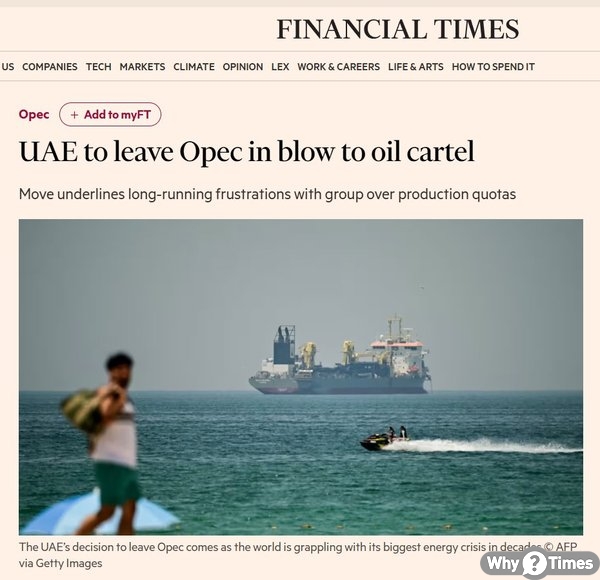
On the 29th, the Financial Times (FT) reported, "The UAE finalized its withdrawal from OPEC via a statement from the Ministry of Energy and Infrastructure, effective May 1." The report noted that while no direct reason was provided, the decision is analyzed as a complex result of damage to energy infrastructure caused by Iran and the blockade of the Strait of Hormuz, policy friction with Saudi Arabia, and a desire for an independent long-term energy strategy.
The UAE has held a pivotal position in the Middle Eastern crude oil supply chain. However, as the conflict between the U.S./Israel and Iran intensified, the UAE’s oil infrastructure suffered direct hits. Drone attacks by Iran—a fellow OPEC member—damaged several facilities, and the repeated blockade of the Strait of Hormuz, a strategic chokepoint through which approximately 20% of the world's maritime crude oil passes, caused severe disruptions to exports, placing immense pressure on the UAE economy.
This unprecedented decision by the UAE, a core member for nearly 60 years since joining in 1967, comes at a time of high volatility in global energy supply chains. Beyond a simple exit, this withdrawal possesses the potential to dismantle the very solidarity of the cartel.
["OPEC is Structurally Weakening": Experts Sound the Alarm]
Energy experts warn that while the immediate impact might be contained, the UAE's exit will structurally undermine OPEC’s market control over the long term. Jorge Leon, an analyst at Rystad Energy, stated, "The short-term impact may be limited, but in the long run, it results in a structurally weaker OPEC." He added that a UAE outside of OPEC will have both the incentive and the capacity to expand production, raising questions about the sustainability of Saudi Arabia’s role as a "market balancer" and increasing price volatility.
Sergey Vakulenko, a former Gazprom Neft executive, suggested the timing is optimal: "With oil prices already high due to the war with Iran, the shock of the withdrawal is buffered." He emphasized that "OPEC becomes significantly weaker without the UAE. Iran and Iraq lack substantial spare capacity, a role that has been largely shared by the UAE and Saudi Arabia."
Michael Brown, Senior Research Strategist at Pepperstone, noted, "The most surprising aspect is the timing." He pointed out that with the Strait of Hormuz effectively impassable, the primary issue in the oil market is currently transportation and logistics rather than just production volume.
[How to Interpret the UAE’s Departure from OPEC?]
The UAE’s withdrawal is a symbolic event demonstrating a complete reorganization of the Middle Eastern geopolitical order. While the surface causes include infrastructure damage and the economic blow from the Hormuz blockade, the underlying motivation is a powerful resolve to break away from the Saudi-led energy monopoly.
From a pragmatic and reformist perspective, the UAE’s decision is highly realistic. For years, the UAE has been unable to fully utilize its production capacity due to Saudi-led production cuts. Friction with Saudi Crown Prince Mohammed bin Salman, who has aggressively pursued foreign investment in direct competition with the UAE's status as a financial and logistics hub, had already created cracks in their economic partnership.
The decisive catalyst was the hostile actions of Iran, a fellow OPEC member. Under attack by Iranian drones, the UAE likely found it untenable to remain in the same "economic tent" as its aggressor while being forced to limit production. This signifies that the pro-Western, anti-Iranian UAE can no longer share an economic destiny with a threat to its national security.
From the perspective of the United States, the UAE’s independence is a positive signal. If the UAE increases supply outside the cartel, it could contribute to market stabilization at a time when energy security is jeopardized by the war.
Ultimately, OPEC’s ability to regulate the market is bound to weaken. The departure of one of its two main pillars marks the beginning of the end for the old-fashioned resource cartel, giving way to market competition and supply-demand principles. The UAE’s 59-year exit proves that Middle Eastern nations are now moving based on national interest and security rather than religious or ideological solidarity. This event serves as a turning point toward a new balance of power in the Middle East.

- TAG