


추부길 whytimespen1@gmail.com
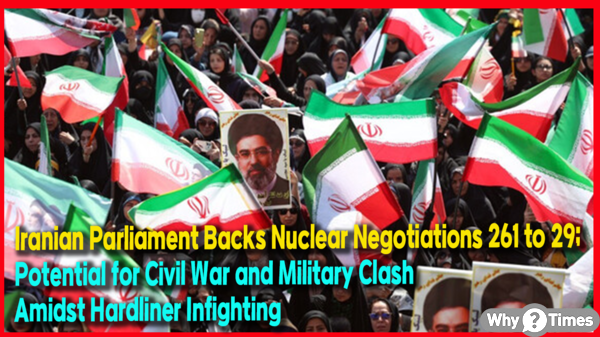
[Hardliner Rebellion — Branding Chief Negotiator Ghalibaf a "Traitor"]
As Iran’s nuclear negotiations with the United States face a crisis of replacing its chief representative due to fierce backlash from domestic hardliners, the very search for a peaceful solution through the negotiating table is being fundamentally shaken. Despite the overwhelming majority in the Iranian Parliament supporting the negotiations, hardliners have gone as far as blocking the delegation's path to Pakistan, causing ominous sounds of rupture within the core of power regarding Iran’s next leadership. Furthermore, the public sentiment, which has reached a breaking point due to economic collapse, is combining with the bloated influence of the military, raising the possibility of a national civil war.
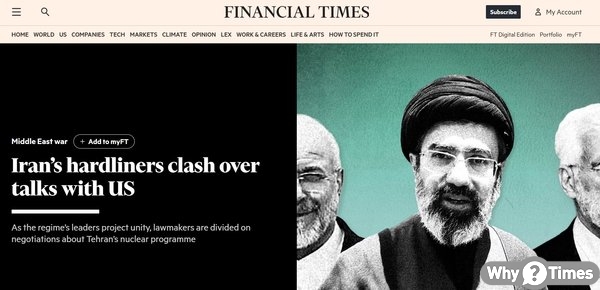
The British Financial Times (FT) reported on the 29th, “The Iranian political landscape has been swept into a maelstrom following reports that Mohammad Bagher Ghalibaf, the Speaker of the Iranian Parliament and chief negotiator for nuclear talks with the U.S., has resigned from his post.” The FT added, “It is reported that Ghalibaf was forced to resign after provoking strong internal pushback within Iranian political circles by attempting to include the nuclear issue on the agenda for talks with Washington.”
The FT continued, “At the heart of this conflict is the ultra-hardline faction Paydari (Stability Front),” noting that “Mahmoud Nabavian, a lawmaker belonging to Paydari, launched a frontal assault on Ghalibaf within the parliament and across state media.”
In fact, Nabavian claimed to local media that “negotiations are now nothing but pure harm, and no one should engage in them,” defining the act of putting the nuclear program on the negotiating table as a “strategic mistake.” He further hinted that such actions “did not properly follow the policies of the new Supreme Leader, Mojtaba Khamenei.” Hardline politician Ali Khezrian also appeared on state TV, claiming that “the Supreme Leader opposes the continuation of negotiations.”
The Paydari offensive did not stop at mere commentary. On domestic social media platforms such as 'Eitaa,' accusations of Ghalibaf being a 'traitor' flooded in, and some even argued that the Revolutionary Guard (IRGC) should intervene to stop Ghalibaf's 'betrayal.' State-run TV amplified these hardline voices through nightly broadcasts, repeatedly airing rallies calling for the continuation of war until 'final victory.'
Undeterred by such criticism, Ghalibaf appeared in a solo interview on state TV to persuade the hardliners. He defined diplomacy as “not a retreat or a departure from Iran’s demands, but rather a means to consolidate military achievements and transform them into political results and lasting peace.” He also declared that for him, “there is no distinction between the battlefield and the negotiating table, and he is prepared to sacrifice everything.”
The first round of negotiations, held in Islamabad, Pakistan, in early April, was attended by a large delegation of over 70 people, including Ghalibaf, Foreign Minister Araghchi, the Governor of the Central Bank, and the Secretary of the Defense Committee. The inclusion of Nabavian, a hardline lawmaker who has consistently opposed negotiations with the West, is analyzed as a strategic move to broadly share political responsibility for the outcome and block future criticism from the hardline faction.
[The Rise of Jalili — A Signal for a Shift Toward a Hardline Stance]
Iran International, based in the UK, reported on the 24th that “Saeed Jalili (60), known to lead a 'shadow government,' is expected to take over the role of chief negotiator as Ghalibaf’s successor.” Jalili served as Iran’s chief nuclear negotiator during the presidency of Mahmoud Ahmadinejad from 2007 to 2013 and is the practical leader of Paydari. During President Hassan Rouhani’s term, he organized and operated a 'shadow government' opposing the nuclear deal (JCPOA).
Ali Safavi of the National Council of Resistance of Iran (NCRI) told Fox News Digital that “Jalili has evolved from a nuclear negotiator into an influential actor within the system.” Jalili’s emergence signifies that the negotiations may strengthen in a direction that weighs resistance over compromise. Indeed, on April 7, he posted on his X account that “the 'infrastructure' of the ruling structure and the American-style order is on the verge of collapse, after which a better foundation will be built.”
The backdrop to this amplification of internal conflict in Iran is the public disappearance of the new Supreme Leader, Mojtaba Khamenei. Mojtaba has ceased public appearances since February 28, when U.S. and Israeli airstrikes began. It is reported that this is related to injuries he sustained during the airstrike that killed his father, the former Supreme Leader Ali Khamenei.
Under the previous system of Ali Khamenei, ultra-hardline factions could pour out hardline remarks and attack moderates publicly, but he personally enforced discipline when necessary. Even during the 2015 nuclear deal, once it became known that he had given at least implicit approval, then-Speaker Ali Larijani passed it through parliament in just a few minutes, silencing opposition. However, it is currently unclear who is truly leading Iran—whether it is one person or a fluid collective system.
The so-called 'red lines' put forward by hardliners are being justified by selectively interpreting messages released by Mojtaba on April 9, citing past remarks by Ali Khamenei opposing negotiations, or quoting anonymous 'reliable sources.' Amir-Hossein Sabeti, a lawmaker from Paydari, claimed on X that he has “the most certain information that negotiations with the U.S. regarding the nuclear issue have been banned,” demanding that Ghalibaf and Foreign Minister Araghchi publicly deny reports concerning the suspension or dilution of uranium enrichment.
[Splits Within the IRGC — "Continue War" vs. "Negotiations Needed"]
Iran International stated, “Cracks are also being detected within the Revolutionary Guard,” and reported that “the faction centered around IRGC Commander Ahmad Vahidi and SNSC Secretary Mohammad Bagher Zolghadr is widely described by internal observers as supporting the continuation of the war.”
The outlet continued, “On the other hand, the Ghalibaf-aligned group is said to maintain influence within the IRGC's aerospace sector,” analyzing that “while the two factions share the goal of defending the Islamic Republic system, they are clashing over the strategic direction of how to achieve it.”
This conflict was also expressed within the Iranian Parliament. The FT pointed out, “On the 27th, 261 out of 290 members of parliament issued a statement supporting Ghalibaf and other negotiators, but key figures of Paydari were missing from the list of signatories.” Ultimately, while 90% of the lawmakers in Iran support negotiations with the U.S., the current reality of Iran is that hardliners are obstructing the progress of negotiations with physical force.
In the end, the greatest element of instability currently enveloping Iran is Mojtaba Khamenei’s loss of actual control. The absence of leadership, failing to appear before the public since the airstrikes, has amplified doubts over 'who is the final decision-maker.' This 'power vacuum' is moving beyond typical political conflict and increasing the possibility of a physical clash between the Revolutionary Guard (IRGC), the core pillar of regime defense, and the bureaucratic group advocating pragmatism.
Experts diagnose the current situation as the most dangerous period since the 1979 Islamic Revolution. For ultra-hardline forces like the Paydari faction to publicly criticize the Speaker of the Parliament over negotiations that determine the nation's fate is an act of insubordination that would have been unimaginable during Ali Khamenei's lifetime. This means that the upper echelons of power, now without a mediator, have begun to seek their own paths of survival, leading to consecutive warnings that 'armed occupations' or 'coups' between forces holding military power could occur.
The real reason the internal political strife is dangerous is that it is intertwined with the exhausted public sentiment. The plunge in the value of the Rial and murderous inflation that began in late 2025 have once again covered all 31 provinces of Iran in a wave of protests. In particular, the fact that even the Tehran Bazaar merchants—traditionally strong allies of the regime—have joined the protests shows that the foundation of the system is shaking.
The protesters' slogan, “What we need now is bread, not missiles,” symbolizes how disconnected the political bickering over U.S. negotiations is from the people's lives. Analysis suggests that if the internal strife among the leadership is prolonged and administrative functions become paralyzed, the suppressed anger of the masses could lead to a nationwide armed uprising. Especially if separatist movements in ethnic minority border areas join in, Iran could fall into an uncontrollable vortex of civil war.
[The Bloated Revolutionary Guard: A Double-Edged Sword]
The actions of the Revolutionary Guard, which has become deeply involved in politics and the economy through the state of war, are also a detonator for civil war. They are more than just a military organization; they are a massive corporate conglomerate controlling over 50% of the Iranian economy. Fears are being raised that if sanctions are lifted and markets open through negotiations with the U.S., hardliners within the Guard—concerned that their monopoly interests will be infringed upon—may resort to internal purges or military action to neutralize diplomatic solutions.
According to foreign media reports such as Alhurra, all strategic decisions in Iran are currently passing through the hands of Revolutionary Guard commanders rather than the Foreign Ministry. If the military completely escapes the control of the civilian government and takes an independent path, it will inevitably lead to a frontal collision with the existing political order. The subtle rivalry between the regular army and the Revolutionary Guard is also a potential powder keg that could explode during this period of chaos.
Because of this situation, the U.S. and Israel are closely monitoring the possibility of a civil war in Iran. This is because if Iran falls into an uncontrollable state of chaos, global disasters such as the leakage of nuclear material or the rise of terrorist groups could occur. President Donald Trump’s comment that “we don’t know who is in power” is interpreted not simply as an attempt to disparage Iran, but as a strategic judgment that the Iranian government, as a negotiating partner, has already begun to collapse.
In the end, bleak forecasts suggest that Iran will walk one of three paths: ▲ a palace coup by hardliners within the leadership, ▲ a civil war resulting from a popular uprising and military suppression, or ▲ territorial fragmentation due to ethnic minority insurgencies. The possibility of a peaceful transfer of power or a rational negotiation settlement is becoming increasingly slim due to the deep internal fissures, and the Iranian people are facing the fear of a 'civil war more terrifying than war itself.'
- TAG