


추부길 whytimespen1@gmail.com
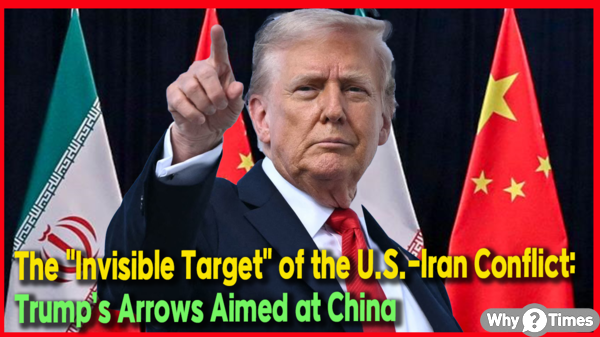
[Hudson Institute: "Operation Epic Fury, an Action to Neutralize China's Strategic Assets"]
While the military clash between the U.S. and Iran has entered a lull, analysis is gaining ground that the ultimate goal of this conflict goes beyond deterring Iranian military power, aiming instead at the strategic isolation and economic debilitation of China. As the U.S. and Iran maintain a precarious truce, geopolitical experts are turning their gaze toward China to determine the ultimate beneficiary or victim of this dispute.
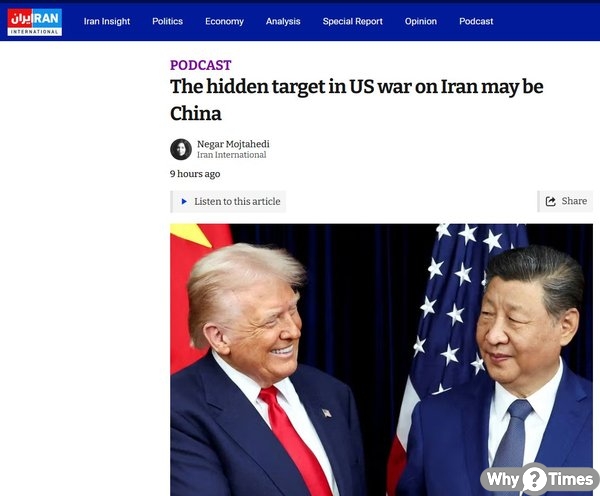
On the 27th, UK-based Iran International reported that Zineb Riboua, a researcher at the Hudson Institute specializing in Chinese influence in the Middle East and North Africa, identified the essence of the situation. Riboua supports the view that Operation Epic Fury, conducted by the U.S. and Israel, is designed to weaken China. She emphasized that while the Trump administration may not explicitly state it, this remains a crucial dimension of the operation.
In an interview with Eye for Iran, Riboua noted that Chinese President Xi Jinping’s unusually direct involvement reflects Beijing’s embarrassment. "Xi publicly called for the immediate reopening of the Strait of Hormuz and a swift ceasefire this week," she pointed out. Given China’s history of restrained public commentary despite its energy dependence on the Gulf, this is an exceptional move.
Riboua interpreted Xi’s remarks as an exposure of Beijing’s anxiety and a revelation of China’s limited leverage over Tehran. She noted that while Xi has long operated on the assumption of U.S. decline, this operation proves the opposite, demonstrating that Washington is effectively disrupting a status quo that previously favored China.
With 45–50% of China’s crude oil imports and 30% of its LNG passing through the Strait of Hormuz, the Chinese economy is the most direct victim of any blockade. When the U.S. implemented a counter-blockade, two China-bound tankers were forced to turn back—a scene illustrating that the U.S.-China conflict is manifesting on the physical energy supply chain, not just the diplomatic stage.
[Iran as China’s "Triple Strategic Asset"]
Riboua’s emphasis on the Chinese context is rooted in three core interests China derives from Iran:
Energy: 90% of Iran’s oil exports go to China at a discount of $8–$10 per barrel. As the world’s largest oil importer, China relies heavily on this cheap Iranian crude. This partnership is formalized through a 25-year strategic agreement, with Chinese tech giants like Huawei and ZTE building Iran’s surveillance and telecom infrastructure—essentially providing Tehran with tools to control domestic resistance, akin to China’s "Great Firewall."
"Laboratory" for Sanctions Evasion: Iran has served as a testing ground for China. Through ghost companies, ship-to-ship transfers, and alternative payment channels, China has accumulated "know-how" in bypassing Western sanctions—a dress rehearsal for if China itself becomes a target of similar measures.
Geopolitical Foothold: Beijing has spent two decades co-opting Gulf states and Iranian proxies to build a forward base for a "New World Order," with the strategic goal of exhausting the U.S. and forcing its exit from the Middle East.
[The Hormuz Card: Backfiring on an Ally]
Ironically, Iran’s attempt to weaponize the Strait of Hormuz has dealt a critical blow to its primary ally, China. While Tehran aimed to pressure President Trump, it inadvertently struck Beijing. Edward Fishman of the Council on Foreign Relations (CFR) warned that a U.S. blockade of Chinese vessels could drag China directly into the conflict. If transport and insurance costs skyrocket, the cost structure supporting China’s manufacturing competitiveness will be fundamentally shaken.
[To the Pacific via Tehran: The Hidden Front]
The Hudson Institute argues that viewing Operation Epic Fury solely as a punishment for terrorism misses the point. By striking Iran, the U.S. is dismantling a "structural asset" Beijing spent billions to build.
Riboua praised Trump as "the only president who understands that the road to the Pacific runs through Tehran." In this light, Operation Epic Fury is not a local tactical move but a long-term strategic gambit to dismantle China’s Middle Eastern influence and secure the high ground in the Indo-Pacific hegemony race.
[The Taiwan Invasion Scenario and the Middle East Trap]
From a strategic standpoint, Iran's actions have become a self-inflicted wound for China. China’s "perfect scenario" for a Taiwan invasion would involve the U.S. being permanently bogged down in a Middle Eastern quagmire. Operation Epic Fury serves to neutralize this "trap," cutting off Chinese influence and ensuring U.S. strategic flexibility.
[Tehran Mired in Internal Strife: Trump’s Psychological Warfare]
Meanwhile, President Trump is escalating psychological warfare by targeting divisions within the Iranian leadership. Trump claimed via social media that the Iranian leadership is in disarray, suffering from infighting between defeated hardliners and ambiguous moderates.
Though President Pezeshkian and other officials have scrambled to project a united front, rumors of resignations (such as Speaker Ghalibaf) and IRGC intervention suggest that the internal cracks are widening. Analysts view Trump’s rhetoric as a sophisticated effort to break the adversary’s cohesion, ensuring a total victory in future negotiations. While the clouds of war hang over the Middle East, Washington’s sights are firmly set on the heart of Beijing.

- TAG