


추부길 whytimespen1@gmail.com
[Iran Pushed to the Brink, Returns to Negotiations Amid U.S. Indifference]
Despite previously walking away from the negotiating table in defiance of U.S. "Maximum Pressure," Iran has made a sudden return to Pakistan. Tehran initially calculated that rejecting dialogue would cause Washington to panic, allowing Iran to seize the initiative. However, reality has proven this to be a massive miscalculation, and it is now Iran that is showing signs of desperation. Conversely, President Donald Trump has expressed no hurry, stating he has no intention of sending a negotiation team to Islamabad for the time being, a stance that has left Tehran visibly flustered.
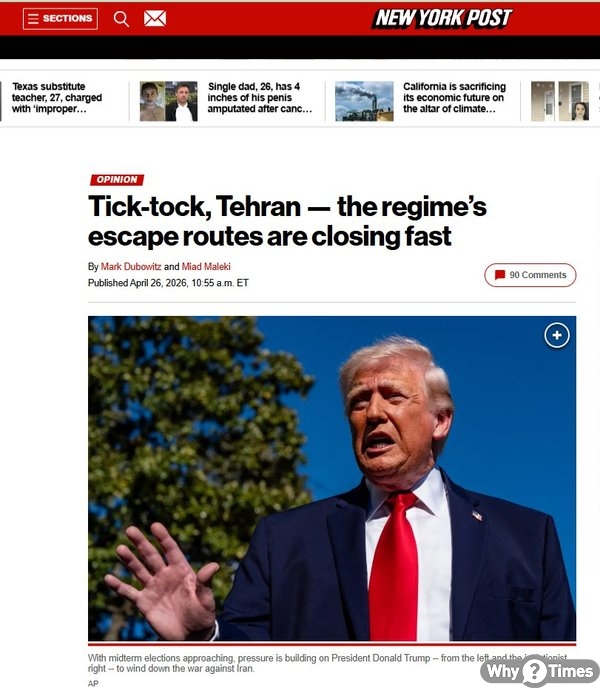
On the 27th, the NY Post reported, "The Islamic Republic of Iran is under immense pressure due to the U.S. blockade of the Strait of Hormuz and is reeling from the devastating impact of Operation Epic Fury." The report continued, "Tehran judged that domestic pressure within the U.S. to end the war might make President Trump impatient, but this was a monumental delusion. It is becoming clear that time is on America's side."
The NY Post further noted that hundreds of high-ranking Iranian commanders and officials have been killed in the joint U.S.-Israeli operation. Iran’s nuclear infrastructure, air defense networks, ballistic missile programs, and naval and defense industries have all been severely weakened. "In this climate, the economic blow could bring even more dangerous consequences for the regime, leaving Iran in a state of high anxiety," the report added.
A critical factor in Iran’s current crisis is the complete cutoff of oil revenue due to the U.S. coastal blockade. The NY Post pointed out that "at least one-third of Iran’s oil revenue is used for military salaries and operational costs. With that funding channel completely blocked, Iran’s lifeline is drying up." Without these funds, Iran’s ability to endure is rapidly evaporating.
Tehran will soon face a difficult question: Is continuing a war against the world's most powerful military forces worth the risk of total national ruin?
[The "Trump Will Yield First" Fallacy: A Tragic Conclusion]
Both the U.S. and Iran are currently holding their ground, each convinced that "time is on our side." The U.S. strategy is to slowly suffocate the Iranian economy via maritime blockade, while IRGC hardliners calculate that the U.S. midterm elections and anti-war sentiment will drag Trump back to the table first. However, Iran’s logic is layered with delusions that reality will not permit. It appears Tehran may have fallen victim to the provocative narratives of anti-Trump media, leading the nation into a state of chaos.
Regarding this, the Financial Times (FT) delivered a sharp critique: "Iran made a simple calculation that U.S. political pressure would reach its limit before Iran's economic pain did, but a fatal error is hidden within this assumption."
Delusion 1: "Trump will cave because of the midterm elections."
The Iranian hardliners' core bet targets Trump’s political vulnerability. They believe that ahead of the November midterms, soaring oil prices and anti-war public opinion will erode GOP support, forcing Trump to concede. While Trump’s approval rating on the Iran issue has indeed dropped to 32%, this logic misreads his political nature. Trump publicly countered this by saying, "It is not true that I want to end this quickly because of the midterms; we have plenty of time." For Trump, yielding without achievement would be a worse political disaster than continuing the blockade.
Delusion 2: "We are hardened by old sanctions and can withstand the blockade."
Hardliners possess an unfounded confidence based on past experiences. However, the current blockade is different. Unlike previous sanctions that left "breathing room" through China or Russia, the current naval blockade shuts down the entire southern coast. Furthermore, Gulf nations like the UAE have turned their backs on Iran. Analysts warn that the blockade could cut off 70% of Iran’s export income, causing an "acute shock" far more severe than the "slow bleeding" of the past.
Delusion 3: "The nuclear program is not a subject for negotiation."
Hardliners believe they can exclude the nuclear issue from talks. However, the very justification for this U.S. military action is the removal of the Iranian nuclear threat. If Trump lifts the blockade without addressing the nuclear program, he would be viewed domestically as having "lost the war." By refusing to even discuss the nuclear issue, Iran is effectively closing the door on any potential deal.
Delusion 4: "The Revolutionary Guard (IRGC) is winning the war."
Tehran's self-assessment that they have successfully deterred the U.S. and Israel is a military distortion. Iran’s ballistic missile launches have plummeted by 90%, from over 400 on day one to just 20–40 per day. Israel has destroyed 70% of Iran’s launchers, and the U.S. has neutralized two-thirds of its weapon-making capacity. Their current tactics are merely a way to "buy time," not a path to strategic victory.
Delusion 5: "As long as the economic machine doesn't stop, we survive."
The goal of the regime has been reduced from regional dominance to mere survival. However, survival has a deadline. With land-based oil storage nearly full, Iran may soon have to shut down its own oil wells, causing permanent damage to its infrastructure. If the blockade tightens, inflation could soar to 180%, and unemployment could rise by another 2 million.
[In a Game of Chicken, Iran Must Be the One to Swerve]
The U.S.-Iran deadlock is a "Game of Chicken" where both drivers are charging at each other. Iran believes the U.S. will swerve first, but the asymmetry is too great. The U.S. has a narrative that allows it to hold out politically, whereas Iran’s national finances will hit a breaking point if the blockade continues.
History offers a lesson: In 1988, Ayatollah Khomeini declared he was "drinking from a poisoned chalice" to end the war with Iraq only after the economy and military reached their limits. Today, the IRGC hardliners refuse the chalice, waiting for the U.S. to kneel. However, all objective data points to one conclusion: as time passes, it is Iran whose options are narrowing.

- TAG