


추부길 whytimespen1@gmail.com
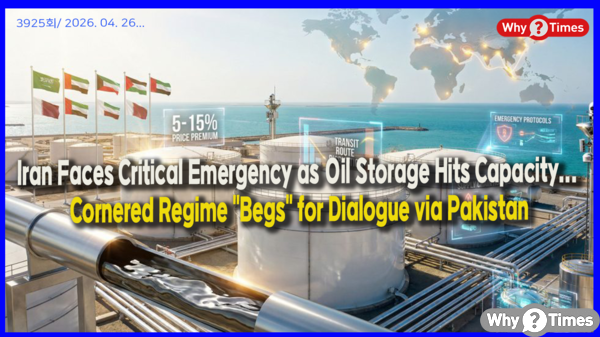
1. Iran’s Crude Storage Reaches Limits: On the Brink of Collapse
Due to the powerful U.S. maritime blockade, storage capacity at Kharg Island—Iran's primary oil export hub—has reached its limit, threatening to completely sever the regime’s economic lifeline. In a desperate move, Iran has mobilized 30-year-old decommissioned tankers to temporarily store overflowing crude. However, this "stop-gap" measure has already exposed its limitations, suggesting that the regime has entered a final countdown toward economic collapse. Consequently, Iran has reached out to Pakistan to facilitate dialogue with the United States.
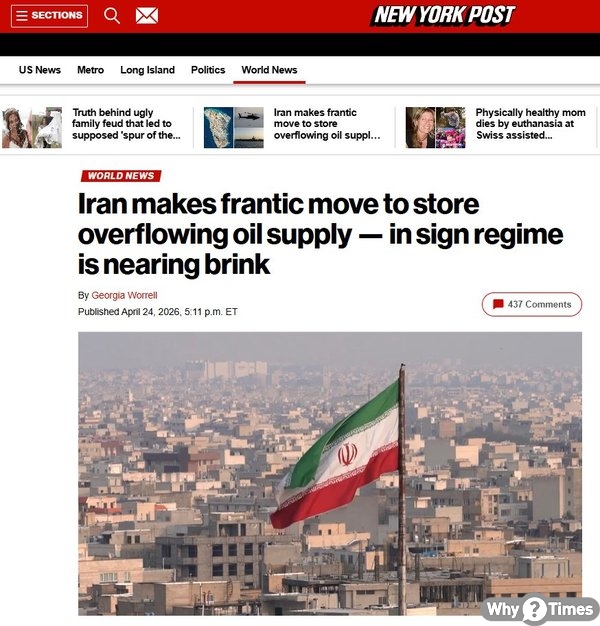
According to the NY Post (April 25), the Iranian regime is taking desperate measures to resolve an oversupply crisis as its storage facilities reach full capacity. The report noted that the maritime blockade led by President Donald Trump has pushed Kharg Island, which handles 90% of Iran’s exports, to the edge. Authorities have even recommissioned the retired tanker 'Nasha' to serve as a "floating storage unit" (FSU). Experts estimate that the remaining space at Kharg Island will be filled within 12 to 13 days, with approximately 1 million barrels of daily net inflow currently trapped with no export route.
The NY Post further warned that this storage glut is not merely a logistical hurdle but a precursor to national economic collapse. If land-based storage fills up, Iran may be forced to shut down its oil wells—a move that could cause permanent technical damage to production capacity and deliver a fatal blow to the economy.
2. U.S. Navy Increases Pressure: Tightening the Blockade
Meanwhile, the U.S. continues to escalate military pressure. On April 24, the U.S. deployed its third aircraft carrier to the region, the USS George H.W. Bush (CVN-77). This nuclear-powered vessel, carrying over 80 aircraft, significantly strengthens the blockade targeting Iranian ports.
While Iran attempts to exert influence within the Strait of Hormuz, the U.S. has expanded its blockade to the broader surrounding waters, employing a "containment strategy" to prevent any Iranian vessels from escaping in any direction. This strategy is built on a clear causal chain: once storage is saturated, production must cease; once production stops, the regime’s core source of foreign currency is neutralized.
The Foundation for Defense of Democracies (FDD) analyzed that the Strait of Hormuz is becoming a structural weakness for Iran rather than a "game-changer." The Guardian also noted that this pressure has reached a tipping point, with storage capacity expected to max out within days. Defense Secretary Pete Hegseth publicly acknowledged that the U.S. Navy's blockade has expanded globally, citing recent interceptions of Iranian tankers near Singapore, India, Malaysia, and Sri Lanka.
President Trump intensified the rhetoric on the 23rd, stating, "If peace negotiations fail, I plan to resume strikes on Iran." He emphasized that "time is on our side" and that he is in no rush to negotiate, as the Iranian regime is the party under duress.
3. Cornered Iran Seeks Mediation via Pakistan
With the overall situation turning overwhelmingly unfavorable, Iran has been forced into a position where it must negotiate. Pushed to the brink, Tehran sent a de facto "SOS" message through Pakistan.
In response, the Trump administration dispatched Steve Witkoff and Jared Kushner to Pakistan on the 24th to begin negotiations with an Iranian leadership that has effectively been "dragged" to the table. This meeting marks a decisive moment, showing that despite Iran's attempts to hold the global economy hostage by threatening the Strait of Hormuz, it has hit a dead end against the U.S. policy of "unrelenting retaliation."
Iranian Foreign Minister Abbas Araghchi arrived in Islamabad for indirect talks. While publicly maintaining a facade of pride by refusing direct engagement, the reality is that the meeting was realized because Iran desperately requested mediation. The White House clarified that this envoy mission is not an act of benevolence but a procedure to confirm a final change in Iran's attitude, noting "some progress" in the regime's stance over the past few days.
Ultimately, Iran’s "Hormuz Card" appears to have been neutralized by Trump's frontal assault. By extending the Jones Act waiver to stabilize oil markets and issuing a "shoot and kill" order against IRGC small craft, Trump has stripped Iran of its last remaining leverage. With three carrier strike groups, 15,000 personnel, and 200 aircraft deployed, Iran faces a total blockade with no choice but to reconsider its position as internal discontent nears an explosion point.

- TAG