


추부길 whytimespen1@gmail.com
[China Plunders Intellectual Property from U.S. Labs; U.S. Signals Ultra-Hardline Response]
The White House has announced a forthcoming ultra-hardline response, claiming to have secured evidence of systematic and industrial-scale theft of Artificial Intelligence (AI) intellectual property by entities affiliated with the Chinese government. This revelation suggests that the reality of China’s AI capabilities lagging significantly behind those of the United States has driven the entire nation into a campaign of technological theft. The exposure of these activities by U.S. authorities has resulted in a major loss of face for President Xi Jinping and has brought the true state of China's AI development into sharp focus.
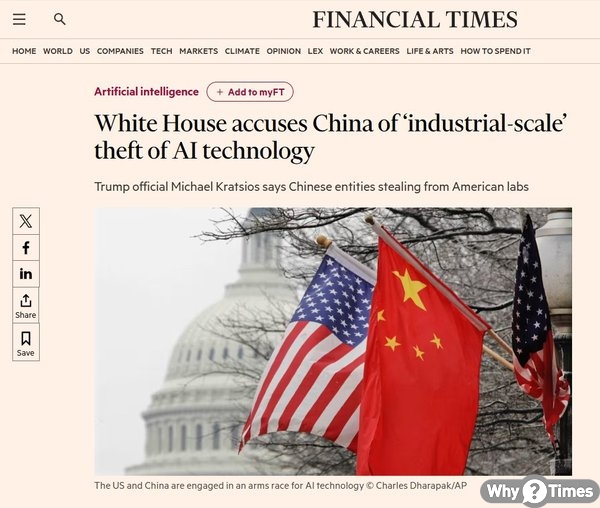
On the 24th, the Financial Times (FT) reported, “The White House has obtained information that foreign entities, primarily based in China, are engaged in a massive, intentional, and industrial-scale theft to siphon off America’s cutting-edge AI systems,” citing an internal document authored by Michael Kratsios, an official at the White House Office of Science and Technology Policy (OSTP). The FT further noted that the U.S. government intends to take "immediate and powerful action to protect American innovation."
The FT highlighted that this announcement is notable as it goes beyond mere diplomatic rhetoric; it marks the U.S. government's official recognition that the front line of the U.S.-China AI hegemony battle has expanded into the technical realm of "model siphoning."
Specifically, the U.S. backlash is centered on China’s use of "Distillation Attacks." This refers to the practice of using "knowledge distillation" to collect and learn from the outputs of an original AI model on a massive scale. While distillation is used legally within the industry to make models more efficient (model compression), unauthorized cloning of a competitor's model violates terms of service and constitutes a serious infringement of intellectual property rights.
Regarding this, Kratsios criticized these actions, stating, “While these copied models may appear to have similar benchmark scores, they cannot match the performance of the original models, and their integrity and reliability cannot be guaranteed.” He further emphasized that models created through unauthorized distillation pose a national security threat, as the "safety guardrails present in original models—designed to prevent the development of biochemical weapons or malicious cyberattacks—are often intentionally removed."
Kratsios exposed that "China's despicable operations are meticulous and sophisticated," revealing that Chinese actors utilize tens of thousands of proxy accounts to avoid detection and employ "jailbreaking" techniques to expose confidential information. He noted that this represents "a systematic cyberattack that goes far beyond simple violations of terms of use."
[Anthropic and OpenAI Issued Warnings Months Ago]
The White House’s public criticism follows months of mounting complaints from major U.S. AI companies. Anthropic has alleged that Chinese AI firms such as DeepSeek, MiniMax, and Moonshot AI created over 24,000 fraudulent accounts and generated more than 16 million conversations with its 'Claude' model to extract its capabilities. Anthropic stated that commercial proxy services were used to operate tens of thousands of accounts simultaneously to bypass service restrictions within China.
Earlier, OpenAI submitted a letter to the U.S. House Select Committee on the Chinese Communist Party, claiming it had detected evidence that DeepSeek and other Chinese firms were continuously attempting to distill its frontier models, including GPT, using new methods including obfuscation.
Consequently, U.S. AI giants like OpenAI, Anthropic, and Google are reportedly sharing information and coordinating responses regarding Chinese technology theft through the Frontier Model Forum, a non-profit organization they co-founded with Microsoft in 2023.
[Why Now? Positioning for Negotiations Ahead of Trump’s Visit to China]
The timing of this announcement is diplomatically sensitive. It comes roughly 20 days before President Trump is scheduled to visit China on the 14th and 15th of next month. Analysts suggest this is a preemptive move to place AI at the center of the agenda for upcoming U.S.-China trade negotiations and export control policies.
Kyle Chan, an expert on Chinese tech development at the Brookings Institution, noted that while President Trump may wish to avoid friction before the summit in mid-May, there is a growing domestic resolve to elevate the issue of AI distillation from a corporate violation to a matter of national export control and industrial policy.
China has reacted strongly to these developments. Liu Pengyu, spokesperson for the Chinese Embassy in the U.S., dismissed the White House's claims as "pure slander," asserting that "China has promoted scientific progress through cooperation and healthy competition and attaches great importance to the protection of intellectual property." However, observers note that the Chinese authorities themselves likely understand the hollowness of such excuses.
[Simultaneous Legislative and Institutional Pressure: “Preventing Erosion of Chip Superiority”]
Alongside the executive branch's warnings, legislative action in Congress is accelerating. The House Foreign Affairs Committee gave unanimous bipartisan support to a bill aimed at identifying foreign actors extracting core technical features from U.S. closed-source AI models and establishing penalties, including sanctions. Bill Huizenga (R-MI), who introduced the bill, emphasized, “Model extraction attacks are the latest front in China’s economic coercion and theft of U.S. intellectual property. It is essential to prevent China from stealing the innovative cyber capabilities of American AI models.”
The bill mandates that the administration consider placing companies that steal U.S. AI technology through distillation on the "Entity List" (an export blacklist). Additionally, the White House announced plans to share information on unauthorized industrial distillation attempts with U.S. AI firms, support private-sector joint responses, and strengthen sanctions and export controls against foreign actors conducting such campaigns.
A structural concern driving these measures is that China’s distillation attacks could bypass the advantage in AI chip technology that the U.S. has secured through export controls. U.S. companies aim to prevent Chinese firms from closing the performance gap at a low cost by leveraging the chip access superiority the U.S. currently holds.
Chris McGuire, a tech security expert at the Council on Foreign Relations (CFR), advised that "Chinese AI companies are relying on distillation attacks to compensate for their lack of computing power and to illegally replicate the core capabilities of U.S. models." He recommended that the U.S. block access to U.S. models by Chinese institutions, sanction entities performing or supporting distillation, and tighten export controls to prevent the smuggling of or remote access to U.S. AI chips.
[Xi Jinping’s AI Ambitions Damped: “Less Than 20% Chance of Surpassing the U.S.”]
Amidst these tensions, key experts leading China's AI sector have offered a pessimistic outlook, suggesting there is less than a 20% chance that Chinese companies will overtake global leaders like OpenAI or Anthropic within the next 3 to 5 years.
Taiwan’s Liberty Times reported, “In contrast to President Xi Jinping’s strong confidence expressed in his New Year’s address regarding China’s AI and semiconductor achievements, the voices from the field point to a harsh reality.” Industry leaders at a recent meeting in Zhongguancun—Beijing’s version of Silicon Valley—expressed extreme caution regarding the possibility of surpassing the U.S. in frontier model development.
The report noted that Lin Junyang, head of the open-source model platform 'Qwen' under Alibaba Group, downplayed the likelihood of a future breakthrough, citing the resource constraints currently faced by Chinese companies.
Lin explained that the widening gap with U.S. firms is due to an imbalance in computing resources. "While OpenAI is pouring massive computing power into next-generation research, Chinese firms are struggling just to meet current service demands with insufficient resources," he said. He added that the "old dilemma of whether innovation lies in the hands of the rich or the poor is resurfacing," lamenting the poor R&D environment.
This concern was echoed by other industry heavyweights, including Yao Shunyu, who recently moved from OpenAI to oversee AI at Tencent, and Tang Jie, founder and chief scientist of Zhipu AI. Tang warned against the market's intoxication with the performance of some open-source models, stating, "While some are excited that Chinese models have surpassed the U.S., the reality is that the gap is likely widening." He emphasized the need for substantial momentum to open the era of Artificial General Intelligence (AGI) rather than engaging in meaningless internal competition.
These anxieties reflect the underlying instability beneath the recent successful IPOs of Chinese AI firms. Industry leaders warn that as long as regulatory barriers, brain drain, and a lack of original innovation persist, financial market success will not translate into a technological leap, leaving China’s position in the global AI race increasingly precarious.

- TAG