


추부길 whytimespen1@gmail.com
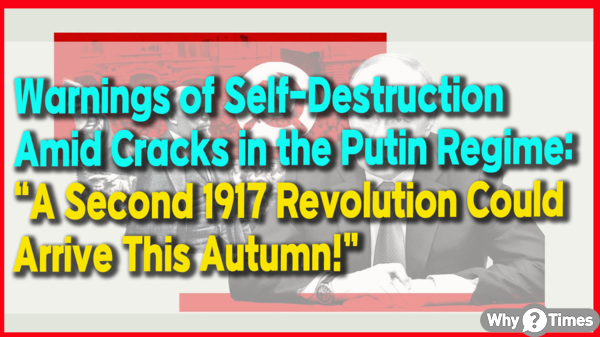
[Putin’s Power Base Shaken by Economic Ruin and Uncontrollable Public Sentiment]
Long-dormant anti-Kremlin grievances are rising to the surface in Russia. Warnings have emerged from the very heart of the political establishment that the Russian society could face a catastrophic regime collapse—reminiscent of the 1917 Bolshevik Revolution—if it fails to address the looming economic disaster and mounting internal discontent. The confluence of a Communist leader’s parliamentary outcry and a viral exposé by a Monaco-based influencer has raised fundamental questions about the durability of Putin’s grip on power.
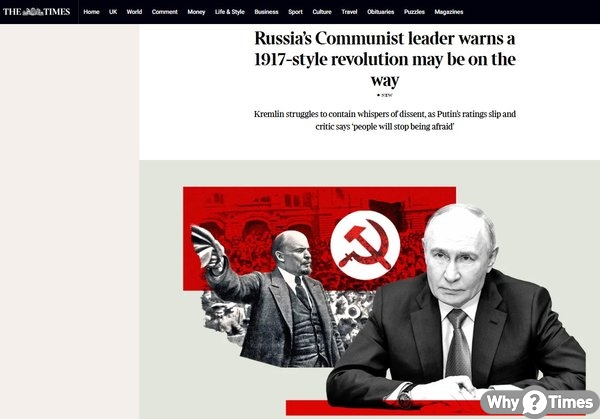
On the 23rd, The Times reported that Gennady Zyuganov, leader of the Russian Communist Party, warned in a parliamentary speech that "the events of 1917 could repeat this autumn," urging the Kremlin to take urgent economic and financial measures. Simultaneously, a video by Victoria Bonya, a Russian influencer residing in Monaco, surpassed 30 million views, acting as a catalyst for publicizing social grievances. Notably, President Putin’s approval rating has hit its lowest point since the full-scale invasion of Ukraine in 2022.
Zyuganov emphasized, “I have warned more than ten times that the economy will collapse. The first quarter was a total disaster. If urgent measures are not taken, we will see a repeat of 1917. We do not have the right to let history repeat itself.” His warning directly references the Bolshevik Revolution, where Vladimir Lenin seized power following the fall of the last Tsar, Nicholas II.
Ironically, Zyuganov’s Communist Party claims to be the successor to the ideologies of Lenin and Marx. While it serves as the second-largest party in parliament, it is widely viewed as a "systemic opposition" tolerated by the Kremlin to maintain an illusion of democracy. Consequently, his warning drew ridicule from some; political analyst Abbas Gallyamov quipped that they are "anti-communists, not communists," while Ukrainian journalist Yuriy Butusov described them as "strange communists."
However, the significance of Zyuganov’s remarks lies in their context. He expressed blatant frustration that the Kremlin ignored the appeals of the political opposition while reacting to an influencer, stating, “We did everything to support Putin’s strategies... and yet you listen to that woman from Monaco!”
[The Kremlin Rattled by 30 Million Views]
The "woman from Monaco" refers to Victoria Bonya (46), a Russian model and former TV star. On April 14, she posted an 18-minute video on Instagram criticizing the Kremlin for neglecting critical issues, including the economy and internet regulations. Speaking to her 13 million followers, she listed various crises: mass livestock deaths in Siberia, deadly flooding in Dagestan, oil pollution in the Black Sea, and the widespread blocking of Telegram.
"There is a thick wall between you and us," Bonya said, targeting Putin directly. She claimed officials are too afraid to report the truth, leaving the President unaware of the reality. She warned, “Do you know what the danger is? It’s when people stop being afraid. Right now, people are being compressed like a spring, and one day, that spring will snap.” Interestingly, she made no mention of the war in Ukraine.
The video garnered 26 million views and 1.3 million likes within four days, eventually surpassing the 30-million mark. In an unusual move, Kremlin spokesperson Dmitry Peskov issued an official statement, claiming that many of the issues raised are being addressed with significant resources. The Kremlin’s decision to respond to an influencer while ignoring seasoned politicians highlights the perceived threat of her reach.
[State TV Strikes Back, Only to Face Backlash]
Following the Kremlin's response, state TV host Vladislav Solovyov launched a vitriolic attack on Bonya, using misogynistic slurs. Pro-Kremlin lawmaker Vitaly Milonov joined in, degrading her as a "Dubai escort."
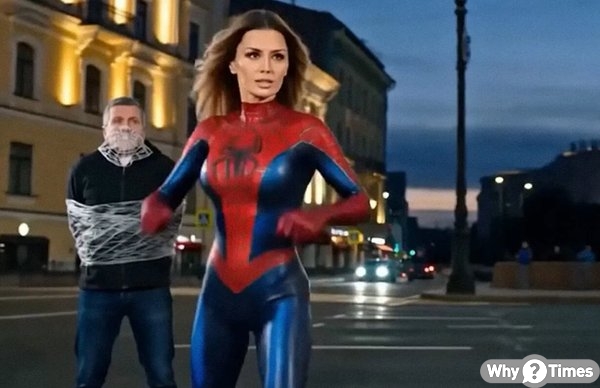
However, this offensive backfired. Bonya countered by launching a petition to remove Solovyov from the airwaves, asking, "Since when did we allow women to be insulted on federal TV?" She also released an AI-generated video depicting herself as "Spider-Woman" punishing Solovyov and Milonov. Thousands of social media users rallied behind her, demanding public apologies from the pundits.
While Bonya avoided direct criticism of Putin himself—leading some to speculate the video might be a Kremlin-orchestrated "safety valve" to show the state responds to the people—she explicitly rejected ties with exiled opposition groups, stating, "I am not with you [the opposition]; I am with the people."
[Plummeting Approval and Deepening Isolation]
These events unfold against a backdrop of declining support for Putin. According to VTsIOM, a state-run polling agency, Putin’s approval stands at 66%. While high by Western standards, this is an 11-percentage-point drop since December, marking a post-invasion low. In a country with total media control and no real opposition, such a decline is significant.
A major driver of this discontent is the massive crackdown on the internet, specifically the ban on Telegram, a vital communication tool for everyone from civilians to military personnel.
Tatiana Stanovaya, a senior fellow at the Carnegie Russia Eurasia Center, noted that an aging and increasingly isolated Putin risks losing control amid internal divisions caused by internet repression. She argued, “Putin can neither achieve peace in Ukraine nor win the war he started. Putin’s greatest asset has always been his strength; a weak Putin is of no use to anyone—including the Russian security apparatus.”
[Historical Shadows and Putin’s Obsessions]
Critics argue Putin remains obsessed with the "glory" of the Soviet era rather than current realities. On April 22, the FSB Academy in Moscow was renamed after Felix Dzerzhinsky, the founder of the Cheka (the KGB’s predecessor) and architect of the "Red Terror." Dzerzhinsky’s statue was famously toppled in 1991 during the fall of the USSR.
On the same day, Putin compared the "Special Military Operation" to the Soviet defeat of Nazi Germany, praising women and children for "knitting socks" for soldiers. Despite the four-year-long stalemate, there is no sign of him scaling back his ambitions.
However, the prolonged conflict and economic strain are pushing the "spring" of the Russian public toward its breaking point. International observers are closely watching whether the warnings of revolution and the cracks in the regime signify a mere moment of turbulence or the beginning of the end for Putin’s long-standing rule.

- TAG