


추부길 whytimespen1@gmail.com
[The IRGC’s Covert Power Grab and the Fall of Civilian Government]
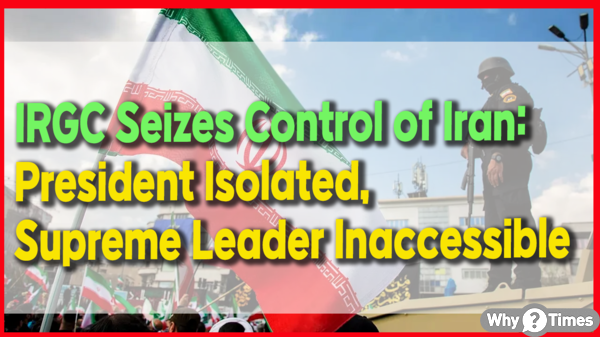
The geopolitical landscape of the Middle East is shifting violently. The Islamic Revolutionary Guard Corps (IRGC) has carried out what effectively amounts to a military coup, placing the new Supreme Leader, Mojtaba Khamenei, under house arrest and forcibly stripping President Masoud Pezeshkian of his administrative authority. By seizing core state functions through a centralized "Military Commission," the IRGC has severed direct communication between the President and the Supreme Leader. This rapid restructuring into a military-led junta has blocked potential temporary ceasefires with the United States, casting a dark shadow over the prospects of peace.
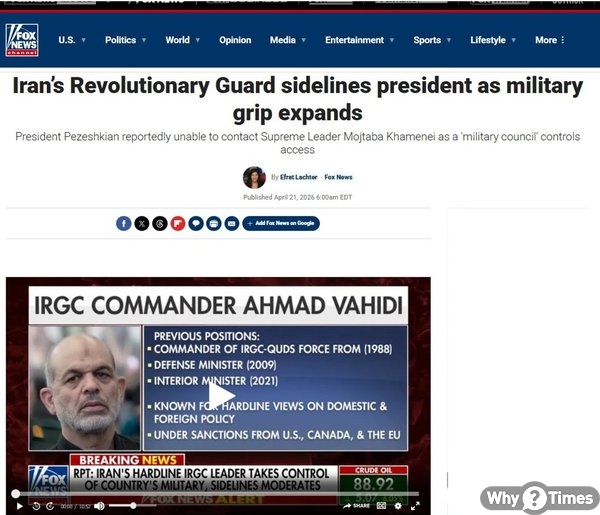
On the 22nd, Fox News, citing exclusive reporting from the dissident outlet Iran International, reported that "a 'Military Commission' composed of senior IRGC officers has effectively seized the nerve center of Iranian power." The report noted that this commission has rejected President Pezeshkian's personnel appointments and established a "security blockade" around Mojtaba Khamenei to prevent any direct contact with the President.
Fox News further highlighted that the commission is reportedly blocking government reports from reaching Mojtaba, essentially severing the link between the elected government and the Supreme Leadership. President Pezeshkian has reportedly made multiple urgent requests for a meeting with the Supreme Leader, all of which have been denied, leading analysts to conclude that the administration is in a state of "total political paralysis."
This power vacuum is most evident in the realm of appointments. According to Fox News, "IRGC Commander Ahmad Vahidi pressured the rejection of all candidates proposed by Pezeshkian, including former Defense Minister Hossein Dehghan, who was nominated for Intelligence Minister." Vahidi maintained that under wartime conditions, the IRGC must exercise direct control over key appointments.
In a related report on March 25, Euronews noted that Pezeshkian was pressured by the IRGC—specifically under Vahidi's demands—to appoint Mohammad Bagher Zolghadr as the Secretary of the Supreme National Security Council following the death of his predecessor, Ali Larijani. This appointment, forced through despite civilian opposition, is analyzed as the first public instance of civilian institutions openly yielding to military personnel demands.
The IRGC's influence is equally dominant on the diplomatic front. Zolghadr was included in the Iranian negotiating team to ensure they did not deviate from IRGC directives or the Supreme Leader's strategic line. He reportedly protested to senior IRGC leadership when Foreign Minister Araghchi showed flexibility regarding support for the "Axis of Resistance," leading to the recall of the entire delegation to Tehran. This serves as a stark illustration that decisions on war and peace have shifted from the hands of the President and Foreign Minister to the military.
[An "Empty Shell" Supreme Leader and the Rise of Ahmad Vahidi]
At the root of this structural shift is the extremely limited public profile of the new Supreme Leader, Mojtaba Khamenei. Since being appointed by the Assembly of Experts in early March, Mojtaba has not appeared in public once, fueling international doubts regarding his health and actual capacity to govern.
This vacuum created the decisive space for the IRGC to intervene. Following his father’s death in late February due to U.S.-Israeli airstrikes, Mojtaba has remained absent from official duties. Analysis suggests the current power structure has solidified into a system where he is positioned as a co-decision-maker alongside IRGC Commander Vahidi.
Warnings were present early on. Iran International reported that Ali Asghar Hejazi, a senior aide in the Supreme Leader's office, had previously warned the Assembly of Experts that Mojtaba lacked the qualifications for the role and that appointing him would effectively hand the country over to the IRGC. This warning has seemingly become a reality; ironically, Mojtaba's allies within the IRGC are now using those very warnings as a pretext to purge Hejazi from the office.
An Israeli national security official characterized Mojtaba's status as an "empty shell" with no real power, describing the regime as fragmented and non-functional. Exploiting this chaos, the new IRGC commander, Ahmad Vahidi, has emerged at the forefront. Vahidi is reportedly the only individual in direct communication with Mojtaba and is unilaterally making all strategic decisions regarding war and peace.
Behnam Ben Taleblu, a senior fellow at the Foundation for Defense of Democracies (FDD), analyzed that this was "not a sudden event but the culmination of 30 years of IRGC influence expansion." He emphasized that the military’s total seizure of power was merely a matter of time, as the military utilized the pretext of wartime pressure to transition the state into a garrison system, effectively ending civilian control.
Despite its leadership suffering devastating blows from U.S. and Israeli operations, the IRGC maintained its core functions through a decentralized command structure. By holding its ground for nearly two months against two superpowers, the IRGC proved its organizational cohesion and demonstrated strategic capabilities by disrupting global energy and food markets through the blockade of the Strait of Hormuz.
[Economic Blockade and Hardliner Radicalization]
This power shift casts a grim shadow over negotiations with the U.S. The Institute for the Study of War (ISW) analyzed that while Iranian political bureaucrats are currently negotiating with the U.S., they lack the independent authority to finalize Iran’s positions. The representatives at the table are not the actual decision-makers.
A symbolic example occurred when Foreign Minister Araghchi announced the reopening of the Strait of Hormuz to commercial shipping. Hardline commentators and semi-official media immediately revolted, and the following day, the IRGC declared the Strait remained closed, overriding the Minister's announcement and proving the Foreign Ministry’s lack of autonomy.
Furthermore, the Trump administration’s "maximum pressure" is accelerating internal fractures. The U.S. Navy’s blockade of the Strait of Hormuz has effectively reduced Iran’s oil exports—its economic lifeline—to zero. While the U.S. keeps the door open for ceasefire talks through third-party channels like Pakistan, the fundamental problem remains that President Pezeshkian lacks the power to negotiate.
Fox News' Jesse Watters Primetime characterized the situation as a "quiet coup." The military commission, driven by hardliners, refuses any form of concession or compromise, suggesting that international efforts for Middle East peace will face severe obstacles. The IRGC appears to be exploiting external tensions to protect its own vested interests, even as the suffering of the Iranian people intensifies.
In conclusion, contemporary Iran is a state where both religious authority and democratic legitimacy have been trampled under military boots. Hardline generals led by Ahmad Vahidi are effectively ruling from behind the scenes, using the new Supreme Leader as a figurehead. Their bellicose stance has raised regional security threats to unprecedented levels, as they are likely to sabotage any agreement perceived as a "concession."
The U.S. and the international community now face the complex challenge of dealing not with a powerless civilian government, but with the IRGC Military Commission hidden in the shadows. As diplomatic channels through Tehran effectively vanish, the world is left with the daunting question: With whom is there left to talk?

- TAG