


추부길 whytimespen1@gmail.com
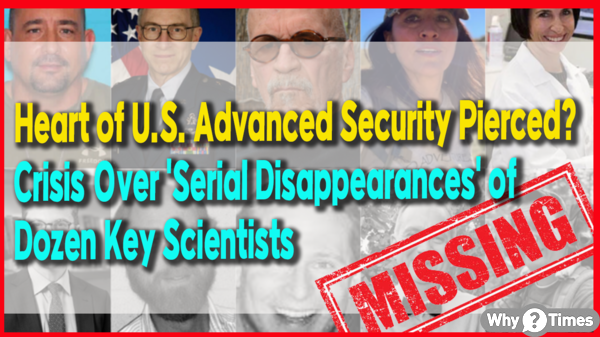
[11 Key Scientists Vanish: White House and FBI on High Alert]
A state-level security crisis has erupted as ten elite scientists and researchers—the backbone of the U.S. nuclear and aerospace sectors—have either died or vanished without a trace over the past three years. In response, the White House and the FBI have launched a full-scale investigation into what they deem a significant threat to national security.
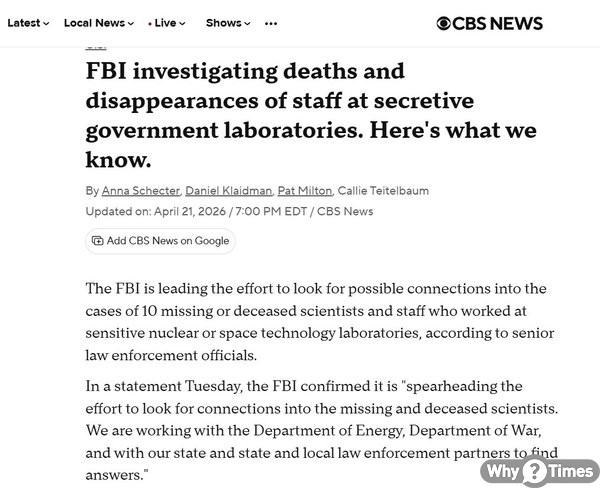
CBS News reported on the 22nd that the FBI is leading efforts to determine links between the disappearances or deaths of ten personnel who worked at sensitive nuclear or aerospace laboratories. The bureau is collaborating with the Department of Energy (DOE), the Department of Defense (DoD), and local law enforcement. While FBI spokesperson Ben Williamson initially described the matter as a "pending investigation" usually led by local authorities, the agency’s stance shifted dramatically after FBI Director Kash Patel announced he would personally oversee the probe.
During a Fox News interview on the 21st, Director Patel declared, “The FBI will lead this investigation alongside the DOE and the DoD.” A spokesperson for the National Nuclear Security Administration (NNSA) also confirmed they are looking into reports involving personnel from their labs. President Donald Trump revealed last week that he attended a briefing on the matter, calling it "very serious" and stating, "I hope it’s a coincidence, but some of these were very important people."
Social media played a pivotal role in bringing these incidents to light. As researchers linked to the NASA Jet Propulsion Laboratory (JPL) and Los Alamos National Laboratory continued to vanish, theories of an organized conspiracy targeting U.S. nuclear and space programs began to spread rapidly online.
[The Beginning: A Chain of Tragedies Starting at NASA JPL]
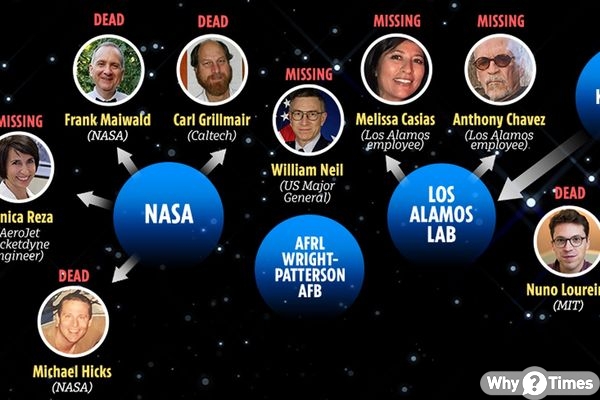
The timeline of suspicion traces back to 2023. The death of Michael David Hicks, who served at NASA JPL from 1998 to 2022, was followed by a series of other losses. At JPL alone, three key figures have been lost: Hicks (died July 2023), Frank Maiwald (died July 2024), and Monica Reza (missing since June 2025).
The victims were specialists in nuclear technology, celestial exploration (planets/asteroids), and jet propulsion. The list includes three NASA researchers and two from Los Alamos National Laboratory—the historic site of the first atomic bomb's development.
The backgrounds of the victims suggest these are not random occurrences. Monica Reza, missing since last June, was a leading authority in next-generation engines and head of materials processing at JPL. She was also involved in classified projects at Wright-Patterson Air Force Base. She vanished while hiking just nine meters ahead of a companion, who testified that she had smiled and waved moments before disappearing.
Other notable cases include:
Nuno Loureiro: A nuclear physicist and director of MIT’s Plasma Science and Fusion Center, shot dead at his home last December.
Karl Grimayer: A Caltech astrophysicist involved in Hubble and Spitzer missions, shot dead at his front door this February.
Steven Garcia: A manufacturer of non-nuclear components for nuclear weapons, last seen leaving his home in Albuquerque last August.
Jason Thomas: A cancer researcher at Novartis, found dead in a Massachusetts lake this March after going missing in December; the cause of death remains undisclosed.
[Key Investigative Clue: 'Disappearances Without Electronic Devices']
Investigators are focusing on a chilling commonality. Congressman Eric Burlison of the House Oversight Committee noted, “These individuals just vanished. Literally, they left all their devices at home.” This pattern—leaving smartphones and GPS-enabled devices behind—suggests a deliberate attempt to evade tracking or, more ominously, actions taken under external coercion.
The disappearance of William McCasland, former commander of the Air Force Research Laboratory (AFRL), has caused particular shock. McCasland was deeply involved in Unidentified Anomalous Phenomena (UAP) projects. Given his access to top-secret military data, his disappearance is being viewed as far more than a routine criminal matter.
[Trump Administration's 'National Crisis' Declaration]
The Trump administration has escalated the federal response, categorizing the events as a "grave challenge to national security" rather than isolated crimes. The National Security Council (NSC) has been convened, and a "Joint Interagency Investigative Team" involving the DoD, State Department, and DOE has been officially launched.
Investigators are particularly concerned by the "slow-motion" nature of the disappearances, which occurred intermittently over a long period. Experts warn this could be a sophisticated psychological tactic designed to bypass early detection and disperse investigative resources. Authorities are currently weighing the possibility of industrial espionage or organized operations by hostile foreign intelligence services.
House Oversight Committee Chairman James Comer warned of a high probability of a conspiracy, while Secretary of Energy Chris Wright confirmed that most nuclear security scientists fall under his department's jurisdiction and are part of the ongoing probe.
[Suspicions of 'Brain Hunting': A Global Tech Hegemony War?]
Intelligence experts view these events as an extreme manifestation of "Brain Hunting"—the aggressive theft of intellectual assets between nations. If the knowledge of these experts has been funneled to adversaries, or if they were eliminated to stifle U.S. progress, it marks the beginning of a 21st-century "Technical Cold War."
There is a strong suspicion that certain nations, unable to bridge the technological gap through traditional R&D, are resorting to asymmetric tactics by targeting human resources directly. Consequently, the U.S. government has raised the security clearance and protection levels for remaining scientists on key projects to the highest tier.
Notably, many of the missing individuals were linked to UAP (Unidentified Anomalous Phenomena) research. President Trump recently hinted at the release of "very interesting documents" regarding UAPs, leading some to speculate on a connection, though no direct link has been proven.
Conclusion
This mystery underscores a shift in modern security: the defense of territory is now inseparable from the protection of elite talent and knowledge. The sudden loss of researchers from institutions like Los Alamos and JPL represents a potential "intelligence vacuum" that could weaken U.S. strategic superiority. The world now waits for the "answers" President Trump promised within the coming weeks, as the truth behind these disappearances has the potential to reshape the global technological landscape.

- TAG