


추부길 whytimespen1@gmail.com
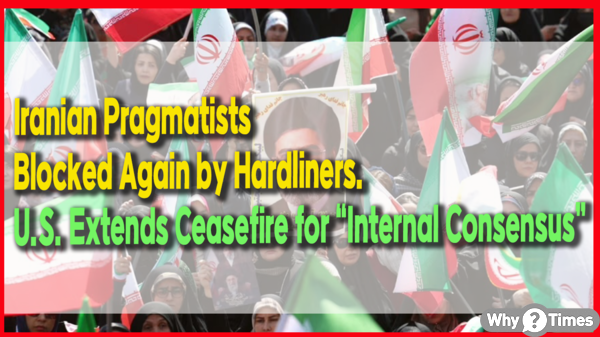
[The Revolt of Iranian Hardliners Unstoppable Even by Mojtaba; Internal Strife on the Cusp of Final Negotiations]
Iranian peace negotiations have stalled once again. Despite direct orders from Supreme Leader Mojtaba to open talks, hardline factions blocked the negotiating team’s path, preventing their departure for Islamabad. Following an urgent request from Pakistan, President Donald Trump eventually extended the ceasefire deadline, and Vice President JD Vance’s scheduled trip to Pakistan was subsequently canceled. The decision to suspend President Trump's public ultimatum—to commence bombing upon the failure of ceasefire talks—is interpreted as a strategic consideration to provide more political breathing room for Iranian pragmatists.
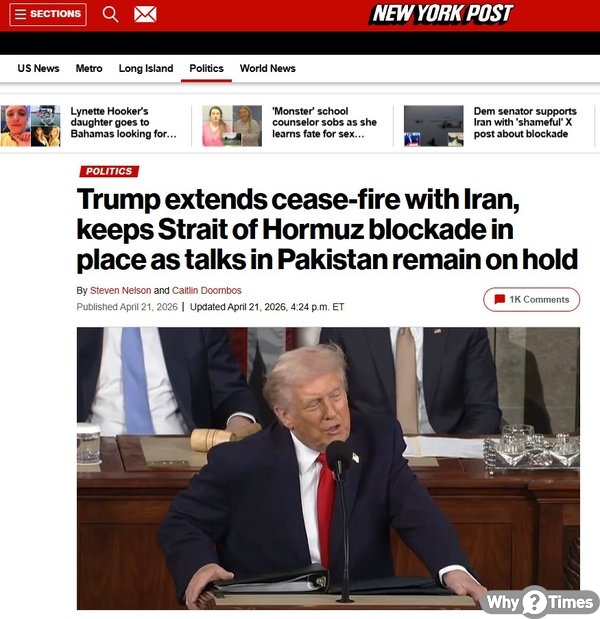
On the 22nd, the New York Post reported, “President Donald Trump formalized the decision to extend the ceasefire with Iran through his social media platform, ‘Truth Social,’” adding that “Trump cited the uncontrollable level of division within the Iranian government as the decisive reason for the extension.”
President Trump stated, “Based on the fact that the Iranian government is as severely divided as expected, and following requests from Pakistan’s Chief of Army Staff Asim Munir and Prime Minister Shehbaz Sharif, I have decided to withhold strikes until the Iranian leadership and delegation can present a unified proposal.” He further emphasized, “I have instructed the military to maintain the naval blockade and remain in a state of immediate operational readiness in all respects,” adding that “the ceasefire will be extended until a unified proposal is submitted and discussions are concluded.”
In light of these developments, Vice President JD Vance, who was originally scheduled to arrive in Islamabad on the 20th, canceled his trip despite President Trump’s prior announcement that he had already departed.
The New York Post noted, “The Iranian side had not even confirmed whether they would send a delegation to Pakistan, the mediator,” and that “Washington maintained a cautious stance to prevent a ‘no-show’ situation, where the U.S. delegation would arrive after a 17-hour flight only to find their counterparts missing.”
The backdrop of this diplomatic confusion is the deep-seated internal fracture within Iran. The disparity between hardliners and moderates has been laid bare on the negotiation front. The hardline Islamic Revolutionary Guard Corps (IRGC) is reportedly opposed to any agreement that could be perceived as surrendering to U.S. demands. The gravity of the situation lies in the fact that ultra-hardliners, centered around the IRGC, blocked the pragmatists' trip to Islamabad despite the Supreme Leader’s direct command.
In essence, while pragmatists argue for negotiations to address the immediate national crisis, hardliners are obstructing them to solidify their own political dominance. This is a blatant power struggle between factions to seize control of national decision-making.
Experts analyze that the current situation in Iran has reached a critical level, equivalent to a power vacuum at the top. This internal discord is the primary reason the nation cannot speak with a single voice during a national crisis. The dissonance within the upper echelons of power is paralyzing general administration and compounding both domestic and international uncertainty.
These internal cracks were evident during the diplomatic process. The Economist reported, “Out of the approximately 80 Iranian negotiators involved in the recent first round of peace talks, it was identified that only about 30 held actual decision-making power,” noting that “they displayed sharp disagreements and internal chaos at the negotiating table, despite their role in presenting a unified national proposal.”
The Economist continued, “The disagreements among participants reached a level so severe that the mediator had to intervene,” and pointed out that “Pakistani officials, judging that normal discussion was impossible due to unresolved internal conflicts, took the unusual step of declaring a recess. This suggests that factional strife in Iran has spiraled out of control, directly impacting diplomatic venues.”
The publication further warned, “Some political circles caution that if this power struggle persists, it could threaten not only Iran’s international credibility but also its domestic political stability,” stating that “as the hardline approach led by the IRGC repeatedly clashes with the reformists’ strategy to restore international relations, Iran is expected to face significant agony in restoring domestic order.”
[Deepening Dilemma for the U.S. Amid Escalating Iranian Infighting and Power Vacuum]
The political climate within Iran is deepening the dilemma for the United States. Prior to this announcement, the international community was under extreme tension, anticipating large-scale airstrikes immediately following the ceasefire expiration on the 22nd. The core issue is that striking Iran’s infrastructure, such as power plants—as Trump previously threatened—could completely undermine the standing of Iranian pragmatists, potentially opening a path toward the ‘North Koreanization’ of Iran. Washington appears to have seriously deliberated its response to avoid this outcome.
Responding to the strong suggestion from Pakistan to grant the Iranian pragmatists more time, the U.S. ultimately decided to extend the ceasefire and allow more time for the internal situation in Iran to settle.
President Trump’s message on Truth Social reflects this concern: “Given the severe division within the Iranian government and based on the requests of General Asim Munir and PM Shehbaz Sharif, I have been asked to hold off on attacks until a unified proposal is ready.”
While anti-Trump media in the U.S. and legacy media in South Korea criticize this shift as "chaos fueled by Trump’s rhetoric," such reports appear to be part of a “Kill Trump” narrative that ignores the hidden intention: strengthening the position of Iranian pragmatists to resolve the issue peacefully.
It is clear that the Trump administration, considering the internal chaos of the Iranian regime, has determined that “withering them out” through economic and physical isolation is currently more effective than military strikes for empowering the moderate faction.
In this regard, President Trump stated in an interview with CNBC’s ‘Squawk Box’ on the morning of the 21st, “If the ceasefire expires without an agreement, bombing will resume,” adding, “The military is ready. I will not rush into a bad deal.” He also wrote on Truth Social, “Time is not my enemy. What matters is finally fixing the Iran problem that other presidents failed to solve for 47 years.”
[Trump Urges Release of 8 Women Facing Execution in Iran]
Despite Iran’s negotiation “no-show,” President Trump, who postponed indiscriminate attacks, officially requested the Iranian leadership to release eight female prisoners facing execution ahead of full-scale peace talks.
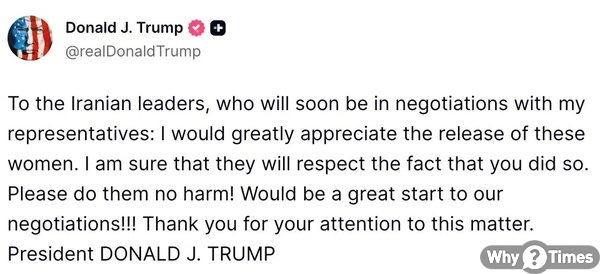
On social media, Trump emphasized, “Releasing the eight women scheduled for execution by the Iranian regime is the path to building trust with the United States.” The requested group includes a 16-year-old girl and a physician arrested during anti-government protests earlier this year. Trump conveyed to the Iranian leaders who will soon sit at the negotiating table that he would greatly appreciate their release.
“If Iran decides to release these women, I am certain our side will respect that decision,” Trump said, urging them “not to harm the prisoners” and adding that “guaranteeing their freedom would be an excellent starting point for negotiations.” This is interpreted as an attempt to verify Iran’s commitment to improving human rights before formal diplomatic discussions.

The New York Post reported that “this request directly cited a post by pro-Israel activist Eyal Yakoby on social media.” The post includes photos of women facing execution, including Bita Hemmati, who was arrested during protests in January. According to the National Council of Resistance of Iran (NCRI), Hemmati has been sentenced to death along with her husband and neighbors on charges of using explosives and disturbing national security.
The New York Post also noted that “the list includes 16-year-old Diana Taherabadi and 33-year-old Mahboubeh Shabani.” Taherabadi faces the capital charge of ‘War Against God’ for participating in the January protests, while Shabani was detained in February for helping injured protesters. It was also reported that Golnaz Naraghi, an internal medicine specialist at Hashemi Nejad Hospital, is currently imprisoned following a forced confession.
Human rights organizations have criticized Iranian authorities for accelerating executions of protesters through summary trials. Human Rights Activists News Agency (HRANA), based in the U.S., estimated that “over 50,000 people were detained during the protests.” The NCRI estimates that more than 300 people were executed in the first month of this year alone, calling for international attention.
- TAG