


추부길 whytimespen1@gmail.com
[Mojtaba Approves 2nd Round Amid IRGC Hardliner Backlash]
Iran, which had previously insisted on the lifting of U.S. blockades as a prerequisite, has abruptly approved participation in the second round of end-of-war negotiations, overcoming fierce opposition from the Islamic Revolutionary Guard Corps (IRGC). Consequently, U.S. Vice President J.D. Vance departed for Islamabad, Pakistan, on the 21st, marking a major turning point in Middle Eastern geopolitics. This sudden shift in Tehran toward opening negotiations appears to have gained significant momentum after Mohammad Bagher Ghalibaf, Speaker of the Iranian Parliament, strongly condemned forces criticizing the talks with the U.S., stating, "They will destroy Iran."
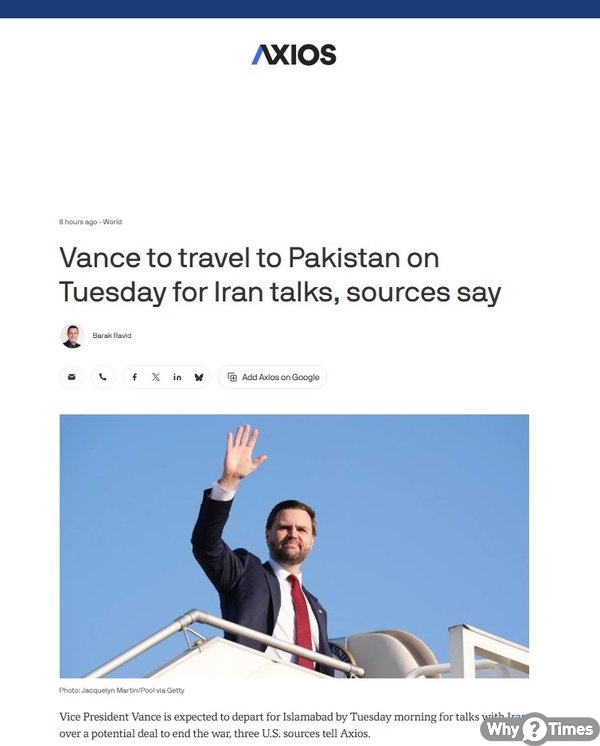
On the 21st, the U.S. online media outlet Axios, citing three administration sources, reported, "Iran's Supreme Leader Mojtaba Khamenei finalized the approval to send a delegation for the second round of negotiations with the United States on the night of the 20th (local time)." The report added that "this decision was reportedly made amidst extreme internal divisions within the Iranian regime."
Axios further noted, "As a result, Vice President Vance is departing for Islamabad, the capital of Pakistan and the venue for the talks, for the second round of end-of-war negotiations with Iran." It pointed out that "hardliners, centered around the IRGC, had been stalling, maintaining that Iran should not return to the negotiating table unless U.S. economic and military blockades are lifted. In particular, they had been pressuring the negotiation team by defining the U.S. blockade of the Strait of Hormuz as a 'declaration of war' and advocating for retaliatory strikes."
However, persistent persuasion from mediating nations—Pakistan, Egypt, and Turkey—is analyzed to have moved Mojtaba's mind. These mediators reportedly delivered a warning that if this second round of talks fails, the overwhelming military power of the Donald Trump administration would be directed at the Iranian mainland. Ultimately, faced with a crisis of national survival, Mojtaba Khamenei granted the working-level negotiation team near-total authority, defying the opposition of hardliners.
Following the news of Iran's approval, Vice President J.D. Vance left for Islamabad on the morning of the 21st. The delegation includes Presidential Envoy Steve Witkoff, who led the first round of talks on the 11th, and Jared Kushner, President Trump's son-in-law and a key behind-the-scenes figure in Middle East policy.
President Trump is investing significant effort into these negotiations. In a previous interview with the New York Post, he expressed high expectations for a settlement, mentioning, "Vice President Vance is on his way to Pakistan and will arrive soon." Through these talks, the White House appears to be attempting a so-called "Grand Bargain," which includes a halt to the nuclear program and a ban on supporting terrorism, moving beyond a simple extension of the ceasefire.
The inclusion of Witkoff and Kushner suggests that the Trump administration views these talks not as mere working-level contact, but as de facto end-of-war negotiations. In particular, Kushner is highly likely to leverage his experience in orchestrating the Abraham Accords to offer Iran unconventional economic support packages, inducing an "agreement close to surrender."
In this regard, Axios analyzed, "While it is difficult to reach a comprehensive agreement within such a tight schedule, President Trump may agree to a further extension of the deadline if meaningful progress is confirmed." Ultimately, the key to this second round of talks in Islamabad will be whether it can secure the momentum to sustain the negotiations themselves, rather than just achieving a short-term agreement.
[Speaker Ghalibaf Warns: "Anti-Negotiation Forces Will Lead Iran to Ruin"]
The catalyst for Iran's sudden shift toward the ceasefire negotiation phase appears to be Speaker Mohammad Bagher Ghalibaf’s direct criticism of domestic hardline forces attempting to block negotiations with the U.S., accusing them of destroying the nation.
On the 21st, the Jerusalem Post (JP) reported, "Mohammad Bagher Ghalibaf, the head of Iran's parliament and co-leader of the negotiation team with the U.S., strongly rebuked internal political opposition in Tehran." The report continued, "Speaker Ghalibaf, who serves as a co-representative alongside Foreign Minister Abbas Araghchi, argued that those refusing dialogue with the U.S. are driving Iran down a path of ruin. He specifically clarified that attempts to obstruct negotiations constitute a grave threat directly linked to national security."
In his remarks, Speaker Ghalibaf increased the intensity of his offensive by naming specific individuals. He identified Saeed Jalili and Amir-Hossein Sabeti as representative "extremists." Jalili, who served as the Secretary of the Supreme National Security Council and chief nuclear negotiator from 2007 to 2013, is a core hardliner who lost to President Masoud Pezeshkian in the 2024 election. Sabeti is classified as a young hardliner representing the post-Islamic Revolution generation.
Ghalibaf’s analysis suggests that these hardline forces are using state-run media to amplify public opposition to the negotiations and inciting fundamentalists to cause civilian chaos. He pointed out that this "militant atmosphere" is hindering the path to negotiations and criticized them for spreading a sentiment of refusing dialogue throughout Iranian society. Speaker Ghalibaf defined such movements as acts that ultimately harm the interests of the entire nation.
Speaker Ghalibaf also expressed concern over potential changes to his personal safety due to political pressure, and he is reportedly feeling threatened that he and Foreign Minister Araghchi could be dismissed from their current positions. This suggests that the offensive from the anti-negotiation faction has moved beyond simple policy criticism to pressuring for personnel reshuffles of the negotiators themselves.
Meanwhile, Speaker Ghalibaf is simultaneously pursuing external cooperation. On the 16th, five days prior, he held a meeting in Tehran with General Syed Asim Munir, the Chief of Army Staff of Pakistan. Amidst this complex international situation, the conflict between moderate/pragmatic forces and hardline conservative forces within Iran is expected to be a key variable in determining the future direction of negotiations with the United States.
As the internal tide in Iran shifts, it appears that Speaker Ghalibaf will likely be established as the U.S.'s primary partner within Iran. Furthermore, it is expected that strong support will be provided to ensure Ghalibaf maintains a firm power base, as this is seen as the only path to actual prosperity for Iran.
[Mossad Declares "Regime Change in Iran" as Goal; Chinese Leadership Alarmed]
In the midst of these developments, Mossad Director David Barnea drew significant attention during a speech at a Holocaust memorial ceremony in Jerusalem, announcing, "We will not stop our operations until the Islamic regime in Iran collapses and transforms into a state that is freer and less violent."
This marks the first time a Mossad chief has publicly declared "Regime Change" in a specific country as an official goal. Director Barnea made it clear that this plan would continue even after attacks on Tehran, and that the current mission is not yet complete.
Chinese intelligence and security authorities are showing unprecedented tension regarding these moves by Mossad. China views Mossad’s strategy as having undergone a qualitative shift from traditional covert deterrence to an aggressive, overt pursuit of regime change. In particular, China, which imports approximately 90% of Iran's energy supply, fears that instability in the Iranian regime will directly strike its own energy security.
The AI-based precision assassination technology utilized by Mossad in recent warfare poses an even greater threat to the Chinese leadership. Regarding this, The Times of Israel (TOI) previously reported, "Mossad is using AI to track and identify targets, eliminating them with lethal accuracy, and has reportedly killed over 250 high-ranking officials, including Iran's top leadership. This system is known to have national-scale strike capabilities by collecting vast amounts of data from street CCTV, payment platforms, and internet nodes."
The flow of public opinion within China is another point of concern for the Chinese Communist Party. Among the Chinese public, watching Mossad’s activities has led to expressions of resentment toward their own leadership or the formation of public sentiment such as "guiding the way for the U.S. military." Analysts point out that Mossad’s method of seizing control within a regime through informants and network infiltration in Iran is instilling a fear in the Chinese leadership that this is "not someone else's problem." In this context, an incident even occurred where CCTV cameras near Zhongnanhai in Beijing were completely dismantled.
Furthermore, Israel is increasing pressure on China by strengthening defense cooperation with Taiwan. China is expressing anger over the growing military contact between the two sides, such as the integration of Israel’s "Iron Dome" technology into Taiwan’s multi-layered missile defense system, "T-DOM." Director Barnea directly warned China to "reconsider actions that help rebuild Iran's missile capabilities," which is interpreted as a suggestion that Chinese assets or technical support could become targets for Israeli strikes in the future.

- TAG