


추부길 whytimespen1@gmail.com
[Iran at a Crossroads Over Attending 2nd Round of Talks While Rejecting the 'Table of Surrender']
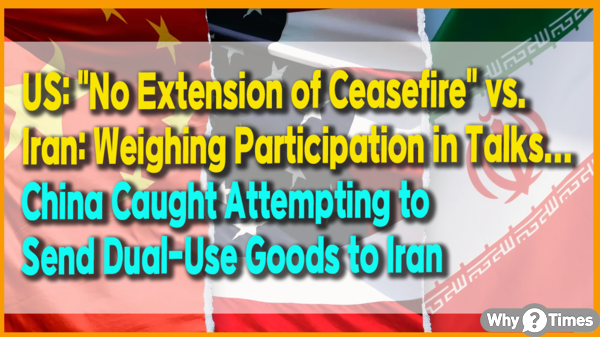
As the countdown begins for the expiration of the two-week ceasefire in the US-Iran war, the prospect of the second round of peace talks in Islamabad, Pakistan, remains uncertain due to the US seizure of an Iranian cargo ship. However, despite declaring they will reject any "table of surrender," Iran appears to be leaning toward participating in the negotiations. The US delegation has already departed for Islamabad, while President Donald Trump is ramping up pressure on Iran to join the talks, stating, "No deal means resumed bombing." Amidst this tension, China faced international embarrassment after being caught by the US Navy attempting to send dual-use military goods to Iran.
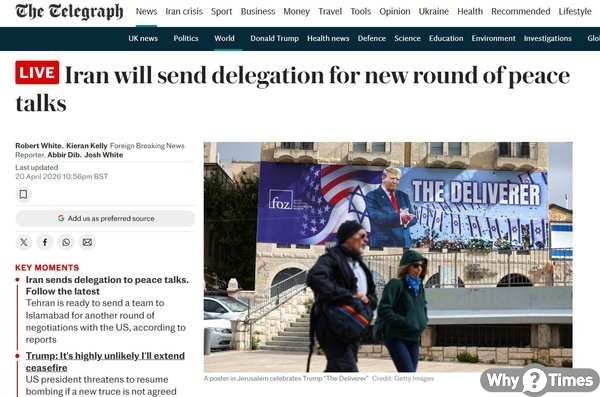
On the 21st, The Telegraph reported, "While Iran repeatedly refuses to confirm its attendance at the new round of negotiations, engaging in last-minute tug-of-war, it has effectively decided to dispatch a delegation to Islamabad for talks with the US on the 21st." The report added that the US delegation, led by Vice President JD Vance, departed for Islamabad on the evening of the 20th.
The Telegraph further noted, "Iran has publicly dismissed the possibility of reaching an agreement, citing excessive US demands. Iranian Foreign Minister Abbas Araghchi accused Washington on the evening of the 20th of committing 'continuous ceasefire violations.' President Masoud Pezeshkian also stated that Tehran holds deep, historical distrust toward the US, asserting that 'Iranians do not yield to force.'"
However, these hardline remarks from the negotiating faction are interpreted as internal rhetoric meant to appease domestic "resistance-at-all-costs" hardliners. Ultimately, it appears Iran has decided to engage in dialogue with the US to resolve its dire domestic situation. Nevertheless, concerns persist that the negotiating table could be overturned at any moment by the hardliners, centered around the Islamic Revolutionary Guard Corps (IRGC). Given this volatility, President Donald Trump is maintaining a stern stance, warning, "There will be no extension of the ceasefire," and "Bombing will resume immediately if a deal is not finalized." The ceasefire is set to expire on the night of the 22nd.
[Iran’s Lead Negotiator: "We Will Not Sit at the Table of Surrender"]
Notably, Mohammad Bagher Ghalibaf, Speaker of the Iranian Parliament and expected lead negotiator, declared on X (formerly Twitter), "Our team will not accept negotiations with the US held under Trump's threats." He argued that the second round of talks is merely a "table of surrender" prepared by the US and demanded a cessation of threats as a precondition for negotiation.
President Masoud Pezeshkian echoed this sentiment, emphasizing deep-seated historical distrust and stating, "Iranians do not succumb to power." These statements from the two primary negotiators come as hardline sources near the IRGC dismiss the Islamabad talks entirely.
This is interpreted as a request for the US to moderate its ultra-hardline conditions to provide Iran with a "justification" to join the talks. The two influential negotiators are essentially calling for "carrots" to pacify domestic hardliners. It is assessed that for the Iranian delegation to depart for Islamabad, there must be a corresponding message from the US; if such an understanding is reached, negotiations are expected to proceed smoothly.
In this context, President Trump issued a series of statements on the 20th that oscillated between threats and conciliation. In an interview with PBS, Trump warned, "If an agreement is not reached within the ceasefire period, the bombs will start dropping," while simultaneously vowing to create a "much better deal than former President Obama’s 2015 nuclear deal (JCPOA)." Trump has long criticized the 2015 JCPOA as "one of the worst deals ever made for our national security," claiming it provided a "guaranteed path" for Iran to obtain nuclear weapons.
Furthermore, in a series of posts on Truth Social, Trump declared, "If a deal with Iran is reached, not only Israel and the Middle East, but also Europe, the US, and the entire world will be guaranteed peace, security, and safety." Trump’s signature negotiation style—deploying both threats and inducements—has once again taken center stage.
[Three Core Issues: Enrichment, Uranium Disposal, and Hormuz]
The core challenges of the negotiations can be boiled down to three key issues:
Nuclear Enrichment Suspension Period: The US demands a suspension of enrichment for up to 20 years, while Iran proposes a limited 5-year suspension, resulting in a stalemate. Iran argues that a demand for indefinite suspension violates its "nuclear sovereignty." However, some flexibility has been detected. The Wall Street Journal (WSJ) reported that Iran queried the US about the possibility of resuming parts of its nuclear program after 10 years. Specifically, a plan is being considered for a total enrichment halt for 10 years, followed by another 10 years where small amounts of low-enriched uranium production would be permitted.
Disposal of Enriched Uranium: Experts analyze that Iran will likely show strong resistance to giving up its enriched uranium stockpiles, as such a move cannot be easily reversed. However, the US position is clear: the very justification for starting this war was the recovery of Iran’s enriched uranium. Therefore, a compromise is expected where Iran peacefully transfers the material to the US in exchange for economic development funds.
The Strait of Hormuz: The US reaffirmed its policy not to lift the maritime blockade on Iranian ports until a final agreement is reached. Iran has used this blockade as a justification to re-block the Strait of Hormuz over the weekend, with hardliners insisting there will be no talks unless the blockade is lifted first. However, it is projected that both sides could reach a compromise for a simultaneous full reopening contingent upon a successful negotiation.
[US Navy Seizes Cargo Ship from China Bound for Iran... 'Dual-Use' Military Supplies Captured]
Amidst these developments, Fox News reported on the 21st that the US Navy forcibly intercepted an Iranian-flagged cargo ship attempting to break through the maritime blockade near the Strait of Hormuz and seized suspicious cargo.
According to the report, "US Central Command (CENTCOM) announced on the 19th that it intercepted and seized the cargo ship Touska bound for Iran near the Gulf of Oman." This operation was carried out as part of the maritime blockade declared by the US in response to Iran’s closure of the Strait of Hormuz. CENTCOM noted that despite multiple orders to stop after violating the blockade zone, the Touska ignored the commands and continued its course for approximately six hours.
The US guided-missile destroyer USS Spruance ordered the crew of the Touska to evacuate to the engine room and then fired upon the vessel’s propulsion system, completely disabling it. US Marines then boarded the ship and took control without resistance.
The nature of the cargo was significant. Fox News stated, "The US military is currently conducting a detailed inspection of the seized cargo, discovering a large quantity of 'dual-use' items that can be used for both civilian and military purposes." Tracking records revealed that the Touska had recently docked several times at Zhuhai, a major port in southern China, before traveling through Southeast Asia and departing Port Klang, Malaysia, on the 12th toward the Iranian port of Bandar Abbas.
Maritime security experts noted, "It appears Iran has been sourcing strategic materials through supply routes linking China and Southeast Asia despite heavy US pressure."
Ray Powell, director of the maritime transparency organization 'SeaLight,' analyzed, "Attempting to break the blockade while powerful US naval forces are deployed is evidence of how desperate Iran was for that cargo." He pointed out that the waters near Malaysia, where enforcement is often lax, are frequently used for ship-to-ship (STS) transfers to 'launder' the origin of cargo.
The Chinese government responded sensitively to the incident. Chinese Foreign Ministry spokesperson Guo Jiakun warned during a regular briefing on the 20th that "the situation in the Strait of Hormuz remains sensitive and complex" and expressed "concern" over the US seizure.
As China has positioned itself as Iran’s primary economic partner and mediator, this seizure is expected to become a new diplomatic flashpoint between the US and China.
The US operation is part of a military campaign against Iran named 'Operation Epic Fury.' The US strategy aims to squeeze Iran economically through a maritime blockade to bring it to the negotiating table while avoiding direct strikes on Iranian territory. However, with this seizure threatening the fragile ceasefire brokered by Pakistan and revealing that Chinese dual-use military supplies were heading to Iran, tensions in the Middle East have reached a fever pitch, signaling an impending clash between the US and China.

- TAG