


추부길 whytimespen1@gmail.com
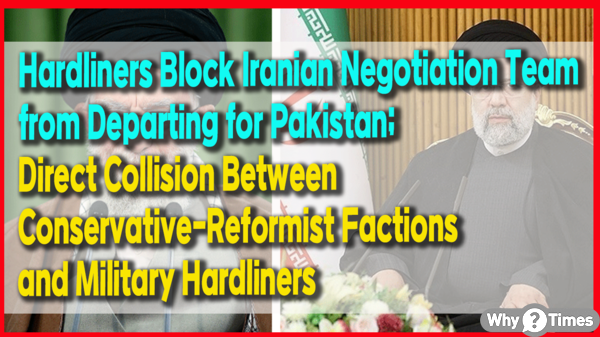
[Ghalibaf Publicly Defends Iran-U.S. Negotiations Despite Hardliner Attacks]
Mohammad Bagher Ghalibaf, Speaker of the Iranian Parliament and chief negotiator, reportedly attempted to participate in ongoing negotiations with the United States in Islamabad. However, military hardliners within Iran blocked his departure to Pakistan, labeling him a "traitor." This represents a direct confrontation between realistic pragmatists and dogmatic hardliners. The fact that this internal struggle is being broadcast live via state media suggests that chaos within Iran has reached a tipping point, potentially leading to armed conflict or an internal coup.
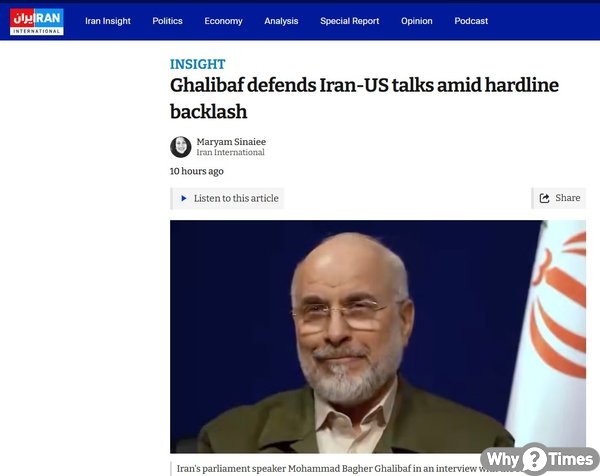
Iran International reported on the 20th that "Ghalibaf, a key political figure, gave an exclusive interview to state broadcaster IRIB on the 19th to justify the indirect negotiations with the U.S. in Islamabad." According to the report, Ghalibaf strongly denied the "humiliating diplomacy" frame pushed by hardliners, instead defining diplomacy as an essential tool to complete military victories.
Utilizing his background as a former member of the Islamic Revolutionary Guard Corps (IRGC), Ghalibaf argued that "diplomacy is not a withdrawal from the battlefield, but another form of struggle that transforms battlefield achievements into political results and sustainable peace." He declared, "To me, there is no difference between the battlefield and the negotiating table," adding that he is willing to sacrifice both his life and honor to secure the rights of the Iranian people.
Conservative outlet Tabnak interpreted this as Ghalibaf presenting a strategic framework that activates military power, public support, and diplomacy simultaneously. Meanwhile, the centrist Asr-e Iran viewed it as a "broader roadmap for Iran to confront the U.S. and Israel."
Notably, Ghalibaf warned against "national narcissism," cautioning against overestimating Iran's diplomatic leverage. He offered a realistic diagnosis that the U.S.'s military superiority and technical capabilities should not be underestimated. This is seen as a rare "realist approach" within the Iranian leadership, signaling an intent to secure sanctions relief and economic benefits through sophisticated maneuvering rather than unconditional confrontation.
[Hardliners Label Ghalibaf a 'Traitor' and Launch Offensive via Eitaa]
Ghalibaf’s move faced immediate backlash. Hardline factions, centered on the indigenous Iranian social media platform 'Eitaa,' began attacking him using extreme terms such as "traitor" or "coup leader." They claim Ghalibaf is crossing the "red lines" set by Supreme Leader Ayatollah Seyyed Ali Khamenei and exposing Iran's weaknesses to the United States.
One critical post on Eitaa stated, "There is no benefit to negotiations other than harm," dismissing Ghalibaf’s optimism as a "worrisome sign." Some extremist supporters even called for the IRGC to intervene directly to stop Ghalibaf’s "arbitrary actions." At nightly pro-government rallies, protesters expressed fury over potential concessions—such as the transfer of highly enriched nuclear material abroad—chanting slogans like "Death to the compromisers."
This conflict has transcended policy differences, evolving into a power struggle over the next presidency and the nation's leadership structure. Social media accounts linked to Saeed Jalili, Ghalibaf’s long-time rival, have branded Ghalibaf a "coup plotter." These accounts even pressured Mojtaba Khamenei (the Supreme Leader's son) to clarify his stance if he supports the talks, asserting that independent actions without the Leader's approval are intolerable.
[Reformists Declare Support: "Protect the Rational Soldier-Politician"]
Interestingly, Ghalibaf is receiving unexpected support from the reformist camp. Mohammad Ali Abtahi, former Vice President under President Mohammad Khatami, stated on social media that a "rare historical moment has placed Ghalibaf in a position of a 'rational soldier-politician' whom anyone who loves Iran should support."
Journalist Ahmad Zeidabadi also praised Ghalibaf's courage for stepping forward in the current high-tension international climate, noting that Ghalibaf is "risking his political life and honor to attempt a breakthrough."
This landscape highlights a dual fracture within Iran: while hardliners view any negotiation as a prelude to surrender, reformists and pragmatists see diplomacy as an inevitable choice under mounting military and economic pressure. As the Trump administration gauges the possibility of resuming talks following the Islamabad breakdown, the world is watching to see if Ghalibaf can break through the hardliners' encirclement.
[IRGC Seizes Full Control, Ousting Moderates]
Amidst this turmoil, there are growing concerns that the IRGC is monopolizing military and diplomatic authority, effectively taking full control of the state administration in Tehran.
The New York Post, citing analysis from the Institute for the Study of War (ISW), reported that "General Ahmad Vahidi, Commander-in-Chief of the IRGC, and his associates have seized full power." This shift is evidenced by recent Iranian attacks on vessels in the Strait of Hormuz and the refusal to attend scheduled peace talks with the U.S.
The report suggests that moderates, including Foreign Minister Abbas Araghchi, have been completely sidelined. While Araghchi had initially agreed to keep the Strait of Hormuz open in a deal with the Trump administration, the IRGC overrode this, demanding the closure of the strait in response to the U.S. blockade of Iranian ports.
With the support of Mohammad Bagher Zolghadr, Secretary of the Supreme National Security Council, Commander Vahidi has solidified his position. Zolghadr reportedly monitored the negotiation team to ensure they followed the orders of the IRGC and Mojtaba Khamenei. ISW noted that Zolghadr complained to the IRGC leadership that Araghchi had "abused his authority" by showing flexibility regarding support for the "Axis of Resistance."
Currently, the alliance between Vahidi and the IRGC has emerged as the supreme decision-making body in Iran, especially as Mojtaba Khamenei remains out of the public eye. This implies that figures like Araghchi and Ghalibaf have lost substantial executive power. As the future of U.S.-Iran negotiations grows murky, it remains uncertain whether the ceasefire deadline on the 21st will be extended.

- TAG