


김정희 whytimes.newsroom@gmail.com
[Trump Announces Dispatch of Negotiation Team to Pakistan; Iran Suspects a "U.S. Trap"]
With only two days remaining before the two-week ceasefire between the U.S. and Iran expires, President Trump has announced a second round of negotiations in Islamabad. However, Iran is refusing to confirm its participation, expressing deep suspicion regarding U.S. intentions. In short, while Iran is attempting to pressure the U.S. by speaking with two voices—negotiation and hardline resistance—the U.S. is launching a counter-offensive by seizing an Iranian ship that breached the blockade. Global attention is now focused on whether Iran will choose the conference table or "resistance to the death."
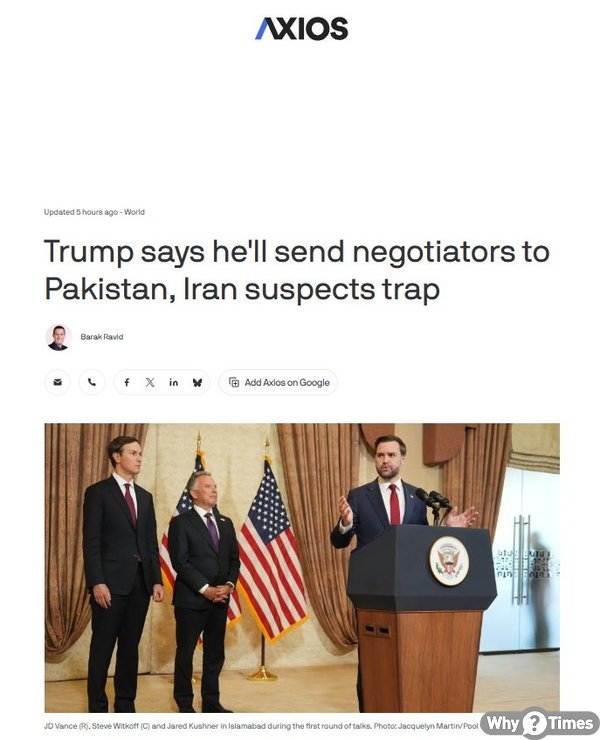
The U.S. online news outlet Axios reported on the 20th, “President Trump announced via Truth Social and media interviews that a U.S. delegation—consisting of Vice President JD Vance, Special Envoy Steve Witkoff, and former Senior White House Advisor Jared Kushner—will depart for Islamabad, Pakistan, for further talks with Iran.” The report added, “However, as of early this morning, the Iranian side had not officially confirmed its participation, and some Iranian officials have publicly expressed doubts that the proposal may be a diversionary tactic for a U.S. surprise attack.”
Axios further noted, “This proposal comes approximately 12 days after President Trump declared a two-week ceasefire with Iran on the 7th. Previous negotiations mediated by Pakistan, which lasted 21 hours over three rounds (indirect for the first, direct for the second and third), failed to reach an agreement.” The situation has deteriorated sharply since the breakdown of those talks.
Iran reaffirmed its stance that it will not open the Strait of Hormuz unless the U.S. lifts its maritime blockade of Iranian ports. The Islamic Revolutionary Guard Corps (IRGC) Navy warned that all vessel movement in the Persian Gulf and the Gulf of Oman is prohibited, and any ship approaching the Strait of Hormuz will be considered as cooperating with the enemy and targeted for attack.
According to the United Kingdom Maritime Trade Operations (UKMTO), an incident occurred where two IRGC gunboats fired upon an Indian-flagged oil tanker attempting to transit the strait. President Trump claimed on Truth Social that “Iran has fired on multiple ships, including French and British cargo vessels,” defining these actions as a “total violation of the ceasefire agreement.” This development is seen as throwing cold water on the negotiation mood, following Trump's earlier confidence that a peace deal was imminent.
[Final Diplomatic Push and Trump’s "Ultimatum"]
During a brief call with Axios on the 19th (local time), President Trump expressed strong optimism. “I feel very good right now. The basic concept for a deal has already been established, and I believe there is a very high probability of finalizing it,” Trump emphasized.
The U.S. delegation’s trip to Islamabad carries the weight of a "final showdown" rather than a mere diplomatic contact. The U.S. aims to extend the 14-day short-term ceasefire dramatically brokered by Pakistan on April 8, or further, to sign a permanent peace treaty to end the conflict. However, while extending a diplomatic hand, Trump is simultaneously pressuring Iran with an unprecedentedly harsh warning.
Trump issued an ultimatum via Truth Social, urging a change in Iran’s attitude. “We are making a very fair and reasonable DEAL, and I hope they accept it,” he stated, but added, “If they refuse, the U.S. will destroy every power plant and bridge in Iran. NO MORE MR. NICE GUY!” This clearly signals that the U.S. is prepared to strike civilian infrastructure if negotiations fail, expressing a firm resolve to stop Iran’s "Killing Machine."
[Iranian Distrust and Threats to Boycott Talks]
Conversely, Iranian state media denied the negotiation plans, stating that the prospects for productive talks are bleak due to "unreasonable and unrealistic U.S. demands, frequent changes in position, constant contradictions, and the ongoing maritime blockade." Reza Amiri-Moghaddam, the Iranian Ambassador to Pakistan, declared on X (formerly Twitter), “As long as the U.S. continues its maritime blockade, the root of the conflict will not disappear.”
Chief negotiator Ghalibaf made it clear: “It is impossible for other countries to pass while we cannot,” reiterating that the Strait of Hormuz will remain closed unless the blockade on Iranian ports is lifted. Internal voices in Iran are increasingly calling for military resistance over "useless" negotiations.
Nevertheless, Iran continues to leak information to the mediator, Pakistan, suggesting a possibility of showing up at the table. This indicates that Iran is employing "brinkmanship" to extract dramatic concessions from the U.S. Experts analyzing U.S.-Iran relations assess that while the parties seem to be moving away from a deal, the situation is not yet irreversible. However, they note that the gap remains difficult to bridge as the Trump administration sets the abandonment of Iran’s nuclear development as a prerequisite.
[U.S. Navy Seizes Iranian Vessel; “Engine Room Disabled”]
Amidst this, another incident highlighted U.S. resolve. A U.S. Navy destroyer forcibly seized an Iranian cargo ship attempting to break through the blockade in the Gulf of Oman.
On the 20th, President Trump announced, “The Iranian cargo ship 'Touska' attempted to breach the maritime blockade but was intercepted by the U.S. Navy.” He explained that the guided-missile destroyer USS Spruance physically stopped the vessel—which had ignored orders to halt—by firing into its engine room. Trump added that the Touska was already on the Treasury Department's sanctions list for past illegal activities and is currently in U.S. custody.
U.S. Central Command (CENTCOM) stated, “The Touska ignored repeated warnings for six hours while sailing toward Bandar Abbas. Following the destroyer's fire, members of the 31st Marine Expeditionary Unit (MEU), deployed to the Middle East last month, boarded and completed an inspection of the vessel.”
[Deepening Fractures in Iranian Leadership]
A critical issue is the extreme confusion between Iranian government departments regarding the opening of the Strait of Hormuz, revealing serious cracks within the regime.
The Telegraph reported on the 20th that although Foreign Minister Abbas Araghchi abruptly announced on the 17th that the strait would be "fully open" to commercial vessels, the IRGC contradicted this just hours later. The IRGC emphasized it maintains "strict management and control" over the waterway and fired warning shots at ships attempting to pass. This immediate backlash suggests a severe conflict between hardliners and moderates over relinquishing control of the strait—their primary leverage against the U.S.
Political criticism followed. Hossein Shariatmadari, editor of Kayhan (appointed by Supreme Leader Ali Khamenei), demanded in an open letter that Araghchi withdraw the decision. Hardline media outlets blasted the minister for informing the world via social media before explaining the policy to the Iranian people, claiming "Iranian society has fallen into a swamp of chaos." While Speaker Ghalibaf later tried to manage the situation by claiming the move was part of Lebanon ceasefire conditions, the uncoordinated explanations only highlighted the lack of communication between ministries.
The Telegraph pointed to the "power vacuum" at the heart of Iran’s leadership as the root cause of this institutional paralysis. With Ali Khamenei's body yet to be buried and his son Mojtaba Khamenei’s authority not yet fully established, the mechanisms to resolve elite conflict are failing. The death of Ali Larijani last month—who previously maintained discipline between the military and civilian sectors—and his replacement by IRGC-affiliated Mohammad Bagher Zolghadr, has removed the neutral mediator from the system.
Experts analyze that Iran's failure to speak with a unified voice has handed the initiative to President Trump. Tehran-based analyst Mostafa Najafi noted, “Iran exposed a weakness in its ability to build a narrative, and Trump immediately seized upon it.” Indeed, Trump is pressing for concessions, claiming Iran has agreed to give up enriched uranium while maintaining the maritime blockade.
Ultimately, the IRGC—which controls 40% of the Iranian economy—fears that accepting U.S. terms would result in the total loss of their vested interests. While they frame their resistance in the name of the "Islamic Empire," their true motive appears to be protecting their own power. The tragedy, observers note, is an egoism that prioritizes the survival of their own interests over the survival of the Iranian state itself.

- TAG