


추부길 whytimespen1@gmail.com
Iran Attacks 2 Vessels in Hormuz; Trump Calls White House Situation Room Meeting
With only three days remaining until the expiration of a two-week ceasefire between the U.S. and Iran, Iran has abruptly re-blocked the Strait of Hormuz and resumed attacks on civilian vessels. In response, President Donald Trump urgently convened a White House Iran Situation Room meeting to coordinate a response. Amidst these tensions, the U.S. Navy destroyer USS Gerald R. Ford has entered the Red Sea, and the U.S. military has decided to begin operations to seize Iran-linked vessels in international waters worldwide within days.
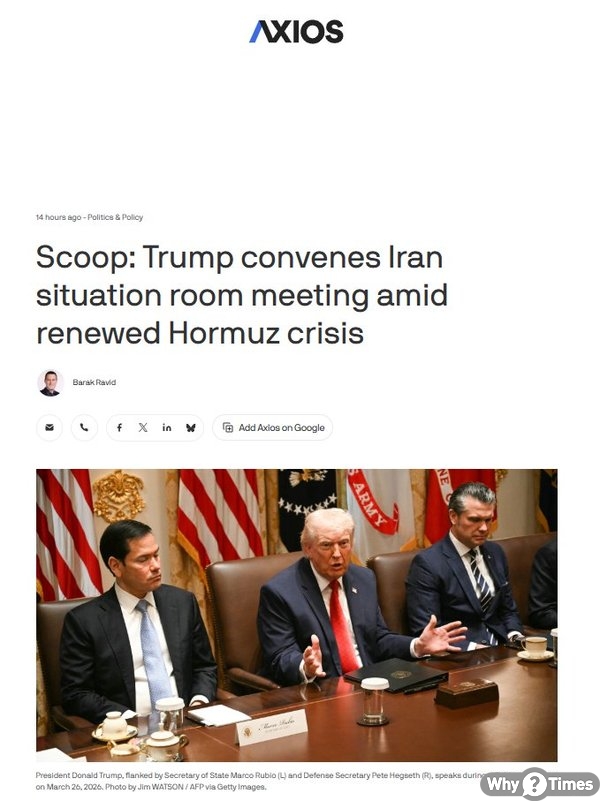
On the 19th, the U.S. media outlet Axios reported: "As the Islamic Revolutionary Guard Corps (IRGC) declared full control over the Strait of Hormuz until the U.S. lifts its maritime blockade and began attacking passing ships, the Trump administration convened an emergency meeting in the White House Situation Room to discuss countermeasures regarding the re-blockade and the upcoming expiration of the ceasefire."
The meeting was attended by high-ranking officials, including Vice President JD Vance, Secretary of State Marco Rubio, Secretary of Defense Pete Hegseth, and Treasury Secretary Scott Bessent. Also present were White House Chief of Staff Susie Wiles, Special Envoy Steve Witkoff, CIA Director John Ratcliffe, and Chairman of the Joint Chiefs of Staff Dan Cain. Senior U.S. officials warned that "war could resume within days if a diplomatic breakthrough is not achieved soon."
Indeed, IRGC fast boats opened fire on an Indian-flagged oil tanker approximately 20 nautical miles northeast of Oman at around 1:00 PM on the 18th, despite no signs of provocation. The United Kingdom Maritime Trade Operations (UKMTO) stated, "Immediately after this attack, another Indian-flagged container ship was struck by an unidentified projectile, causing cargo damage. A third merchant ship east of Oman witnessed projectile debris falling into nearby waters but sustained no direct damage."
Following the attacks, ship-tracking data showed numerous vessels turning back to avoid the strait. After an Indian tanker carrying 2 million barrels of Iraqi crude oil was forced to retreat, the Indian government summoned the Iranian ambassador to express deep concern and demand the immediate restoration of safe passage. The motive behind the attack remains unclear, as Iran had previously permitted passage for Indian vessels.
Regarding the incident, President Trump warned at a White House press conference: "Iran is trying to close the Strait again as they have done for decades, but they cannot blackmail us." However, he offered an unexpectedly optimistic outlook, stating, "Aside from the violence, diplomatic dialogue is proceeding very well." He added that the long-term impact of the closure would be limited as global shipping companies are already rerouting to ports like Texas and Louisiana.
The U.S. Central Command (CENTCOM) confirmed that "23 vessels have turned back under U.S. military direction since the start of the blockade."
Negotiation Clock Ticking… D-3, 'Fire' or 'Deal'
The most critical variable is time. The two-week U.S.-Iran ceasefire expires on April 21 (EST). A second round of negotiations was expected to take place in Islamabad, Pakistan, but the feasibility of the meeting is now uncertain due to Iran's aggressive re-blockade. While Trump hinted at a willingness to extend the ceasefire if necessary, he has kept the possibility of renewed war open without a breakthrough, having previously declared, "If no deal is made, the fighting resumes."
A Pakistani government official maintained a cautious stance, saying, "We must wait and see if a deal happens. We remain hopeful and are continuing to press both sides." Some sources suggest a format where the two countries first sign an MOU on principles during the second round, followed by a detailed final agreement within 60 days.
The most unsettling paradox of this crisis is that armed provocations resumed just as progress was being made at the negotiating table. The Strait of Hormuz, a vital energy artery for one-fifth of the world’s oil supply, has emerged alongside the nuclear deal as the greatest obstacle to ending the war. The world is now watching the final choices of Trump and Iran at this crossroad between a historic deal and a return to war.
U.S. Forces Launch Global High-Seas Seizure Operations
In a move to decisively cut off Iran’s funding, the U.S. military is launching a massive operation to seize Iran-linked tankers and commercial vessels in international waters globally.
The Wall Street Journal (WSJ) reported on the 19th: "The U.S. military has completed preparations to board and seize Iran-linked vessels in international waters." This unprecedented expansion of maritime interdiction—moving beyond the Strait of Hormuz to the global high seas—will target weapon and crude oil carriers even outside the Persian Gulf.
The WSJ noted that the primary targets are the "dark fleet"—shadow vessels that transport Iranian oil illegally while evading sanctions by turning off their Automatic Identification Systems (AIS).
Chairman of the Joint Chiefs of Staff Dan Cain emphasized, "The U.S. will actively track not only Iranian-flagged vessels but any vessel providing material support to Iran." As 90% of Iran’s oil exports go to China, this operation is expected to cause inevitable financial and diplomatic friction with Beijing.
According to the WSJ, this military move aligns with the Treasury Department’s "Operation Economic Fury." Treasury Secretary Scott Bessent recently sent letters to two Chinese banks warning of "secondary sanctions" for facilitating transactions with Iran. The U.S. strategy aims to completely sever the link through which Iran receives oil payments via Chinese banks despite being barred from the dollar clearing system and SWIFT.
Law enforcement is also on the offensive. Acting Attorney General Todd Blanche announced a policy to prosecute all buyers of sanctioned Iranian oil, while the Washington D.C. Federal Prosecutor’s Office has activated a "Threat Finance Unit" to track Iran’s global financial networks. Experts analyze this as a "maximum pressure" tactic to force concessions on the nuclear program.
USS Gerald R. Ford Deployed to the Red Sea
The deployment of the USS Gerald R. Ford, the U.S. Navy's most advanced nuclear-powered aircraft carrier, from the Mediterranean to the Red Sea has further heightened military tensions.
Iran International reported on the 19th: "This movement is a measure to strengthen military readiness for a potential resumption of attacks against Iran if the ceasefire is not extended." President Trump also showcased strength by sharing videos on Truth Social featuring Iranian-Americans and citizens within Iran supporting U.S. military action. He posted an image with the caption, "The best is yet to come," hinting at further hardline responses.
CENTCOM announced that the maritime blockade of Iranian ports is being strictly enforced, effectively halting Iran's maritime trade. Naval forces, led by the USS Rushmore, have pushed into the Arabian Sea to block Iran’s economic corridors.
Iran Unable to Hold Funeral for Assassinated Khamenei
A notable development is that the body of Iran’s Supreme Leader Ali Khamenei, who was killed in a joint U.S.-Israeli airstrike in February, has not been buried for over 50 days.
Khamenei died at the age of 86 on February 28, 2026, following a precision strike on his residence in Tehran. Despite Islamic tradition requiring immediate burial, Iranian authorities continue to delay the process, citing a lack of security measures for large crowds. Security experts interpret this as evidence of a "weakened regime, too terrified to take risks."
The regime's hesitation stems from multiple fears: the risk that high-ranking officials attending the funeral could become targets for further Israeli strikes, and the possibility that anti-government protests could overshadow the mourning. Furthermore, Khamenei’s son and successor, Mojtaba Khamenei, has not appeared in public since his appointment, leaving the regime in an awkward position.
Behnam Ben Taleblu, a senior fellow at the Foundation for Defense of Democracies (FDD), criticized the regime, stating: "The regime has shut down the internet for 50 days to stop the truth from spreading, but this only proves how fragile their foundation is." While Iran claims the delay is to prepare for "unprecedented crowds," the international community views it as a sign of a severe power vacuum and internal collapse.

- TAG