


추부길 whytimespen1@gmail.com
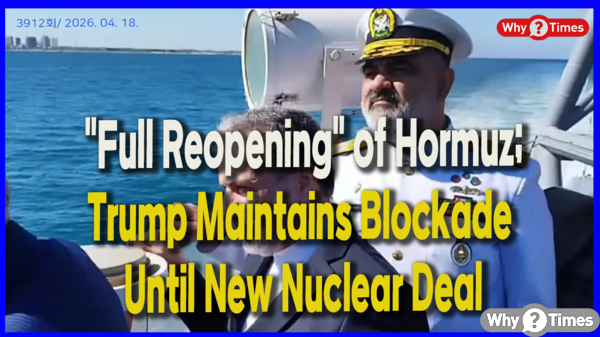
[Trump: "Iran Agreed Never to Block the Strait of Hormuz Again"]
The crisis in Iran is shifting rapidly. Iran has declared the full reopening of the Strait of Hormuz. In response, U.S. President Donald Trump stated, “While the reopening is appreciated, the U.S. blockade will remain in place until a nuclear deal is reached,” signaling continued pressure on Tehran. Iran’s sudden shift in posture appears to be driven by a sense of crisis within its leadership, as the U.S. counter-blockade has resulted in zero revenue for the regime.
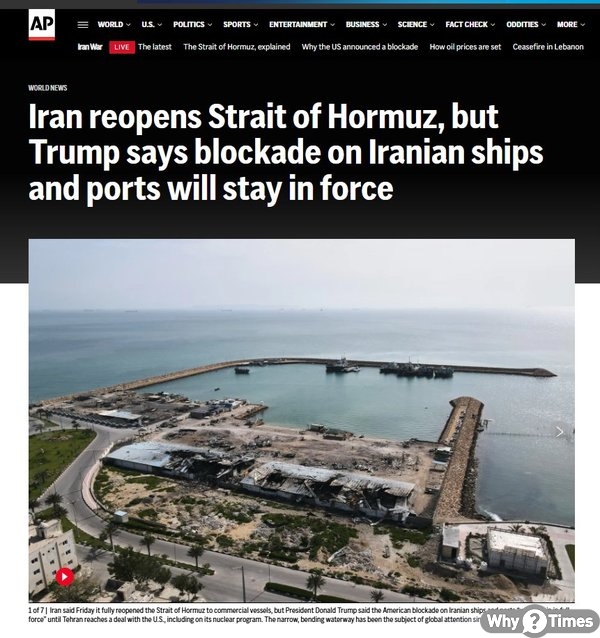
On the 18th, AP reported that Iranian Foreign Minister Abbas Araghchi announced via his X (formerly Twitter) account that the strategic strait—through which 20% of the world's oil flows—is now fully open to commercial vessels. This move coincides with a 10-day ceasefire holding between Israel and the Iranian-backed militant group Hezbollah in Lebanon. However, President Trump countered that the U.S. blockade of Iranian ships and ports would remain fully enforced until an agreement is reached on several issues, including Iran’s nuclear program.
AP further noted that Araghchi indicated vessels must use routes designated by the Islamic Republic in consultation with Iranian authorities, suggesting Tehran intends to maintain a degree of control. Data analysis firm Kpler confirmed that passage through the strait is currently limited to corridors requiring Iranian approval.
[Trump: "Iran Has Consented to Most of My Demands"]
Regarding these developments, President Trump declared that Iran has effectively accepted all U.S. demands, including a permanent halt to its nuclear program. However, the Iranian government immediately denied this, leading to a "truth battle" between the two sides.
On the 17th, Trump stated via social media that Iran had agreed to an "indefinite" suspension of nuclear activities and that the process of transferring highly enriched uranium stored underground to the U.S. is progressing smoothly. Notably, he specified a plan to excavate and transport the uranium using heavy equipment in cooperation with Iran, without deploying ground troops. He also made it clear that "no cash compensation" would be paid to Iran for this deal.
The most immediate effect of the announcement was the reopening of the Strait of Hormuz. Trump claimed that Iran is currently removing mines from the strait and has promised never to close it again. Following this announcement, Brent crude futures plummeted more than 10%, falling below $89 per barrel. Global financial markets reacted instantly to the news of the reopening of a route responsible for 20% of global oil and gas shipments.
Tehran’s response, however, was cold. Foreign Minister Araghchi clarified that the reopening is limited to the temporary ceasefire period and passage is only allowed through "coordinated routes." The Iranian Foreign Ministry dismissed Trump’s claims in a statement, saying, "The Americans are making noise and exaggerating the situation," and that "no new agreement exists." President Masoud Pezeshkian also criticized Trump’s remarks as "groundless rhetoric" intended to undermine the pride of the Iranian people.
["Zero Revenue" from Iran's Blockade Attempt... Leadership Mired in Turmoil]
Internal conflict in Iran is reportedly intensifying as the plan to collect "transit fees" by blocking the Strait of Hormuz has effectively failed. Iran International reported that high-ranking officials are lashing out because revenue from shipping fees has fallen far short of expectations. Since the start of the conflict, the Iranian government had planned to collect up to $2 million (approx. 3 billion KRW) per tanker. A specialized committee, led by Mohammad Bagher Zolghadr, Secretary of the Supreme National Security Council, had been meticulously preparing for this.
Last month, the Iranian parliament even established a legal basis for these fees, including a payment system using the Iranian Rial and cooperation with neighboring Oman. However, these national efforts yielded negligible results. Records show that payment was requested for only eight shipments, and zero actual revenue has reached the national treasury to date.
As the plan stalled, the Iranian leadership began seeking accountability. Discussions are reportedly underway to dismiss Secretary Zolghadr and transfer all related authority to President Pezeshkian. This is interpreted as a move to punish early planning failures and have the head of state directly seek a breakthrough.
Despite the internal friction, some hardline lawmakers remain optimistic. Representative Ahmad Naderi claimed on the 16th that the project could generate up to $15 billion (approx. 22 trillion KRW) annually if it gets on track, calling the monetization of the strait's geography a "key to national economic reconstruction."
Experts, however, are skeptical. The U.S. counter-blockade has completely severed Iran’s primary source of income—crude oil exports. Consequently, Iran is suffering astronomical losses of approximately $435 million (approx. 641 billion KRW) daily. In an attempt to collect fees, they have instead crippled their own economy by losing access to core resource export routes. Currently, Iranian oil storage facilities are at a dangerous 51% capacity. If the U.S. blockade is not lifted within two weeks, Iran may be forced to cut production entirely as storage tanks reach full saturation.
[Trump: "War Ending Agreement This Weekend"... Discussion on Permanent Nuclear Halt]
Amidst this, President Trump provided a bold outlook, stating that "negotiations to end the war with Iran will resume this weekend and reach a final settlement shortly."
In a phone interview with Axios on the 17th, Trump claimed that Iran "strongly desires a meeting and an agreement with the U.S." He mentioned a high probability of talks happening this weekend, adding, "I believe we can reach a practical agreement within a day or two."
In a separate interview with Bloomberg, Trump continued his optimism, suggesting that most major issues have been finalized. He emphasized that the halt of Iran's nuclear program would be "indefinite," marking a departure from past time-bound agreements and signaling a hardline U.S. stance to root out the nuclear threat permanently.
Pakistan, which hosted the first round of talks, is the likely venue for this second round. While Vice President JD Vance led the U.S. delegation on the 11th, Trump has left the door open for his own attendance. He told Bloomberg that while a head of the delegation has not been finalized, he may personally travel to Pakistan to lead the negotiations, exerting further pressure on Tehran.
Practical cooperation for de-escalation is also surfacing. Trump told Reuters that the U.S. is working closely with Iran to remove mines in the Strait of Hormuz. This is viewed as a preemptive measure to ensure the safety of the world's economic artery and as a confidence-building step toward a final peace agreement.
However, analysts warn that Iran’s complex internal politics and leadership grievances remain volatile variables. Whether Trump’s "early settlement" boast leads to a signed treaty or stalls due to a final stand by Tehran’s leadership is the focus of global attention heading into the weekend.

- TAG