


추부길 whytimespen1@gmail.com
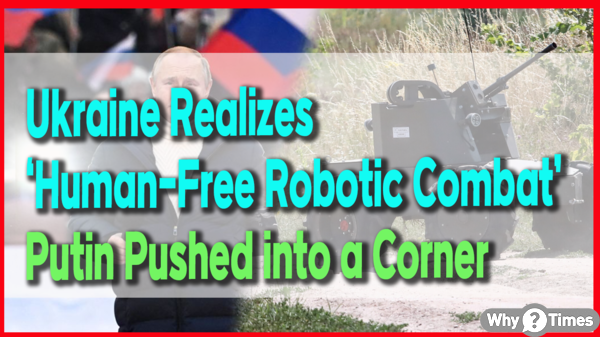
[Unmanned Frontline: Robots Capture Positions Without Infantry]
The Ukrainian military has achieved a fundamental shift in the paradigm of warfare by successfully capturing Russian positions and securing surrenders using only ground robots and drones, without deploying a single infantryman—a first in military history. Conversely, Russia is facing a triple crisis: the exhaustion of military assets due to the protracted war, economic limitations, and a public turning its back on the ruling elite, shaking the very foundations of the state.
On the 16th, the New York Post reported that Ukrainian President Volodymyr Zelenskyy, during his "Arms Makers Day" speech on the 13th, stated: "For the first time in the history of this war, an enemy position was captured solely by unmanned platforms—specifically, Unmanned Ground Vehicles (UGVs) and drones. The occupying forces surrendered, and this operation was carried out without infantry participation and without any losses on our side."
The report noted that while Zelenskyy did not disclose specific details such as the exact location or scale of the operation, he emphasized that this mission serves as a watershed moment changing the course of modern warfare, declaring, "The future is already here on the frontlines."
This was not mere rhetoric. The fact that robotic systems directly engaged in combat and elicited a surrender signifies that "fully autonomous combat," once relegated to the realm of science fiction, has now stepped onto the physical battlefield.
[Operational Flow: FPV Drones First, Robots Followed]
The specific flow of the operation was as follows: FPV (First-Person View) drones entered first to bombard Russian defensive strongpoints. Once the ground was cleared, armed robots moved into the enemy positions, pointing machine guns with 360-degree rotating turrets. Russian soldiers emerged from their shelters with their hands up in surrender. Not a single Ukrainian soldier crossed the start line; there were no medical evacuations and zero Ukrainian casualties.
The Kyiv Independent noted that while this tactical pattern was tested by Ukraine’s 3rd Assault Brigade in the Kharkiv region in July 2025, the April 2026 operation is considered to be on a different level because it involved "capturing a position across the frontline."
The publication further detailed the accumulation of these successes: in January 2026, a UGV (DevDroid TW-7.62) captured three Russian soldiers on the Lyman front, and in March of the same year, a larger model (Droid TW-12.7) held a frontline position alone for 45 consecutive days. These individual incidents have culminated in the systematic "capture" of territory.
President Zelenskyy highlighted these achievements from the perspective of protecting lives. He noted that various UGV models—such as Ratel, TerMIT, Ardal, Rys, Zmiy, Protector, and Volia—have performed over 22,000 missions on the frontlines in the past three months. "Robots saved lives more than 22,000 times by entering the most dangerous areas instead of soldiers," he emphasized.
[Infantry Shortage Births Innovation]
The proliferation of UGVs is driven by structural challenges. As the full-scale invasion enters its fourth year, the shortage of frontline troops has intensified, and traditional infantry-centric tactics have become increasingly costly under the saturation of Russian drones.
A drone system commander from Ukraine’s 12th Azov Brigade (callsign 'Bud') told Foreign Policy, "Sending armored vehicles to evacuate infantry positions is hopeless; you are 100% guaranteed to be engaged on the way." The report explained that with Russian drone 'kill zones' extending up to 15km from the front, human movement has become nearly suicidal.
[Russia Pushed into a Corner: Plunging Approval and State Asset Sales]
Meanwhile, reports suggest that Russia is reeling from the exhaustion of military assets and economic strain. The Russian military is showing significant flaws in its air defense operations, particularly with supply disruptions for the 'Pantsir' system.
Signs of economic crisis are also surfacing. Russian Railways recently put the historic Riga Station in Moscow up for sale for approximately 4 billion rubles (approx. $43 million USD). Putting a symbolic national infrastructure icon on the market suggests that the financial health of major state-owned enterprises and the government has reached a breaking point.
Politically, President Vladimir Putin’s grip on power appears to be weakening. Even in state-run polls, his approval rating fell to a post-invasion low of 67.8%, while private surveys suggest actual trust has collapsed below the 30% mark.
[Putin’s Telegram Ban Faces Backlash from Political Elites]
In a move to tighten control, the Putin regime is facing unprecedented political blowback for attempting to block Telegram and forcibly promote a state-controlled messenger, 'MAKS.'
Carnegie Politika reported on the 15th that Russia’s "political elite"—including major parties, governors, and pro-government bloggers—are collectively protesting the ban. While public dissent within the ruling class is traditionally taboo in Russia, the debate over Telegram has broken this unwritten rule.
The push for a forced transition stems from Telegram's anonymity and uncontrollable information flow. However, with the State Duma elections scheduled for September, politicians who rely on Telegram as their primary promotional tool are pushing back. Even the Governor of Belgorod criticized the move, noting that blocking Telegram would paralyze real-time warning systems for Ukrainian missile and drone attacks.

- TAG