


추부길 whytimespen1@gmail.com
[Counter-Blockade of the Strait of Hormuz Pushes IRGC into a Corner]
Following the collapse of peace talks with Iran, the United States has implemented a full-scale maritime blockade of the Strait of Hormuz. This narrow waterway, long considered the ultimate flashpoint of a Middle East conflict, has now emerged as the final battleground of the U.S.-Iran war. The Iranian military leadership currently stands at a critical crossroads of survival, seemingly left with no choice but to proceed with a second round of peace talks.
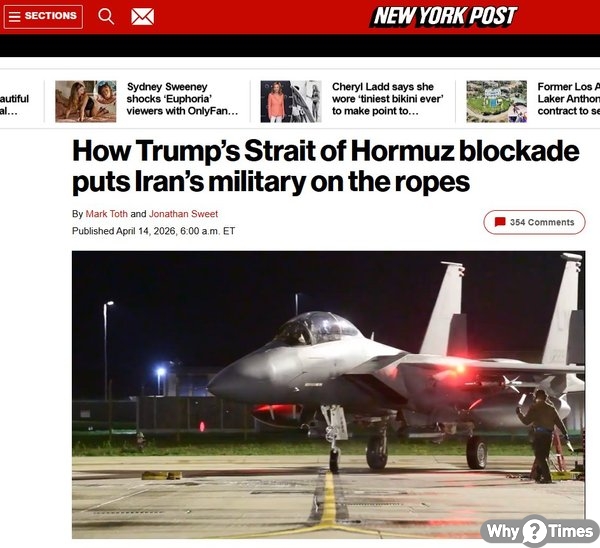
On the 15th, the New York Post reported, “The Iranian negotiating team made a fatal miscalculation in Islamabad last weekend.” The report added, “Speaker Mohammad Bagher Ghalibaf believed that breaking off the talks to stall for time would allow the Islamic Revolutionary Guard Corps (IRGC) to regroup, but Donald Trump’s blockade of the strait has rendered that strategy futile.”
The New York Post continued, “Ghalibaf naively thought that Iran’s control over the Strait of Hormuz—through which 25% of the world’s oil flows daily—would provide a much-needed lifeline for the IRGC.” However, Vice President JD Vance reportedly corrected this notion, clarifying that the U.S. delegation did not fly 7,500 miles to haggle with Iran, but to demand the unconditional surrender of the Islamic Republic. It was in this high-stakes environment that Iran chose to flip the negotiating table.
“President Trump is now targeting the IRGC’s jugular,” the New York Post explained. “While talks were ongoing, Trump ordered the U.S. Navy destroyers USS Frank E. Petersen Jr. and USS Michael Murphy to force transit through the strait, compelling the resisting IRGC Navy to withdraw.” With this move, the U.S. made it clear that this vital waterway is now the front line of the war.
The New York Post noted, “The Strait of Hormuz is the decisive theater of this war. The U.S. had to act because allowing Iran to control the strait would lead to its greatest geopolitical failure. This reality prompted Trump's decision to enforce the blockade.”
The report further emphasized, “The blockade is a warning to the IRGC that their time is running out. It is not difficult for the U.S. to seize Kharg Island—which handles 90% of Iran’s oil exports—or to intercept and block maritime traffic to and from Iranian ports.”
Furthermore, the New York Post argued that focusing solely on a blockade risks giving Tehran time to reorganize. To "break the neck" of the IRGC and end the regime, the U.S. must resume multi-layered military operations. Sustained military pressure through overwhelming force would allow President Trump to exert "maximum pressure" at the moment the IRGC and the regime are most vulnerable, both militarily and economically.
“This means that in addition to tightening the blockade, the U.S. must resume strikes on IRGC and Basij militia targets,” the report stated. “The reason is simple: they are the pillars sustaining the Iranian regime.”
Consequently, experts argue that the U.S. should return to the "Powell Doctrine"—a strategy of rapidly concentrating overwhelming force to break the enemy's will to resist. Analysis suggests that temporary ground deployments along portions of the Iranian coastline may be inevitable to ensure total control of the strait.
Forces such as the U.S. Marines, Army Rangers, and the 82nd Airborne Division—supported by A-10 Warthogs and AH-64 Apache helicopters—would need to secure key coastal points to physically prevent the IRGC from attacking vessels. This is envisioned as a time-limited tactical operation to achieve strategic goals, rather than a permanent occupation of Iranian territory.
Finally, as an additional measure of pressure, special operations teams infiltrating deep into the Iranian interior should seek out regular Iranian military units willing to directly engage the IRGC and Basij militias. “This worked in Afghanistan, and it will work in Iran,” the New York Post predicted.
“Controlling the Strait of Hormuz is crucial for the U.S. as it holds the key to ending Iran’s nuclear program,” the report concluded. “The regime remains obstinate in its nuclear ambitions, and the strait is the only strategic card they have left. Once the waterway is seized and controlled, the game is over—regardless of whether Ghalibaf or the IRGC is at the helm.”
[Blockade as a Strategic Signal to China]
This blockade serves as a message beyond Iran, targeting China as well. The Trump administration has previously pressured energy supply chains in Venezuela and Nigeria in a similar fashion. China currently purchases 90% of the approximately 1.7 million barrels of crude oil Iran exports daily. Thus, the Hormuz blockade is a direct blow to China’s energy security.
As President Xi Jinping expands military influence in the Taiwan Strait and the South China Sea, Trump intends to check Beijing’s expansionism by applying strategic pressure on its core energy supply route. Retired Vice Admiral John Miller, former commander of U.S. Naval Forces Central Command, analyzed that once Iran’s revenue sources are cut off, the regime will find it extremely difficult to survive. The economic strangulation of Iran thus serves a dual purpose as a warning to China.
['End Game' — The Final Showdown with the Nuclear Program]
Experts emphasize that seizing the Strait of Hormuz is more than a military victory; it is the ultimate means to terminate Iran’s nuclear program. The control of the strait is the last remaining strategic card for a regime that refuses to abandon its nuclear ambitions. Losing the strait would collapse the regime's economic foundation and drain the resources required for nuclear development.
The U.S. demanded a pledge to cease nuclear pursuits and the reopening of the strait, neither of which Iran accepted. In response, the Trump administration chose a blockade over negotiations, marking the completion of a "maximum pressure" strategy targeting the regime's very survival. The moment the U.S. effectively controls the Strait of Hormuz, the strategic deterrence the Islamic Republic has built over 40 years will essentially vanish. The fate of the war will be decided upon these narrow waters.
[CENTCOM: "Zero Vessels Passed on First Day of Blockade"]
Meanwhile, U.S. Central Command (CENTCOM) announced, “During the first 24 hours of the blockade targeting Iranian ports, not a single vessel passed through the blockade line.” More than 10,000 personnel from the Navy, Marine Corps, and Air Force, along with over 12 warships and numerous aircraft, have been deployed for this mission.
CENTCOM added, “No ships departing from Iranian ports have breached the U.S. blockade. During this process, six commercial vessels reversed course following U.S. instructions and returned to Iranian ports in the Gulf of Oman. No instances of actual forced intervention have been reported thus far.”
In contrast, more than 20 commercial vessels have recently transited the Strait of Hormuz, suggesting that the flow of traffic in major corridors has improved slightly. A U.S. government official noted, “While commercial volume is still far below pre-war levels, the increase in movement at critical points is noteworthy.” This is attributed to the success of U.S.-led mine-clearing and Freedom of Navigation operations.
On the diplomatic front, UN Secretary-General António Guterres mentioned the possibility of resuming dialogue between the U.S. and Iran. Accordingly, the foreign ministers of Saudi Arabia, Egypt, and Pakistan are scheduled to meet with Turkish officials this week to discuss a proposal for Iran. However, economic pressure continues to mount. The U.S. Treasury Department decided not to extend the temporary permit for the sale of Iranian crude oil already at sea as of late March.
The Treasury announced via social media that the short-term authorization allowing the sale of Iranian oil already in transit will expire within days and will not be renewed. This measure is set to conclude on April 19. While the permit applied to oil in transit and related services like docking and insurance, new purchases and production have remained prohibited. Officials expect this move to release approximately 140 million barrels of oil into the market, helping to mitigate upward price pressure.
[Trump: "Talks in 2 Days"; Mossad: "Mission Until Regime Collapse"]
Amidst these developments, President Donald Trump suggested in an interview with the New York Post on the 13th that talks with Iran could resume in Pakistan within the next two days, despite last weekend's breakdown. Trump praised Pakistan's Chief of Army Staff, General Asim Munir, stating he is doing an "excellent job" in the negotiation process.
While the U.S. explores diplomatic avenues, Israel’s intelligence agency, Mossad, maintained a hardline stance, aiming for the total downfall of the Iranian regime. At a Holocaust Remembrance ceremony, Mossad Director David Barnea emphasized, “Our mission is not yet complete.” He added, “We have plans to continue operations to achieve the result of regime change even after the strikes on Tehran have concluded. Mossad’s responsibility ends only when the radical Iranian regime is replaced and the threat to Israel's existence is removed from the world.”

- TAG