


김정희 whytimes.newsroom@gmail.com
[Trump: “Iran Has Reached Out”... Simultaneous Diplomatic and Military Pressure]
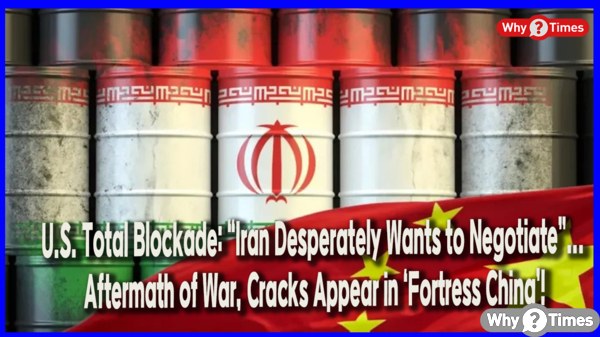
President Trump has signaled the possibility of resuming nuclear negotiations with Iran, while simultaneously taking a "maximum pressure" stance by launching a full-scale blockade of the Strait of Hormuz and issuing a destruction warning against Iranian vessels. Amidst these developments, reports indicate that the U.S. blockade of Iranian ports is dealing a severe blow to China’s supply chain, placing immense pressure on its economy.
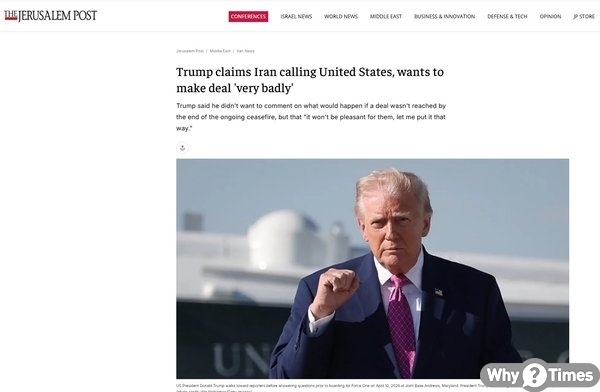
The Jerusalem Post reported on the 14th: “President Donald Trump met with reporters at the White House on the 13th (local time) and stated that Iran has contacted the U.S. directly and ‘desperately’ wants to negotiate.” This statement came just one day after high-level talks in Islamabad, Pakistan, collapsed due to disagreements over nuclear issues, suggesting that diplomatic channels remain open despite rising military tensions.
While President Trump avoided specific details on how the situation would unfold following the failed talks, he simply remarked, “It won’t be pleasant for them.” He also emphasized that “Iran has not agreed to possess nuclear weapons” and that “the U.S. will recover nuclear-related materials.” He further declared to reporters: “We cannot allow any nation to blackmail or extort the world.”
[Full-Scale Blockade of Hormuz... Warning to Annihilate Fast Attack Crafts]
At 10:00 AM ET on the 3rd, the U.S. officially launched blockade operations against vessels traveling to and from Iranian ports. Concurrently, President Trump posted on Truth Social, claiming that “158 Iranian naval vessels have already been completely destroyed.” He warned that while relatively small Iranian fast attack crafts were previously ignored as minor threats, they would be “immediately annihilated” if they approached the blockade line.
However, U.S. Central Command (CENTCOM) added that “this blockade applies only to vessels traveling to and from Iranian ports and coastal areas, and does not impede the freedom of navigation for ships traveling to ports of other nations.”
Chris Featherstone, a political scientist at the University of York, analyzed that “Trump is using the blockade threat as a lever for negotiations,” reflecting a strategy based on the judgment that “Iran holds no remaining cards.”
The New York Post echoed this, reporting that since Iran lacks the practical means for sustained military retaliation against the U.S. and Israel, the blockade could serve as the decisive pressure card to bring Tehran back to the table. Retired Lieutenant General Muhammad Saeed, a former high-ranking Pakistani military official, noted that while Iran might continue drone and missile strikes for a few days, it lacks a cost-effective alternative to U.S. military power and is well aware of the internal economic suffering and currency collapse.
[Aftermath of War: Cracks Begin in ‘Fortress China’]
Significantly, the U.S. blockade is dealing a massive blow to China. This measure is interpreted as a strategic move targeting nations reliant on Iranian oil, particularly China.
The Financial Times (FT) reported on the 14th: “This U.S. action has exposed a fatal weakness in President Xi Jinping’s ‘Fortress China’ strategy—a multi-year effort to build economic self-reliance. Just six weeks into the Hormuz blockade, severe cracks are appearing across China’s supply chain.”
Cameron Johnson, a senior partner at Tidal Wave Solutions in Shanghai, warned that “this supply chain disruption could be more severe than the COVID-19 pandemic.” According to the FT, prices for petrochemical raw materials—the backbone of Chinese industry—are skyrocketing. Polyethylene prices have doubled, carbon fiber has risen by over 20%, and helium, essential for semiconductors and medical devices, has seen its spot price surge by 110%. Since China relied on the Middle East for one-third of its oil and 25% of its gas before the conflict, the impact is devastating.
Even within China, rare voices of concern are emerging. Feng Shaozhong, Vice Chairman of the China Institute for Reform and Development, urged the abandonment of “groundless optimism” and preparation for “worst-case scenarios.” He noted that costs in energy-intensive industries like logistics and steel have risen by over 25%, pushing SMEs to the brink of collapse.
[U.S. Strategic Victory and the Reshaping of the International Order]
The Trump administration's hardline approach is being interpreted as a sophisticated strategy to reorganize the global supply chain around the United States. President Trump mentioned that other nations have offered support for the blockade, stating, “We don’t need the help, but we will soon release the list of assisting nations,” showcasing a powerful U.S.-led alliance.
Notably, Trump identified “Cuba” as the next target after the Iran issue. He labeled Cuba a “long-mismanaged country” and suggested the U.S. could address the Cuban issue next, signaling a wide-ranging campaign against socialist and anti-American regimes.
In conclusion, President Trump’s decisive maritime blockade and "zero-tolerance" nuclear policy are successfully pulling Iran toward negotiations while dealing a heavy blow to China’s “Economic Great Wall.” The strategies of anti-American forces that used energy and security as hostages are being neutralized by overwhelming U.S. power, as the world stage converges once again toward a U.S.-led order.

- TAG