
Update2026.11.24 (화)

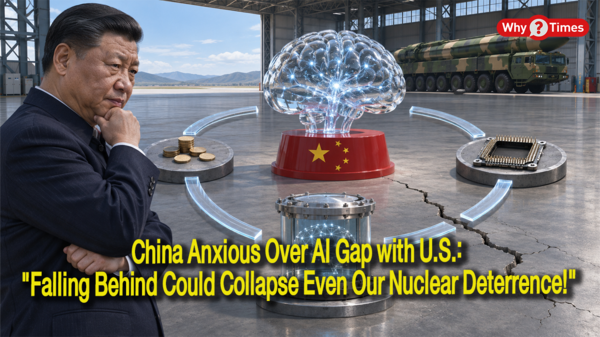
[The AI Gap Spills Over into the Survivability of Nuclear Forces]
An analysis has emerged indicating that Chinese military researchers fear artificial intelligence (AI) could render their country's nuclear forces more vulnerable. If AI rapidly integrates satellite and radar data to track down mobile missiles and compresses decision-making timelines during a crisis, China's nuclear retaliatory capability could itself be jeopardized. At the same time, a global sell-off in AI stocks has cast a dark cloud over the listing and investment prospects of Chinese AI firms. Compounding these woes are U.S. restrictions on chips and computing power, alongside efforts to block model distillation. China's AI race now faces a dual squeeze—not just a widening technological gap, but also acute military anxiety and a tightening capital crunch.
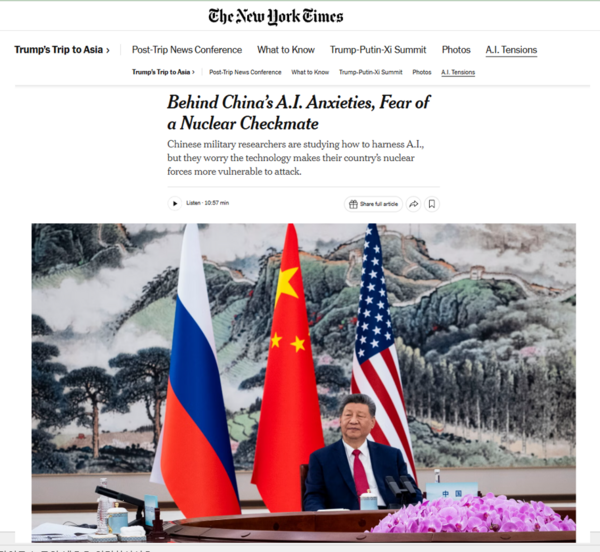
The New York Times (NYT) reported on the 23rd (local time) that "a review of more than 100 recent studies by Chinese civilian and military researchers, along with interviews with experts, reveals growing concern within China that U.S. advancements in AI could threaten the survivability of China's nuclear forces." When Xi Jinping launched a major expansion of China's nuclear arsenal more than a decade ago, the core objective was to ensure the capability to absorb an enemy first strike and retaliate with surviving missiles. However, if AI fuses data from satellites, radars, and sensors to locate mobile and concealed missiles faster and more accurately, that "survivable retaliatory capability" could collapse. Behind Beijing's unease is the fear that falling behind in AI translates directly into falling behind in nuclear deterrence.
Expectations from the top leadership remain high. In July, Xi convened a meeting of senior officials to study the military implications of emerging technologies such as AI and ordered steady progress toward operational deployment. Sam Bresnick, a research fellow at Georgetown University's Center for Security and Emerging Technology (CSET), noted that "there is great optimism in China that AI will be the tool that finally allows them to catch up to or surpass the United States militarily." While the leadership expects Beijing to overtake Washington, the gap on the ground continues to widen. That disconnect lies at the heart of the anxiety weighing on Beijing's inner circle.
[Nuclear Anxiety: The Terror of '90 Seconds']
This anxiety can be quantified. In a report published several months ago, two researchers at the Academy of Military Sciences in Beijing wrote that "if the United States embeds AI and similar technologies into its nuclear decision-making systems, it could compress the decision process from the traditional 15 to 30 minutes down to under 90 seconds, dramatically accelerating response speeds." While this does not mean the U.S. nuclear command-and-control system is actually automated to that degree, it represents the worst-case scenario envisioned by the Chinese military.
The Federation of American Scientists (FAS) estimates China's nuclear warhead stockpile at roughly 620. Even if that number rises to around 1,000 by 2030, it will still fall well short of the approximately 1,800 warheads deployed each by the United States and Russia. For a numerically inferior China, survivability is the entirety of deterrence. Gerald C. Brown, a former U.S. State Department analyst, explained that what China fears is a scenario in which the United States can "strike the moment something pops out of concealment or moves," adding that "from their perspective, survivability could become vastly more difficult."
Semiconductors form the critical link in this chain of fear. Jacob Stokes, a senior fellow at the Center for a New American Security (CNAS), pointed out that America's lead in advanced chips fuels Chinese concerns that the U.S. can integrate AI into its military—including nuclear-related systems—far more rapidly. Chinese military officers still closely study the Korean War and the Taiwan Strait crises of the 1950s, when the United States hinted at using atomic weapons against Mao Zedong's nuclear-free military. Memories of helplessness in the face of technological superiority are resurfacing in the AI era.
Fear breeds haste. Rocket Force scientists have trained deep reinforcement learning AI to help hypersonic glide vehicles evade missile defenses around Alaska and simulated AI-controlled trajectory recovery for ballistic missiles after dodging interceptors. Scholars at the Rocket Force University of Engineering wrote in a paper this year that China must use AI and other cutting-edge technologies to enhance the "survivability and retaliatory capability" of its forces. Conversely, researchers at the National University of Defense Technology and the Academy of Military Sciences have warned that misinformation amplified by AI poses "enormous decision-making risks." Beijing is caught in a double bind: terrified of falling behind if it moves too slowly, yet terrified of catastrophic accidents if it rushes ahead.
Diplomatic guardrails are equally absent. During their summit in Shenzhen on the 19th, Donald Trump, Xi Jinping, and Vladimir Putin agreed to hold talks on reducing the risk of nuclear war, but set no timetable. According to the NYT, the role of AI in nuclear weapons was not raised, and Xi showed no interest in calls to join arms control frameworks. There have also been no follow-up discussions since Xi and then-President Joe Biden affirmed in 2024 that human control must be maintained over decisions to use nuclear weapons. Melanie Sisson, a senior fellow at the Brookings Institution, warned that among the pathways through which AI could threaten humanity, "nuclear weapons are probably the most plausible mechanism."
[Three Doors Closed in a Single Week]
For a beleaguered Beijing, the third week of this month was nothing short of a nightmare. The first pillar to wobble was funding. Anthropic raised $81.3 billion in the largest initial public offering (IPO) in history—bringing its total haul to $107.3 billion when combined with a separate $26 billion private placement. Yet amid a global sell-off in AI stocks that accelerated following the listing, a rally in Chinese tech equities reversed into a $1.7 trillion rout. Zhipu AI (Z.AI) has plunged more than 85% from its June peak, while MiniMax has fallen below its IPO price. Dark clouds have also gathered over Moonshot AI—valued at roughly $50 billion and eyeing a Hong Kong IPO in the first quarter of next year—as well as DeepSeek, which aims to go public in early 2027. The Financial Times (FT) reported that the China Securities Regulatory Commission (CSRC) has issued informal guidance instructing investment banks to temporarily pause IPOs. Thea Jamison, managing director at Change Global Investment, forecast that "the IPO frenzy won't return until market sentiment improves."
The second door to shut was chips. On the 16th, the U.S. Commerce Department's Bureau of Industry and Security (BIS) issued a rule requiring export licenses for advanced AI chips shipped to overseas data centers that supply computing power to Chinese firms. The workaround of remotely leasing compute from data centers in Southeast Asia has been cut off. The frantic scramble by Chinese companies to lock up overseas Nvidia computing capacity right before the rule took effect underscored just how vital that lifeline had become. On the 17th, Nvidia announced it had halted shipments of Hopper chips to China, following CEO Jensen Huang's resignation on the 12th amid espionage allegations tied to suspected chip-smuggling firm Megaspeed. Beijing denounced the BIS rule as "economic coercion."
The third door to close was the shortcut of piggybacking on American models. In a report released on the 20th, OpenAI announced it had reduced the success rate of attacks aimed at extracting its models' internal reasoning from 54.0% to 0.2%. Notably, weekly enforcement actions against distillation attempts have reached into the thousands or tens of thousands of accounts, accelerating sharply since this summer. OpenAI has identified individuals linked to DeepSeek and Moonshot AI as culprits behind these distillation efforts. Moonshot denies the allegations, and the figures come from OpenAI's internal testing. Meanwhile, the U.S. Congress is moving to attach three chip-control bills to the National Defense Authorization Act (NDAA) in December.
[Pillars of Support, and the Cracks Beneath]
China's AI sector has not collapsed yet. Moonshot's Kimi K3, unveiled in July, briefly topped AI model leaderboards, and Cambricon's third-quarter revenue doubled. Still, Cambricon's revenue fell well short of market expectations, and Epoch AI estimates that Huawei's compute output this year amounts to less than 4% of Nvidia's. A de facto rationing system has even emerged, with the government directly allocating remaining high-performance chips. Huawei's decision to move up the launch of its next-generation Ascend 960DT chip by three quarters reads less like a show of confidence than an expression of intense pressure to rush.
[Why Times Insight]
The emotion driving Beijing right now is not ambition, but anxiety. The editorial board assesses that the recognition that losing ground in AI means losing the ultimate showdown with the United States is the fundamental motive compelling the Xi Jinping regime to stake the nation's fate on AI. The surge in distillation attempts over the summer, the pre-regulation rush to secure computing power, and the rationing of chips are all behavioral signals stemming from that same anxiety.
The trouble is that all exits are closing simultaneously. Without capital, China cannot buy chips; without chips, it cannot train indigenous models; and with distillation blocked, the shortcuts are gone. The editorial board views this vicious cycle as pushing China's AI industry to the "brink of collapse." Even more dangerous is the point where anxiety distorts judgment. As fears over nuclear survivability grow, Beijing may refuse arms control and rush untested AI systems into its nuclear command structure. In an era where decision times are compressed to 90 seconds, the impatience of the party falling behind translates directly into the risk of miscalculation.
The rematch between Trump and Xi at the G20 summit in Florida in December, the passage of the NDAA, and Moonshot AI's planned Hong Kong listing in the first quarter of next year will serve as key tests of where Beijing's growing desperation leads next.
-중국 푸단대학교 한국연구원 객좌교수
-전 EDUIN News 대표
-전 OUR NEWS 대표
-제17대 대통령직인수위원회 정책기획팀장
-전 대통령실 홍보기획비서관
-사단법인 한국가정상담연구소 이사장
-저서: 북한급변사태와 한반도통일, 2012 다시우파다, 선거마케팅, 한국의 정치광고, 국회의원 선거매뉴얼 등 50여권