Update2026.11.21 (토)

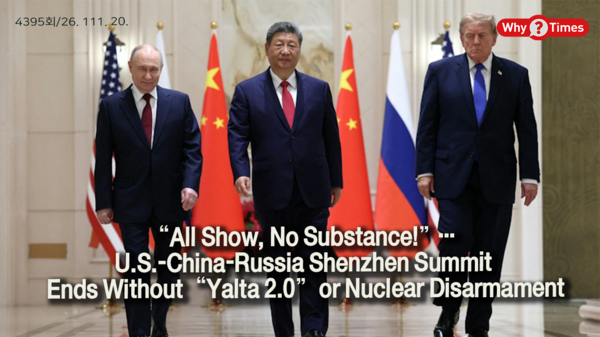
[A “Historic Summit,” Yet a Foregone “No Deal”]
U.S. President Donald Trump, Chinese President Xi Jinping, and Russian President Vladimir Putin held the first-ever trilateral summit among the leaders of the world’s three largest nuclear powers in Shenzhen, China, on the 19th. Yet compared to the lavish protocol and rhetoric of a “historic summit,” tangible achievements were meager. Trump placed nuclear arms reduction front and center, but China refused to join trilateral nuclear disarmament talks even before the meeting began. Putin aimed for a “Yalta 2.0”—where major powers decide the fate of smaller nations—but Trump, whose room for maneuver has narrowed following midterm election losses, had little leeway to unilaterally concede Ukraine. Xi walked away with the symbolism of host and “mediator,” while Trump secured photo-ops as a “leader who engages in dialogue.” After the talks, the three countries adopted a “Declaration on Peace,” but it contained neither nuclear warhead reduction targets nor provisions to end the war in Ukraine, and even the much-anticipated Trump–Kim Jong Un meeting fell through. Ultimately, the summit served only to confirm the diverging calculations of the three great powers.
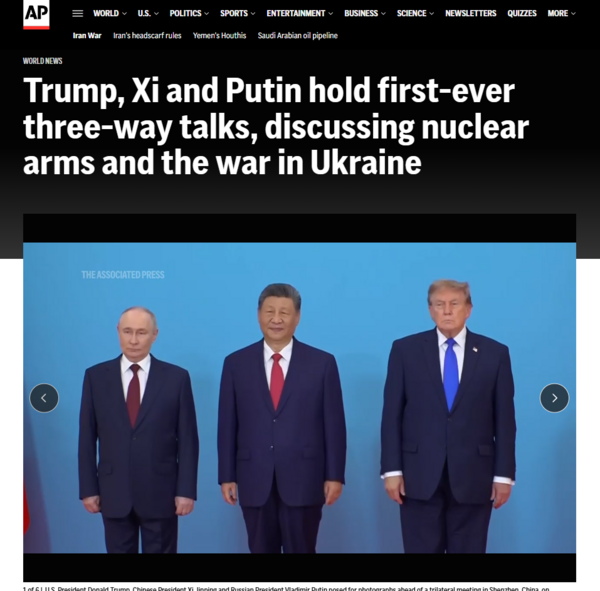
The Associated Press (AP) reported on the 19th that “U.S. President Donald Trump, Chinese President Xi Jinping, and Russian President Vladimir Putin held their first trilateral summit in Shenzhen, China, sitting down face-to-face for about 90 minutes.”
According to the AP, Putin stated that the three nations share “numerous common interests in resolving regional conflicts, including the conflict in Ukraine.” By contrast, Xi avoided mentioning Ukraine altogether, offering only the principled remark that “history shows the world is peaceful when major powers live in harmony.” President Trump praised the gathering, saying, “We are truly making history,” and adding, “No problem has ever been solved by refusing to discuss it.” However, a week prior to the summit, the White House had already framed the meeting as an “entry point” and a “first conversation,” explicitly stating not to “expect an agreement.” Indeed, major reports released that day confirmed no joint trilateral agreements on a nuclear disarmament negotiation schedule, Ukraine ceasefire terms, or the Iran issue. While bringing the three leaders together in one place was historic, each sought to take home a different prize.
Following the summit, the Kremlin and Chinese state media announced that the three leaders had adopted a “Declaration on Peace” covering four points: United Nations reform, energy, the International Criminal Court (ICC), and nuclear risks. The leaders agreed that “a nuclear war cannot be won and must never be fought.” They also affirmed the importance of stable energy flows and agreed to hold dialogues on nuclear risk reduction and non-proliferation. However, the declaration contained no clause on ending the war in Ukraine, nor did it set targets or deadlines for reducing nuclear warheads. No joint verbal statements were made by the three leaders afterward, and Trump immediately boarded Air Force One to return home.
[Trump’s Nuclear Disarmament Card Rejected by China From the Start]
President Trump remarked that “as the world’s three largest nuclear powers, the United States, Russia, and China are in a unique position to discuss ways to reduce the number of nuclear weapons on Earth and mitigate the risk that nuclear weapons will ever actually be used.” In a Fox News interview on the day of the summit, he took direct aim at China, stating, “We have 4,000 nuclear weapons. Russia has 3,800, and China currently has 400 to 500, though they are accelerating their nuclear weapons development.” New START, the last remaining nuclear arms control treaty between the U.S. and Russia, expired in February this year. The U.S. Department of Defense projects that China will possess more than 1,000 operational nuclear warheads by 2030.
Beijing’s answer, however, had already been delivered before the summit. Chinese Foreign Ministry spokesperson Guo Jiakun dismissed participation in trilateral nuclear disarmament negotiations as “neither reasonable nor realistic.” Edgard Kagan, a senior advisor at the Center for Strategic and International Studies (CSIS), also noted that China strongly opposes the very idea of discussing nuclear weapons trilaterally with the U.S. and Russia. At the summit, Xi declared that “nuclear weapons hang like the Sword of Damocles over humanity” and called for their complete elimination, yet offered no reduction targets or timelines. In effect, the country expanding its nuclear arsenal fastest sidestepped concrete talks behind the high-minded rhetoric of a “nuclear-free world.” The final declaration likewise stopped short of “reductions,” settling instead for “risk-reduction dialogue.” Even the phrase “a nuclear war cannot be won” was recycled from a 2022 joint statement by the five nuclear-weapon states.
[Putin’s “Yalta 2.0” Vision Blocked in Ukraine and Washington]
Russia was the side that initially proposed the trilateral summit. The Wall Street Journal (WSJ) reported that Putin suggested the meeting to discuss a Ukraine peace deal favorable to Moscow. Trump and Putin met separately for 35 to 40 minutes ahead of the trilateral session. Kremlin aide Yuri Ushakov said the war in Ukraine dominated their conversation and described Putin’s mood afterward as “simply wonderful.” However, U.S.–Russia–Ukraine talks held in Abu Dhabi last week yielded only a prisoner swap agreement, failing to achieve a breakthrough on a ceasefire or territorial issues. In the end, Ukraine did not receive a single line in the final declaration. Xi, too, only stated that parties to conflicts should sit at the negotiating table, without naming Ukraine directly.
What stood out instead was the ICC. Trump criticized the ICC on the day of the summit as a “globalist body that has spun out of control,” and a clause regarding the ICC was included in the declaration. Putin is currently the subject of an ICC arrest warrant over the unlawful deportation of Ukrainian children. Having Putin formalize a joint pushback against the ICC alongside the United States is likely to heighten concerns among European allies.
[Xi Jinping’s “Host Diplomacy” and the “Two-Against-One” Dynamic]
Xi walked away with the symbolic gains. By breaking protocol and personally greeting Trump at the airport, he projected an image of standing at the center of great-power diplomacy. During the trilateral talks, he put forward “four principles”—mutual respect, peaceful coexistence, win-win cooperation, and dialogue and consultation—voicing opposition to decoupling and supply chain disruptions. In an earlier U.S.–China bilateral meeting, Xi pressed Washington on the Taiwan issue to “continue doing the right thing.” According to Reuters, Xi also stated at the same venue that “building a constructive and stable strategic relationship between China and the United States is also unprecedented.” Beneath the veneer of peaceful principles lay warnings against U.S. tech and supply chain containment as well as interference over Taiwan.
In an op-ed for The New York Times (NYT), former U.S. Deputy Secretary of State Kurt Campbell pointed out that Xi and Putin have met roughly 50 times since 2012, warning that Trump had stepped into a disadvantageous “two-against-one” setup. Indeed, the Kremlin coordinated the draft declaration with China prior to the summit before awaiting Washington’s response. Conversely, one American conservative commentary pushed back, noting that Trump had reaffirmed the U.S. mutual defense treaty with the Philippines just before the summit to continue countering China, arguing that his “embrace” was merely tactical.
[The Scuttled Kim Jong Un Meeting and Trump’s Narrowing Room for Maneuver]
Another closely watched possibility at the Shenzhen summit—a meeting between Trump and Kim Jong Un—ultimately failed to materialize. Trump had earlier left the door open in Manila, saying Kim “wants to come” to APEC, though the White House drew a line by stating no meeting was planned. Some observers suggest that while China moved to broker an encounter, the meeting collapsed because Kim insisted on upfront concessions—demanding that Washington drop denuclearization demands and lift sanctions—before sitting down. The U.S. maintained that all issues should be discussed once they met. The prevailing analysis is that North Korea, facing less urgent pressure for sanctions relief thanks to backing from Russia and China, opted for the status quo.
An even more fundamental variable is U.S. domestic politics. Following the Republican defeat in the November 3 midterm elections, Trump’s diplomatic latitude has visibly narrowed. On any Ukraine peace plan, it is now difficult to force unilateral concessions on President Volodymyr Zelensky, as congressional approval cannot be secured without Democratic cooperation. Under such constraints, there is little room for Putin’s vision of “Yalta 2.0” to materialize. The three leaders may cross paths again at the G20 Summit in Miami this December, though the Kremlin stated that Putin’s attendance would depend heavily on the outcome of this trilateral meeting. The gaps exposed in Shenzhen appear unlikely to be bridged within a single month.
[Why Times Insight]
The real deliverable of the Shenzhen summit was not a written agreement, but a photograph. Xi brought the U.S. and Russian leaders onto his home turf to project the image of a “mediator,” while Putin secured visuals undermining Western efforts to isolate him. Following midterm losses, Trump obtained a domestic-facing image of a “president negotiating directly with world leaders.” Russia paid the lowest price and walked away with the greatest gains.
A document did emerge. However, the four points of the Declaration on Peace—UN reform, the ICC, energy, and nuclear risks—align far more closely with long-standing Sino-Russian agendas than with American priorities. The “nuclear reductions” Trump sought were diluted into “risk dialogue,” while the Ukraine settlement Putin wanted never made it onto paper. There was a declaration, yet still no real substance.
China’s calculation is two-pronged. While rejecting trilateral nuclear disarmament, Beijing claimed the mantle of a responsible major power through rhetoric about a “nuclear-free world” and “strategic stability,” buying itself more time to continue expanding its nuclear arsenal. Meanwhile, regarding the airport arrival, allegations surfaced—primarily among dissident-leaning outlets—that CCTV edited out footage of Xi greeting Trump. While unconfirmed, the episode is notable insofar as it aligns with Chinese propaganda authorities’ long-standing practice of simultaneously managing “extraordinary courtesy” for foreign audiences and “great-power dignity” for domestic consumption.

-중국 푸단대학교 한국연구원 객좌교수
-전 EDUIN News 대표
-전 OUR NEWS 대표
-제17대 대통령직인수위원회 정책기획팀장
-전 대통령실 홍보기획비서관
-사단법인 한국가정상담연구소 이사장
-저서: 북한급변사태와 한반도통일, 2012 다시우파다, 선거마케팅, 한국의 정치광고, 국회의원 선거매뉴얼 등 50여권