
Update2026.06.19 (금)

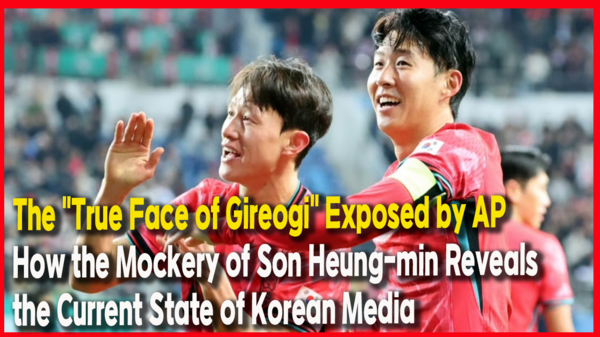
[National Team and Media Clash Ahead of the World Cup, Escalating into International News]
At the World Cup, the world's largest sporting stage, Korean journalists were caught on a hot mic uttering profanity-laced mockery behind the back of their own national team captain. As the true face of these reporters was broadcast to the world, major international outlets, including The Washington Post, rushed to report on the backwardness of Korean media, triggering an unprecedented international embarrassment.

On June 17, the Associated Press (AP) highlighted the severe rift between the squad and their domestic media, reporting that "South Korea's preparations for their match against Mexico have been marred by controversy over derogatory remarks made about captain Son Heung-min." The article detailed the entire trajectory of the incident for international readers, from the initial spark to the Korea Football Association's (KFA) official statement and the resignation of the press corps leader.
The story quickly expanded into a global news item as The Washington Post (WP), Al Jazeera, and ESPN picked up the report. The extensive coverage by prestigious outlets like WP served as a stark warning to South Korean media. The international gaze had shifted past mere sports coverage to scrutinize the overall state of journalistic ethics in South Korea.
The incident unfolded on June 7 at the Chivas Verde Valle training ground near Guadalajara, Mexico. During an open training session for the South Korean national team, two domestic journalists shared a quiet conversation as the squad jogged past. Their exchange was captured and broadcast raw on the YouTube channel of JTBC, the official tournament broadcaster in South Korea. In the video, one man remarked about Son, "Is he running like a platoon leader just because he's the captain?" and "He runs like an officer in the military." Another man responded with profanity, saying, "Those bastards who haven't even been to the army, bastards who don't know the first thing about the military..."
This was no mere backstage gossip. It was a direct insult to the character of a player sweating to represent his country on the world stage, coming from the mouth of a journalist embedded to cover them. Once this unedited, raw audio went live on JTBC's YouTube channel, it triggered immediate international outrage. In Mexico, where Son Heung-min enjoys immense popularity, locals directly confronted Korean journalists, demanding to know why they had shown such disrespect to a world-class player.
The AP reported that "following the incident, players have avoided contact with South Korean media outside of official World Cup mandatory obligations, leading to a string of canceled pre-scheduled interviews."
The reason this comment garnered such heavy focus from foreign media lies in the unique social weight of military service in South Korea. Son legally earned an exemption from the 21-month mandatory service after leading South Korea to a gold medal at the 2018 Asian Games. Furthermore, during the 2020 Premier League suspension due to COVID-19, he voluntarily completed three weeks of basic military training with the Marine Corps, which included live-fire drills and a 30-kilometer march.
The core of the issue is that an embedded journalist used profanities to disparage a player who has both contributed to his nation via a gold medal and fully fulfilled his legal duties. International media focused heavily on the fact that domestic journalists chose to mock a player who had given so much to his country and legally resolved his obligations.
[The Squad Strikes Back — National Team Begins Distancing Itself from the Media]
Once the incident came to light, the team’s response was immediate and resolute. Son Heung-min, who usually engages actively with the press regardless of match outcomes, politely walked past domestic reporters in the mixed zone right after a 2-1 victory over the Czech Republic. A pre-arranged interview with Hwang In-beom, who recorded a goal and an assistance in that match, was abruptly canceled. In an unusual move, the KFA even requested domestic outlets to take down a published interview with player Lee Dong-gyeong that had been conducted on a day off.
In an official statement, the KFA expressed regret over the "inappropriate remarks made by certain media personnel during the training process at the Guadalajara base camp," adding that "the disclosure of the conversation has caused great shock and disappointment to the squad." The KFA emphasized, "The association places the protection of the squad as its highest priority and will strive to create a healthy reporting environment."
As the situation spiraled out of control, the KFA took unprecedented disciplinary measures. Jesus Bernal, a veteran reporter for ESPN Mexico, exposed a shocking scene on social media: "KFA media officers ordered all foreign journalists to leave during a press conference at the Chivas training facility, before delivering a harsh reprimand to the South Korean press corps behind closed doors." Bernal added, "I was baffled when told to leave, but I later learned that the Korean media officers were fiercely scolding their own press. You could feel the tension in the camp." It was an unprecedented, humiliating spectacle where a domestic association's public tongue-lashing of its own media was leaked to the international community through a foreign journalist.
[An Apology Was Made, But Restoring Trust Remains Far Off]
The coordinator of the South Korean World Cup press corps resigned voluntarily, taking full responsibility for the situation. A formal apology from the press followed. A delegation of four representatives—one each from a broadcaster, a newspaper, a wire service, and a digital media outlet—met directly with Son Heung-min and Kim Min-jae to deliver a collective apology, which Son accepted on behalf of the squad. However, the apology did not instantly restore trust.
The primary reason the boycott persisted even after the apology was accepted lay in the conflicting attitudes of the parties involved. While one journalist from a wire service personally apologized to the squad and withdrew from the site, the broadcasting company of the other journalist pushed back, calling the KFA's access restrictions "excessive" and vowing to maintain their existing coverage policy. Currently, three-way negotiations between the KFA, the squad, and the press corps are taking place behind the scenes. The broadcasting station's stubborn insistence on continuing coverage even after extracting an apology from the victims has become the key variable prolonging the boycott.
[Pressure to Dox — Silence Deemed an Admission of Guilt]
Several YouTube channels began widely circulating the alleged identities of the journalists involved across online communities. While reporters from a specific wire service and a news channel have been heavily named, both the respective media outlets and the KFA have refused to officially confirm their identities. The journalists themselves have issued no public statements.
However, this silence backfired. Immediately after the controversy erupted, internet users noticed that the introduction pages for the accused journalists on their respective outlets' websites were quietly switched to private. This prompted widespread reactions in online communities, with users noting, "While they haven’t been officially named, the players, reporters, the association, and netizens all know exactly who they are." Public opinion strongly views the sudden hiding of the journalist profile pages as a de facto admission of guilt. The media establishment’s insistence on shielding the identities of those involved looks less like the behavior of a watchdog and more like a self-protecting cartel.
[Foreign Media See 'Broken Trust,' Not Just 'Profanity,' as the Core Issue]
The perspective of international media has hardened from shock into cynicism. Claro Sports, a Mexican sports channel operating across 17 Latin American countries with 4.99 million YouTube subscribers, described the situation as "a literal K-drama style conflict." The outlet detailed the unprecedented ejection of foreign press during the press conference, the cancellation of scheduled player press conferences, and the drastic reduction of official interview windows.
The British BBC reported that "South Korean players are refusing contact with domestic media outside of official World Cup obligations," while sharing the full text of the KFA's official statement. India's sports-specialized outlet Sportskeeda provided a comprehensive account, reporting that "the South Korean national team is boycotting its own domestic media following the leak of derogatory comments about captain Son Heung-min."
Football Asian defined the crisis as "the deepest rift between the squad and the press corps in modern Korean football history." The outlet evaluated that "the KFA prioritizing player protection over media access and publicly reprimanding its own domestic press is an action virtually unprecedented in the history of international sports journalism."
[Mocking Their Own National Players: "Have They Lost Their Minds?"]
It is difficult to dismiss this incident as a mere slip of the tongue by one or two journalists. What the hot mic exposed was not just an individual failure, but a deep-seated crisis of credibility that South Korean media has carried for a long time. It raises fundamental questions about how well basic principles—such as respect for interview subjects, responsible use of language, and transparent accountability for errors—are actually being practiced.
Sharp criticism has also been directed at the domestic "press club" ( 기자단 ) culture. Critics argue that "press clubs enjoy exclusive access to institutions, collectively coordinate the direction of coverage, and systematically pressure or exclude media outlets outside their circle." The behavior displayed at this World Cup camp—protecting the identities of the offending journalists until the very end—resembled a self-preserving cartel rather than a public watchdog.
In this crisis, independent internet media outlets took on the role of reconstructing the timeline of the event and demanding to know why the parties involved refused to issue a public apology. This background is precisely why Why Times decided to report directly on this matter. In a related critique, The Korea Times, an English-language daily, noted, "Public trust in the media has been declining for a long time amid hyper-competition reliant on clickbait headlines and anonymous reactions—this incident showed the world just how far that floor has dropped."
Ironically, amidst this complete breakdown of media relations, the squad has rallied inward. Football Asian analyzed that "the external friction has paradoxically united Manager Hong Myung-bo's squad. Camp morale is at an all-time high, as the players have converted the external friction into a fierce 'siege mentality' ahead of the Mexico match." The analysis that the journalists' mockery inadvertently fueled the fire for Son and his teammates is gaining strong traction.
Accepting an apology does not mean the wound is healed. Even with their identities effectively exposed, one media outlet refuses to take responsibility, while the traditional press establishment repeated old habits by shielding their colleagues with collective silence. The Korea Times concluded on a sobering note: "Whether the South Korean media can regain the trust of the players they cover, and the fans who watch them, remains an open question."
Reported by the AP and The Washington Post, relayed by Al Jazeera, witnessed firsthand by an ESPN Mexico reporter, and dubbed an "unprecedented civil war" by Football Asian—this situation is no simple mishap. It is a self-inflicted international disgrace, where the structural ugliness that South Korean journalism has long ignored was laid bare to the world on the biggest sporting stage by a single hot mic.
Today, the match against Mexico finally takes place. We hope our squad can deliver a strong performance despite these turbulent circumstances.

-중국 푸단대학교 한국연구원 객좌교수
-전 EDUIN News 대표
-전 OUR NEWS 대표
-제17대 대통령직인수위원회 정책기획팀장
-전 대통령실 홍보기획비서관
-사단법인 한국가정상담연구소 이사장
-저서: 북한급변사태와 한반도통일, 2012 다시우파다, 선거마케팅, 한국의 정치광고, 국회의원 선거매뉴얼 등 50여권