
Update2026.06.11 (목)

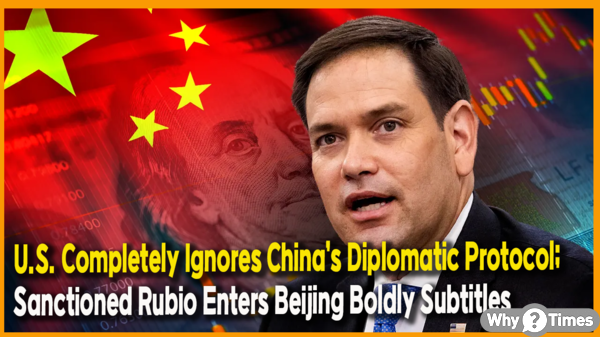
['Sanctioned' Rubio Enters Beijing, Shaking the Chinese Diplomatic Circle]
U.S. Secretary of State Marco Rubio, who was placed on China's sanctions list in 2020 due to issues such as human rights in Xinjiang, has made a bold entry into the Great Hall of the People as the head of U.S. diplomacy—without offering any apologies or seeking understanding. From China's perspective, they should have blocked Secretary Rubio's entry, but unable to do so, they suffered a major humiliation by resorting to the expedient of changing the Chinese characters of Rubio's name to allow him into the country. This is noteworthy as it shows China undermining its own diplomatic protocols through such makeshift measures.

The French outlet France 24 reported on the 13th, "Despite Chinese sanctions, Secretary of State Marco Rubio visited Beijing on the 13th to meet with President Donald Trump, and China undermined its own sanctions by using the expedient of changing the orthography of his name." It added, "During his time as a Senator, Rubio strongly raised Chinese human rights issues, leading China to impose sanctions on him twice—a tactic Beijing often uses against hostile figures."
AFP also commented on Secretary Rubio’s visit, stating, "A figure who was twice sanctioned by China for his fierce criticism of human rights during his Senate years has now entered Beijing as America's top diplomat." It reported that "China announced on Tuesday it would not prevent Rubio from entering the country aboard Air Force One with Trump."
France 24 further noted, "What the international media noticed most during this visit was China’s so-called 'Hanzi (Chinese character) loophole' that made Rubio’s entry possible." It revealed that "In early January 2025, immediately after Trump nominated Rubio as Secretary of State, the Chinese government and state media began changing the first character of his surname from the existing '卢 (lú)' to '鲁 (lǔ)'." Multiple diplomats stated that this change was an immediate arrangement by China to avoid enforcing its own sanctions, as Rubio would be subject to an entry ban under the previous spelling.

Regarding this, the Malay Mail reported the situation under the headline, "Lu Loophole—China Hacks Its Own Sanctions to Allow Rubio Entry." This refers to how Chinese state media recently began adjusting their tone by subtly changing Rubio's name from '卢比奥' to '鲁比奥,' which clearly reflects their embarrassment. The behavior of showing "friendliness" by even changing a name after having imposed heavy sanctions reveals the shallow and opportunistic nature of the Chinese Communist Party's (CCP) diplomacy.
While changing the spelling of a name may seem trivial to outsiders, changing the Chinese character representation effectively creates a new written identity. Malay Mail, citing diplomats familiar with the situation, reported that "this move allowed China to bypass the awkward contradiction of hosting a sanctioned individual without officially retracting the original sanctions."
Radio Free Asia (RFA) also reported that "the Chinese Ministry of Foreign Affairs used the new Hanzi spelling for the first time in a press release on January 16, 2025." Regarding this, Chinese Foreign Ministry spokesperson Mao Ning said, "I am not aware of the change. I will check," adding, "What is more important is his English name." She also reaffirmed the position on the existing sanctions, stating they were "aimed at words and deeds that infringed upon China's legitimate rights and interests."
The Chinese Embassy also stated via AFP that "the sanctions in question were targeted at Rubio's words and deeds related to China during his tenure as a Senator." Effectively, they are using the logic that 'the Rubio of that time' and 'the Rubio of now' are different people.
[First Sanctioned U.S. Secretary of State to Visit Beijing]
Regarding this, the South China Morning Post (SCMP) reported, "Rubio has become the first sitting U.S. Secretary of State to visit Beijing while under Chinese sanctions." It noted that "he had previously avoided direct visits to China by meeting Foreign Minister Wang Yi twice outside of mainland China, but he ultimately chose the trip to Beijing as President Trump's visit was confirmed."
Rubio, a Cuban-American who has strongly opposed communism, was a key author of legislation imposing broad sanctions on China due to allegations of forced labor of the Uyghur Muslim minority. Even during his confirmation hearing, he clearly defined China as an "unprecedented adversary," maintaining a hardline stance. However, after taking office, he has shown a move to align with President Trump’s China policy, which focuses on building trade relations, even calling President Xi Jinping a "friend."
Secretary Rubio is a figure who has persistently attacked the CCP’s Achilles' heel. On July 31, 2024, he introduced the 'Falun Gong Protection Act,' which centers on sanctioning those involved in forced organ harvesting, and he has shown an uncompromising attitude toward religious minorities and human rights issues. This history poses a significant threat to the CCP, which has dismissed human rights issues as a tool for internal cohesion.
Furthermore, in a recent interview with Fox News, Secretary Rubio directly criticized the CCP’s "dual-track" propaganda method. He dismissed a press release from the Chinese side regarding a past call with Foreign Minister Wang Yi, which included the expression 'Haoziweizhi (manage yourself well / watch your step),' stating, "That is an expression I never heard during the actual call." He exposed China’s 'two-faced propaganda'—acting tough domestically while being conciliatory externally.
Ultimately, this visit is expected to be a scene of immense diplomatic humiliation for the CCP. Treating a person they once considered a "thorn in their side" as a state guest is tantamount to admitting the defeat of the "Wolf Warrior diplomacy" that China has pursued.
The U.S. is now signaling more than just sitting at a negotiation table; it is signaling fundamental pressure on the Chinese system itself and a quest for the truth. The world's attention is focused on what kind of expressions the CCP leadership will wear on this embarrassing stage.

The photo of him boarding Air Force One also became a hot topic for another reason. In the photo released by the White House, the Nike tracksuit Rubio was wearing was noticed online for being the same product worn by former Venezuelan President Maduro, who was abducted by the U.S. military in January this year. Interpretations that the anti-communist Rubio chose this intentionally spread on Chinese social media, sparking controversy.
[Pressure from the 'Trump Team' Spanning Economic, Military, and Tech Networks]
Beyond Secretary Rubio, the visiting delegation is filled with figures that China finds most uncomfortable. Treasury Secretary Scott Bessent and U.S. Trade Representative (USTR) Jamieson Greer are leaders of President Trump’s 'America First' economic policy, and they have already increased economic pressure by raising tariffs on China. Secretary Bessent recently warned that "the global economy cannot sustain China's $1 trillion trade surplus," strongly calling for a resolution to global imbalances.
In the military sector, Defense Secretary Pete Hegseth is accompanying the group. SCMP reported, "A figure as notable as Rubio in this delegation is Defense Secretary Pete Hegseth," adding, "Hegseth’s presence on Air Force One is the first instance since President Nixon’s historic 1972 visit where a U.S. President has traveled to China accompanied by the Secretary of Defense." This is also Hegseth’s first visit to China since taking office and the first visit by a U.S. Defense Secretary in nearly eight years.
Secretary Hegseth previously stated, "Last April, Beijing delivered high-level assurances to the White House that it would not supply weapons, including surface-to-air missiles, to Iran." He explained that "this progress is thanks to the strong and direct relationship between President Trump and President Xi." Hegseth’s accompaniment is read as a strong signal that military and security issues such as Iran, Taiwan, and the South China Sea will be core agendas in this meeting.
[Big Tech and Financial CEOs Out in Full Force… Each with Their Own Calculations]
Apart from the political and diplomatic delegation, the accompaniment of top U.S. business executives also reveals the nature of this visit. Bloomberg reported, "Elon Musk (Tesla/SpaceX), Tim Cook (Apple), and Kelly Ortberg (Boeing), along with the CEOs of Goldman Sachs, Blackstone, BlackRock, Citigroup, and Meta President Dina Powell McCormick, are on the list." It also noted that CEOs of Mastercard, Qualcomm, Micron, Cargill, and Visa are included, while confirming that Nvidia CEO Jensen Huang did not receive an invitation.
In this regard, the Council on Foreign Relations (CFR) analyzed the economic agenda of this summit: "China’s goal is to buy time to revive its sluggish economy and strengthen its technological and industrial status, while the U.S. goal is closer to securing symbolic achievements rather than meaningful structural reforms of China’s economic model." It predicted that "Beijing may be willing to announce the purchase of Boeing aircraft and U.S. soybeans and the establishment of a trade and investment committee for the sake of stability."
However, the CFR reminded that "the investment scale of the West Virginia MOU signed during Trump’s 2017 visit exceeded that state’s GDP, yet it was never actually implemented," emphasizing that President Xi Jinping has a history of making promises without following through.
Furthermore, diplomatic experts analyzed that "this visit is not merely about promoting friendship, but is a symbolic event showing that the U.S. has completely discarded the outdated idea of 'change through engagement' with China." This is because the appointment of Rubio as Secretary of State itself is a powerful signal that the U.S. will no longer hide behind ambiguous diplomatic rhetoric and will instead pursue direct confrontation and national interests.
Ultimately, Beijing stands at a crossroads. It must decide whether to save face and maintain a confrontational stance with the U.S., or endure humiliation and bow before Secretary Rubio. However, what is clear is that the era of the CCP’s "tricky diplomacy" is over.
Trump’s second-term China policy will be far more sophisticated and destructive than before. Rubio’s entry into Beijing will be a symbolic event exposing the contradictions of the CCP system to the world, and I am certain this will become the catalyst for reshaping the security landscape of Northeast Asia around the liberal alliance.

-중국 푸단대학교 한국연구원 객좌교수
-전 EDUIN News 대표
-전 OUR NEWS 대표
-제17대 대통령직인수위원회 정책기획팀장
-전 대통령실 홍보기획비서관
-사단법인 한국가정상담연구소 이사장
-저서: 북한급변사태와 한반도통일, 2012 다시우파다, 선거마케팅, 한국의 정치광고, 국회의원 선거매뉴얼 등 50여권