
Update2026.06.28 (일)

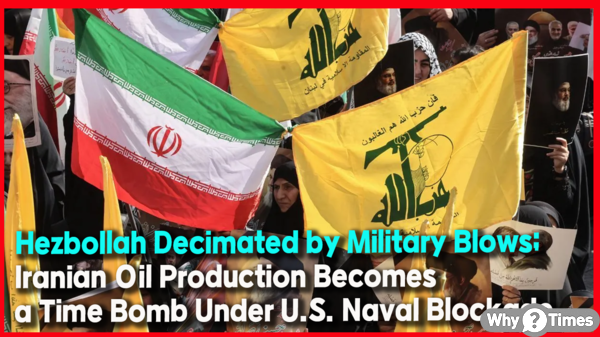
[Hezbollah’s Entry into War: A High-Stakes Gamble with a Fatal Price]
Hezbollah, Iran’s proxy force, made a strategic political and military gamble by intervening in the war against Israel and the United States. However, it now faces its greatest existential crisis since its inception, with thousands of members killed and a significant portion of its southern territory occupied by Israel. Meanwhile, as the U.S. Navy’s physical blockade has completely seized control of Iran’s oil export routes, the authorities in Tehran have entered a defensive phase, preemptively reducing crude oil production. In short, the situation has entered a final countdown: negotiation or catastrophe.
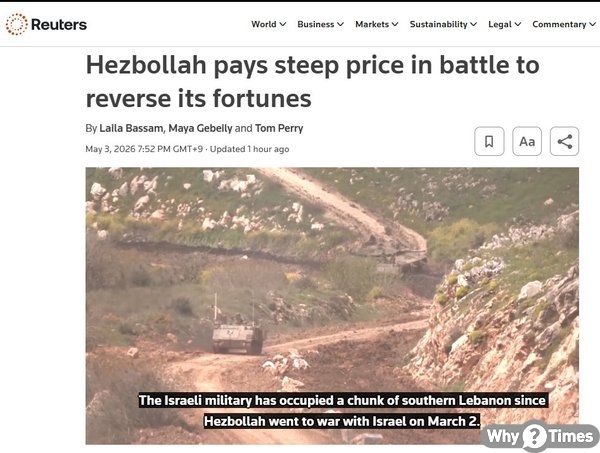
On May 4, Reuters reported, "The 2024 version of the Lebanon War, which began when Hezbollah opened fire on Israel on March 2, has returned as a massive burden to the militant group two years later." It further noted that "Hezbollah has lost parts of southern Lebanon to the Israeli military, displaced hundreds of thousands of its Shiite support base, and lost thousands of combatants."
According to the Lebanese Ministry of Health, more than 2,500 Hezbollah members have been killed and over 7,700 injured since March 2. However, Reuters cited internal Hezbollah sources saying, "The Ministry of Health’s figures do not fully reflect the casualties of Hezbollah fighters," and that "thousands of Hezbollah members have been killed in this war."
The reports from the field are harrowing. One Hezbollah commander said, "Dozens of fighters deployed to frontline cities like Bint Jbeil and Khiyam fought prepared for the end, and even their bodies have not been recovered." In the Hezbollah-controlled southern suburbs of Beirut, dozens of fresh graves appeared within days of the ceasefire taking effect, quickly filled with the remains of the fallen. Simple marble headstones were engraved with the names of both commanders and rank-and-file fighters.
Israel is maintaining its troops in a 'buffer zone' extending up to 10km from the Lebanese border while demolishing villages. An Israeli government official claimed, "Hezbollah breached the November 2024 ceasefire agreement itself by firing on Israeli civilians on March 2," and stated, "Thousands of Hezbollah members have been killed, and Israel is steadily destroying the organization’s infrastructure." The Israeli military announced that Hezbollah has fired hundreds of rockets and drones toward Israel since March 2.
[Growing Political Backlash Against Hezbollah Inside and Outside Lebanon]
As severe as the military damage is the political isolation. The Shiite community became a target of concentrated Israeli attacks and fled to areas inhabited by Christians, Druze, and other sects. In this process, resentment grew among residents of other sects, blaming Hezbollah for inviting the war. Opponents within Lebanon are more strongly raising criticisms that Hezbollah's maintenance of its status as an armed group exposes Lebanon to repeated wars with Israel.
In April, the Lebanese government conducted face-to-face negotiations with Israel for the first time in decades. Hezbollah strongly reacted against this decision. Lebanese President Joseph Aoun and Prime Minister Nawaf Salam have been demanding Hezbollah’s peaceful disarmament since last year, and on March 2, the government went as far as officially banning Hezbollah's military activities. Hezbollah is demanding the reversal of this decision and the cessation of direct negotiations with Israel, but the Lebanese side remains firm in its intention to continue direct dialogue, stating that only the United States has enough influence to move Israel.
Why, then, did Hezbollah jump into this war? Hezbollah officials who spoke with Reuters explain this participation not as a simple proxy war for Iran, but as a calculated choice for the organization's survival.
One diplomatic source defined Hezbollah’s decision to enter the war as a "huge gamble and survival strategy," saying, "The organization judged that it must be part of the conflict to secure its place as a party in the final regional solution." Hezbollah’s calculation is based on the logic that by participating in the war, the Lebanese issue will be placed on the U.S.-Iran negotiation agenda, giving Iran a pressure card to extract a stronger ceasefire. Judging that the previous ceasefire signed in the aftermath of the Gaza War in November 2024 ultimately became nominal, the plan is to utilize Iran’s bargaining power to secure a more substantial ceasefire this time.
In the 2024 war, Hezbollah lost its leader Hassan Nasrallah and about 5,000 fighters, dealing a blow that shook its long-standing dominance over the Lebanese state. Afterward, it rearmed with Iranian support and introduced new tactics such as drones. It maintained restraint even while Israel continued attacks during the 15 months of uneasy ceasefire, before finally engaging in full-scale combat this time.
What Hezbollah hopes for is the belief that Iran will protect Lebanon in negotiations. Al-Musawi said, "Iran is prioritizing the Lebanese issue in negotiations and is demanding a halt to Israeli attacks along with a withdrawal from Lebanon," adding, "We fully trust Iran. Iran will not sell out its friends."
However, the U.S. position is cold. President Trump drew a line last month, stating, "Any agreement Washington makes with Tehran is not bound by the Lebanon issue." Secretary of State Marco Rubio also stated that "Israel has the right to self-defense against Hezbollah's attacks." In short, it means Hezbollah is not even being considered.
Thus, while Hezbollah rose up to support Iran, the United States—the actual party in the war against Iran—is not even looking at Hezbollah, and Iran itself is in such a desperate situation that it cannot help Hezbollah in its greatest crisis. In this regard, it can be said that Hezbollah, which suffered thousands of casualties, has only ended up in a ridiculous position.
[Iranian Oil Blocked by U.S. Naval Siege, Finally Entering Production Cuts]
Meanwhile, as Iran’s crude oil export routes have been effectively blocked by the U.S. Navy’s powerful maritime blockade, the Iranian government has begun to reduce crude oil production. As the U.S. Navy moved to physically block areas near the Strait of Hormuz—Iran’s main export route—unsold crude oil accumulated in storage facilities and reached capacity limits. The U.S. Treasury Department estimated that Iran would suffer a revenue loss of about $170 million per day through this pressure, clearly stating its intention to pull Iran to the negotiating table.
The way the U.S. is choking Iran is on a different dimension from the past. Beyond simple financial sanctions or paper-based embargos, the U.S. Navy has physically seized control of the Strait of Hormuz, fundamentally blocking Iran’s oil exports. This is a reflection of the strong U.S. will to completely cut off the funding for Iran, which continues to support terrorism and nuclear development in the Middle East.
The Iranian government claims that its technological prowess is sufficient to restart after production cuts, but this is merely a bluff from those driven into a corner. For Iran, which relies on oil exports for the vast majority of its national finances, a loss of $170 million a day is a fatal figure that could shake the survival of the regime. Stopping production because storage is full is no different from a signal that the heart of the Iranian economy is stopping.
Particularly noteworthy is that a strong brake has been applied to the illegal "honeymoon" relationship with China. Until now, Iran had survived by selling crude oil at discounted prices to China’s small independent refineries, known as 'teapots.' However, as the U.S. Treasury precision-targeted Iran’s 'shadow finance' network, it became very dangerous and difficult for even China to receive Iranian crude oil.
This measure demonstrates the powerful U.S. hegemony strategy that has become even more consolidated since the Trump administration. The U.S. is not just announcing sanction lists but has established a 'physical wall' by mobilizing actual military force. This sends a firm message that the U.S. will no longer merely issue verbal warnings to anti-American countries that disturb the international order.
Iran is suggesting land-based detour exports through Turkey or Pakistan as an alternative, but the volume is at most 300,000 barrels per day. This is a drop in the bucket compared to the pre-blockade production of 3.2 million barrels. Ultimately, Iran stands at a desperate crossroads: watch its internal economic collapse or come to the humiliating negotiating table according to U.S. conditions.
From the perspective of energy security, this blockade also carries great significance. By proving its ability to control the Strait of Hormuz—a key point for world oil transport—Iran's attempt to threaten the West using oil prices as a weapon has come to naught. The U.S. is setting an example of how a country that has achieved energy hegemony beyond energy independence can neutralize an adversary.
Furthermore, this incident will accelerate the alienation of public sentiment within Iran. When the funds that maintained the regime and supported the Revolutionary Guard through oil profits are depleted, the anger of the suffering Iranian people will inevitably turn toward the regime. The U.S. is achieving a high-level strategic victory by shaking the foundations of the Iranian regime through economic strangulation without firing a single shot.
In addition, such strong punishment for state sponsors of terrorism should be seen as an inevitable measure for world peace. This is because every dollar flowing into Iran turns into a weapon that causes instability throughout the Middle East. Therefore, we must keep in mind that strengthening the ROK-U.S. alliance and keeping pace with this resolute international strategy of the U.S. is directly linked to our national interest.
China must also be feeling the power of the U.S. through this blockade. The reality of watching its supply chain partner, Iran, collapse while not daring to respond to the U.S. Navy’s physical pressure clearly shows where the current global hegemony lies. Iran’s isolation means the weakening of the anti-American alliance, which will be recorded as a victory for the liberal democratic camp.
In conclusion, Iran’s current production cut is not a simple operational measure but a harbinger of defeat. The tens of millions of barrels of crude oil floating on the sea and the rusting tankers eloquently and symbolically speak of the harsh price a dictatorial regime must pay when it violates the rules of the international community. There is no way to withstand a physical blockade; Iran’s full storage tanks will become a time bomb signaling the collapse of the regime.


-중국 푸단대학교 한국연구원 객좌교수
-전 EDUIN News 대표
-전 OUR NEWS 대표
-제17대 대통령직인수위원회 정책기획팀장
-전 대통령실 홍보기획비서관
-사단법인 한국가정상담연구소 이사장
-저서: 북한급변사태와 한반도통일, 2012 다시우파다, 선거마케팅, 한국의 정치광고, 국회의원 선거매뉴얼 등 50여권