
Update2026.06.10 (수)

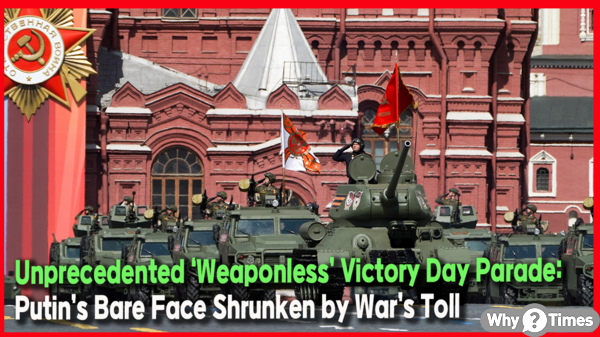
[No Tanks, No New Weapons… Russia’s Diminished Victory Day Parade]
On May 9, Russia decided to exclude all military hardware, including tanks and missiles, from its Victory Day parade, proceeding solely with infantry marches. This marks the first time in nearly 20 years that weaponry has vanished from the Red Square parade. While the Kremlin officially stated that mobilizing equipment is impossible due to the rising risk of Ukrainian terrorist activities, the move is drawing attention as a stark reflection of Russia’s withered military power after more than four years of invading Ukraine.
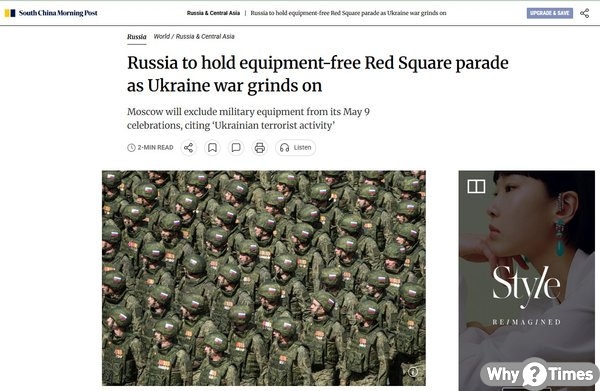
On May 1, the South China Morning Post (SCMP) reported: "The Kremlin announced that this year’s annual Victory Day military parade has been scaled back and will not include military hardware due to the risk of Ukrainian terrorist activity. Personnel from all types of higher military educational institutions and various branches of the Russian Armed Forces will participate as part of the marching columns."
Since 2008, the Victory Day parade held annually at Red Square has showcased a wide array of military equipment and weaponry. The absence of military hardware on May 9—Russia’s most significant national holiday—is the first such instance in nearly two decades and the first since the start of the war with Ukraine.
This decision stands in sharp contrast to last year’s 80th-anniversary event. At that time, leaders from about 20 countries, including Chinese President Xi Jinping, visited Moscow. The large-scale event featured thousands of troops alongside a massive display of the latest weaponry, including new tanks and drones. Captured weapons seized from the Ukrainian front lines were even put on display.
Regarding this shift, the Financial Times (FT) assessed that "Russia's decision is an admission that it faces severe headwinds in its war against Ukraine."
[Moscow’s Defense Shaken by Drone Threats]
Behind this decision lies Ukraine’s sophisticated drone strike capabilities. Russian military expert Ruslan Leviev analyzed in an interview with the Russian-language independent broadcaster TV Rain that "The authorities fear the Ukrainian military will target and destroy weaponry during the parade rehearsal period." He added that "Concerns that equipment gathered during rehearsals could become targets for drone strikes led to this decision."
Leviev further warned, "Russia is losing its air defense systems at a significant rate, which is weakening Moscow’s ability to respond to intensifying drone attacks."
Indeed, Ukrainian drone strikes are penetrating deep into Russia. Last month, an oil export facility near St. Petersburg was hit by a drone, resulting in approximately $1 billion in losses. Recently, an emergency was declared in Tuapse, a southwestern port city with a high concentration of oil facilities, following a fire caused by a drone strike. Ukraine is employing a strategy of targeting Russian military supply chains and energy infrastructure using both indigenously developed drones and Western-supplied missiles.
[Victory Day: From a Tool for Justifying War to a Burden]
Victory Day is Russia’s largest national event, commemorating the Soviet Union's victory over Nazi Germany. Every May 9, decorated veterans take to the streets, and the country is flooded with war-themed films and music in an outpouring of national emotion. President Vladimir Putin has actively utilized this symbolism to justify the war, framing Ukraine as a "neo-Nazi regime" that must be defeated.
However, four years later, the front lines remain largely deadlocked. While Russian forces continue a gradual advance centered in eastern Ukraine, they have failed to achieve a decisive breakthrough. Although the Russian Ministry of Defense consistently reports the capture of villages, Putin’s goal of total control over the entire Donbas region remains far out of reach.
Since the full-scale invasion in February 2022, Victory Day events have served to justify the war. Paradoxically, the same event is now becoming a window into internal Russian fractures. According to the All-Russian Public Opinion Research Center (VTsIOM), President Putin’s approval rating has fallen for seven consecutive weeks to 65.6%, the lowest level since the invasion began and similar to pre-war figures.
Factors contributing to this public alienation include economic deterioration due to the prolonged war and tightened internet controls. According to the Russian Ministry of Economic Development, GDP for January and February this year decreased by 1.8% year-on-year, marking the first negative growth since 2023. During this year’s Victory Day parade, mobile internet shutdowns in central Moscow are expected once again, potentially fueling further public discontent.
[Resource Depletion and Vulnerable Homefront Security]
The fact that tanks and armored vehicles have vanished from the Victory Day parade—once a stage for boasting "invincible military might"—carries profound implications. Beyond the Kremlin’s excuse of "terrorist threats," this move proves the severe military and strategic crisis Russia is facing. From a conservative perspective, the fact that the nation's grandest event symbolizing state authority and military prestige has become so diminished signifies a crack in the Putin regime’s control.
Above all, Russia has effectively admitted that Ukrainian drone strikes and sabotage now threaten the very heart of Moscow. For a nation pursuing strong centralized power, the inability to guarantee security even for a capital-city event—leading to the abandonment of military displays—exposes the illusion of an authoritarian state clashing with the free world.
As the war drags on past the four-year mark, the analysis that Russia lacks enough equipment even for the front lines is gaining traction. Just last year, Putin sat beside Xi Jinping while flaunting new tanks and drones. His decision only a year later to hold a "weaponless parade" is read as a signal that available resources for the battlefield have reached their limit.
While Ukraine, backed by the U.S. and the West, increases its ability to pressure the Russian mainland, Russia remains mired in outdated tactics, leading only to mounting casualties. This scaling back of the parade reveals the fiction behind Russian propaganda claiming victory through the capture of small villages on the eastern front.
Furthermore, this decision may be a desperate measure to prevent domestic unrest. Political calculations may have suggested that a flamboyant display of weaponry could provoke anger among the families of the countless soldiers killed in the Ukraine war. This "half-parade" reflects Putin’s dilemma: wanting to hide the tragedy of war while needing to maintain the symbolism of victory.
From the perspective of the liberal international order, Russia’s diminished presence reaffirms its desperation, forcing it to cling to military cooperation with North Korea. The fact that Russia, which once prided itself as the "world’s second military power," can no longer even properly conduct its own national festival suggests that a war of aggression never ends sweetly.
The difficulty in procuring components for high-tech weapons due to international sanctions likely also played a role. Exposing the maintenance status or insufficient quantity of equipment destined for the parade could be as fatal a "exposure of weakness" as a leak of military secrets.
Ultimately, the "Special Military Operation" launched by Putin has not only driven Russia into international isolation but has also tarnished the Victory Day celebrations—the pride and foundation of the nation. The memory of historical victory, once cherished by the Russian people, is now being consumed as a meager backdrop for a dictator’s grip on power.
Through this situation, we witness the grim reality facing those who attempt to change the status quo by force. The empty asphalt of Red Square represents Russia’s current national strength more accurately than the tricolor flags flying in the Moscow sky.
From a reformist perspective, Russia must stop its reckless aggression and return to the international order. The Putin regime must realize that the true path to Russia’s survival is not hiding weapons from parades, but withdrawing them from the battlefield.
In this sense, a Red Square without tanks is a stage of paradox, proving not Putin’s "victory," but Russia’s "exhaustion."


-중국 푸단대학교 한국연구원 객좌교수
-전 EDUIN News 대표
-전 OUR NEWS 대표
-제17대 대통령직인수위원회 정책기획팀장
-전 대통령실 홍보기획비서관
-사단법인 한국가정상담연구소 이사장
-저서: 북한급변사태와 한반도통일, 2012 다시우파다, 선거마케팅, 한국의 정치광고, 국회의원 선거매뉴얼 등 50여권