
Update2026.06.10 (수)

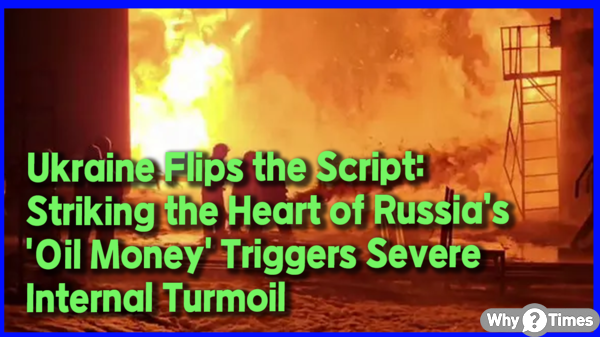
Ukraine is systematically dismantling Moscow’s war chest by launching a series of drone strikes against oil facilities deep within Russian territory. Recently, Ukrainian drones demonstrated remarkable prowess by reaching inland facilities 1,500km away from the front lines, effectively neutralizing Russia’s air defense networks. As flames erupt from refineries on the Black Sea coast to ports on the Baltic Sea, the Russian economy is reeling under the dual weight of a 21% interest rate and defense spending reaching 7.3% of its GDP.

The AP reported on the 2nd that "Ukrainian drones are penetrating deep into Russian territory to attack oil facilities, creating massive plumes of smoke visible from space and causing toxic rain in Black Sea tourist resorts." The report added that "these attacks are aimed at cutting off Moscow’s oil exports—the primary funding source for the invasion—and the scale and environmental impact are forcing ordinary Russians far from the front to confront the gravity of the war."
Now entering its fourth year since the full-scale invasion on February 24, 2022, this conflict has become the worst in Europe since World War II, with casualties nearing 2 million. While early forecasts predicted an overwhelming Russian victory, as of May 2026, the momentum has shifted decisively toward Ukraine. By countering ground-level attrition with drone and long-range strike strategies, Ukraine has entered a new phase, shaking Russia’s very capacity to wage war.
Ukraine’s drone strategy has evolved from a tactical tool into a strategic weapon targeting the foundation of the Russian economy. Focusing on oil infrastructure, Ukraine struck the Tuapse refinery on the Black Sea coast more than three times in April alone.
Ukrainska Pravda reported, "Tuapse is a core export hub for the state-owned Rosneft. Following strikes on April 16, 20, and 28, the facility was closed indefinitely after the third strike hit just four days after the second fire was officially extinguished." The outlet noted that a single strike required 300 firefighters and five days to contain, with benzene concentrations in the air soaring to 2-3 times normal levels.
The offensive extends beyond Tuapse. The Ust-Luga terminal on the Baltic Sea—one of Russia’s largest oil and gas hubs—was hit three times in a week, despite being 800km from the Ukrainian border. Ukraine also claimed responsibility for hitting a pumping station in the inland Perm region, over 1,500km away.
Robert "Magyar" Brovdi, commander of Ukraine’s Separate Presidential Brigade’s drone unit, described the series of attacks as a "remake of the movie Groundhog Day," implying the strikes will repeat until the facilities are permanently disabled. These are not isolated incidents but a systematic pressure campaign against export revenues that account for nearly one-fourth of Russia's national budget.
The success of this strategy is rooted in Ukraine’s technological evolution. The Ukrainian Ministry of Defense stated that it has more than doubled its long-range precision strike capabilities since 2022, allowing drones to approach from multiple directions to saturate and confuse Russian responses.
Marcel Plichta of the University of St Andrews noted, "Drone strikes are a symbol of strategic asymmetry. They are successfully targeting areas no one expected Russia to be vulnerable in at the start of the war." This capability essentially did not exist four years ago.
Lethality: Drones were responsible for 70-80% of personnel and equipment losses on the Ukrainian front last year.
Cost-Efficiency: Drones costing hundreds of dollars are destroying tanks worth millions.
Scale: Ukraine reportedly strikes nearly 90,000 Russian targets per month using drones.
Impact: Last June, "Operation Spiderweb" used 117 drones to strike five Russian airbases simultaneously, damaging or destroying 10 to 20 strategic bombers.
This offensive is pushing Russian air defenses to a breaking point. Leningrad Governor Alexander Drozdenko publicly stated that the St. Petersburg region now resembles a "front-line zone" due to aerial threats—a statement that directly contradicts the Kremlin’s narrative that the "Special Military Operation" does not affect the domestic lives of its citizens.
A massive gap has emerged between Russia’s surface-level advances and its actual resource depletion. Citing the think tank CSIS, The Guardian pointed out that Russia progressed an average of only 70m per day in Pokrovsk and 23m per day in Kupyansk over the last 18 months.
In 2025, Russia seized approximately 3,000–5,000 $km^2$ of territory—a mere 0.4–0.8% of Ukraine’s total area. For this negligible gain, CSIS estimates Russian casualties at 1.2 million, compared to Ukraine's 600,000. No major power since WWII has sustained such losses.
To maintain this attrition, Russia has hiked defense spending to unprecedented levels. The IISS 'Military Balance 2026' report shows Russia spent $186 billion (7.3% of GDP) on defense last year, a twofold increase compared to 2021.
The economic fallout is becoming undeniable. The IMF downgraded Russia’s growth forecasts to 0.6% and 0.8%, the lowest since 2014 (excluding the pandemic).
Revenue Drop: Fossil fuel taxes, which once funded 40% of the federal budget, dropped to 25% by Q3 last year.
Financial Strain: The Central Bank raised interest rates to 21% to curb inflation, further stifling growth.
Trade Shift: EU trade plummeted from 38% in 2020 to 8% in 2025, while trade with China rose to 33%, creating a structural dependency on Beijing.
Ukraine’s decision to strike Russia’s "Achilles' heel"—its oil infrastructure—is a strategic turning point. By bringing the war to the "backyards" of Russian citizens, Ukraine is dismantling the deception that the Russian mainland is safe. This is a psychological victory that erodes the legitimacy of the Putin regime.
President Zelenskyy has aptly termed these strikes "physical sanctions." While Russia tries to bypass Western financial sanctions, seeing its "black blood" (oil) go up in smoke is the most effective way to maximize the impact of international pressure.
Ultimately, the end of this war will be decided when Putin’s war chest runs dry. Ongoing infrastructure destruction will lead to rising repair costs and parts shortages, eventually suffocating the Russian economy. Ukraine's drones have become the sharpest dagger, poised to dismantle Putin's war-driven dictatorship by cutting off its economic arteries.


-중국 푸단대학교 한국연구원 객좌교수
-전 EDUIN News 대표
-전 OUR NEWS 대표
-제17대 대통령직인수위원회 정책기획팀장
-전 대통령실 홍보기획비서관
-사단법인 한국가정상담연구소 이사장
-저서: 북한급변사태와 한반도통일, 2012 다시우파다, 선거마케팅, 한국의 정치광고, 국회의원 선거매뉴얼 등 50여권