Update2026.10.24 (토)

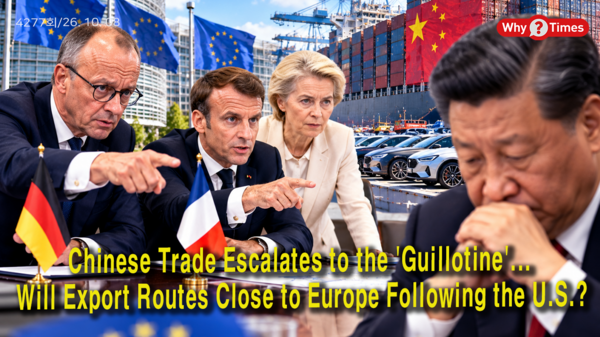
[Even Germany, Which Shielded China, Has Turned Its Back]
China's export economy stands at a critical crossroads. As the United States continuously erects barriers against Chinese overcapacity and exports, even Germany—traditionally the most cautious nation regarding hardline policies toward Beijing—has joined hands with France to demand that the European Union strengthen its trade defenses against Chinese goods. Furthermore, the measures put forward by France and Germany include ultra-potent mechanisms that could, if necessary, block a target nation's access to the EU single market altogether. If another massive, high-income market like Europe narrows its doors alongside the United States, China's model of "overcapacity → exports → sustaining growth" will face unprecedented pressure.
Highlighting "Germany's pivot on trade policy toward China," the Financial Times (FT) reported that Germany—which previously prioritized economic ties with Beijing and exercised caution regarding EU trade retaliation—has begun demanding stronger EU-level industrial protections alongside France to counter unfair Chinese trade practices.
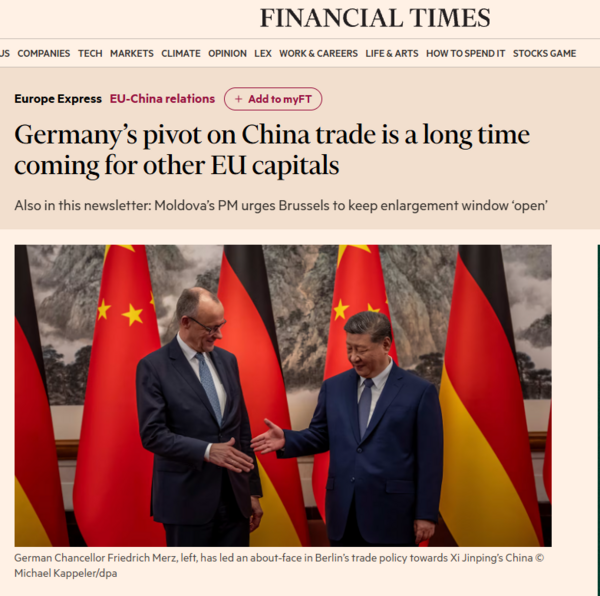
The FT noted that key manufacturing sectors in Germany and broader Europe, including automotive, aerospace, and chemicals, are under severe pressure from China's industrial policy and surging imports. It emphasized that this is not a simple policy adjustment, but a fundamental shift in the interests of Germany, which had effectively acted as a brake whenever the EU sought to take a hardline stance against China in recent years.
[Negotiations in Beijing: Šefčovič Is Not Empty-Handed This Time]
Against this backdrop, European Commissioner for Trade and Economic Security Maroš Šefčovič visits China. The meeting carries exceptional weight because Šefčovič travels to Beijing backed by a completely transformed political environment. Just ahead of the talks, France and Germany jointly proposed new trade defense instruments enabling the EU to respond more swiftly to unfair traders, including China. Sitting across from Chinese officials, Šefčovič now has not only Paris but also Berlin standing firmly behind him.
[1 Billion Euros a Day… Numbers Moved the EU]
The primary driver behind the EU's shifting posture lies in the numbers. According to Eurostat, in 2025, the EU exported 199.6 billion euros worth of goods to China while importing 559.4 billion euros. The resulting trade deficit reached a massive 359.8 billion euros. Converted to a daily average, this translates to roughly 986 million euros—effectively accumulating a deficit of nearly 1 billion euros every single day.
Even more concerning is the trajectory. In 2025, EU exports to China fell by 6.5% year-on-year, whereas imports of Chinese goods grew by 6.4%. Chinese products are flooding into Europe at an accelerating pace, while European products are losing ground in the Chinese market.
[Germany in Particular Is Cracking]
The shift within Germany is even more dramatic. According to Destatis (Federal Statistical Office of Germany), German exports to China dropped 9.7% year-on-year in 2025 to 81.3 billion euros. Conversely, imports from China surged 8.8% to 170.6 billion euros. Consequently, Germany's trade deficit with China widened from 66.9 billion euros to 89.3 billion euros in a single year—an increase of 22.4 billion euros. Although China remains Germany's largest trading partner, the fundamental nature of this relationship is undergoing a radical change.
In the past, China served as a vast consumer market buying substantial quantities of German automobiles, machinery, and chemical products. Today, however, Chinese firms compete directly with German companies in those very sectors, and Chinese goods are flowing back into German and European domestic markets. For Germany, the fear that "provoking China will harm German companies" is increasingly superseded by the existential dread that "failing to block China will destroy German industry itself."
[In 2024, Germany Shielded China]
This context is vital. Just two years ago, in 2024, when the EU imposed tariffs on Chinese electric vehicles, Germany opposed the move. German automakers, with vast commercial interests in the Chinese market, feared severe blowback from Chinese retaliatory measures.
However, the FT evaluated the latest joint proposal by France and Germany as a major strategic pivot in German policy toward China. Germany, which had been hesitant to endorse aggressive EU-wide action due to economic reliance on China, has now aligned with France to protect its core domestic industries.
For China, this represents the single most alarming developments.
[Macron and Merz Unveil a New Trade Weapon]
This shift ultimately materialized into concrete policy proposals. French President Emmanuel Macron and German Chancellor Friedrich Merz sent a joint letter to European Commission President Ursula von der Leyen, demanding a sweeping upgrade to the EU's trade defense capabilities.
The two nations proposed two primary mechanisms. The first is reducing excessive reliance on specific countries or suppliers in strategic sectors such as batteries, critical raw materials, and clean energy products. However, the second mechanism is far more aggressive: establishing new trade defense tools capable of restricting EU market access for countries that structurally distort competition within the EU single market through dumping, massive state subsidies, and currency restrictions. Although the document does not explicitly name any single nation, analysts broadly agree that China is the primary target.
The joint Franco-German proposal goes even further. Both nations argued for creating a robust "last-resort" mechanism to complement existing EU trade tools, capable of completely blocking a target country's access to the EU single market in cases of severe economic pressure, such as restrictions on critical supply chains. Put simply, this goes beyond adding a few percentage points in tariffs; it seeks to construct a weapon capable of denying specific countries or enterprises entry into the vast EU market altogether.
[Even Pascal Lamy Turned Around… A 'Plan B' Is Required]
Another notable figure altering his stance is Pascal Lamy, former Director-General of the World Trade Organization (WTO). A prominent free-trader who previously served as EU Trade Commissioner and played a key role in China's accession to the WTO, Lamy reassessed past approaches toward Chinese state subsidies in an interview with Le Monde. He argued that while voluntary adjustments through negotiations should remain Plan A, Europe must prepare a distinct defense system—a Plan B—in case talks fail.
The Plan B outlined by Lamy is formidable. It proposes a tariff-rate quota system allowing Chinese goods to enter at low tariffs up to a certain threshold, after which significantly higher tariffs would automatically kick in. The system would utilize objective metrics—such as import surges, price drops, state subsidies, and exchange rates—to activate defense mechanisms whenever market distortion crosses a set threshold, disengaging once the market normalizes. This approach aims to create a much faster defense shield than launching month-long anti-dumping investigations on individual items. The objective is not for the EU to abandon trade with China, but to institute an automatic emergency brake against an unrestricted influx of Chinese products.
[China Pushes Back Immediately]
China is well aware of the gravity of the situation. The Chinese Ministry of Commerce issued an immediate response to the Franco-German proposal. A ministry spokesperson argued that "interdependence is not a risk, and the convergence of interests is not a threat," warning that protectionism cannot enhance competitiveness and that decoupling or severing supply chains would harm both sides. Beijing urged France and Germany not to encourage the EU to abuse protectionist tools or to politicize and security-drape economic and trade issues. While diplomatic in phrasing, Beijing's message is unmistakable: the EU must not construct new trade weapons.
Of course, the EU cannot exert pressure on China without risk. Beijing holds powerful retaliatory cards, namely critical raw materials and rare earths. Here, a clear distinction must be drawn between "rare earth elements" and "rare earth permanent magnets." According to official EU Commission data, Chinese imports satisfy 98% of the EU's demand for rare earth permanent magnets—components vital for electric vehicle motors, wind turbines, robotics, industrial machinery, and advanced electronics.
If China leverages these supply chains for retaliation, European manufacturing would suffer significant shocks. Paradoxically, this very vulnerability is precisely why the EU is moving urgently to reduce its reliance on Beijing and build new trade defenses.
[China's Calculation: Divide the EU Once Again]
Consequently, China's anticipated strategy is relatively predictable. Rather than engaging in a frontal conflict with the entire EU, Beijing will likely attempt to persuade member states and corporations with heavy stakes in the Chinese market, leverage critical raw material supply chains, and offer limited concessions during negotiations in Beijing to delay the implementation of hardline EU measures. However, a decisive variable has emerged this time: Germany. This explains why the FT characterized this shift specifically as "Germany's pivot on trade policy toward China." If Germany remains firmly aligned with France, one of the most critical fault lines China previously exploited when dealing with the EU will crack. Therefore, the core of this issue is not merely new tariffs, but how long Germany maintains its current stance.
[Why Times Insight | Why Chinese Trade Stands Before the 'Guillotine']
This structural shift in EU policy is not a mere adjustment of trade guidelines; it directly impacts China's broader economic growth model. Amid a real estate downturn and sluggish domestic consumption, China continues to maintain massive manufacturing capacity. Because domestic demand alone cannot absorb the output flooding from sectors like electric vehicles, batteries, solar energy, steel, chemicals, and machinery, overseas markets serve as a vital lifeline for the Chinese economy.
With the United States already narrowing that exit, the European market has become immeasurably more critical for Beijing. Yet Europe is now moving in unison, with Germany—the traditional advocate of caution—turning its back. This is why the FT's characterization of this shift as a fundamental "pivot" is so significant.
If the EU successfully equips itself with swift trade defense mechanisms capable of restricting single-market access beyond standard anti-dumping duties, the paradigm changes completely. This is precisely the capability France and Germany are now demanding.
Ultimately, China faces three options: curb production, absorb more output domestically, or push greater volumes into alternative foreign markets. However, cutting production threatens growth and employment. Expanding domestic consumption remains a deep structural challenge Beijing has struggled to resolve for years. Meanwhile, redirecting exports to third countries risks triggering fresh trade frictions in those regions. To be clear, this does not imply an immediate collapse of the Chinese economy; China possesses alternative markets across ASEAN, the Middle East, and Latin America, as well as potent retaliatory capabilities in rare earths and critical raw materials.
Nevertheless, facing simultaneous defense barriers from the world's two largest high-income consumer markets—the United States and Europe—is an entirely different challenge. Going forward, the critical metric is not solely what concessions China offers during talks in Beijing. It will be equally vital to observe whether Beijing attempts to buy time with minimal compromises, mobilizes EU nations and corporations heavily reliant on its market to fracture the Franco-German front, and, most importantly, whether Germany retains its firm posture if China initiates real retaliation through rare earths and raw materials.
The United States narrowed the door first. Now, Europe has reached for the handle—and Germany, which long kept that door propped open, has begun to let go. This is precisely why Chinese trade now stands before the "guillotine." The true trial lies not in the talks in Beijing, but in the moment China launches its first retaliatory strike.

-Why Times Newsroom Desk
-미국 Midwest 대학교 박사
-월간 행복한 우리집 편집인
-월간 가정과 상담 편집인