


추부길 whytimespen1@gmail.com
[D-5 to Ceasefire Expiration: U.S.-Iran Termination Framework Negotiations Gain Momentum]
With only five days remaining until the April 21 ceasefire expiration, the U.S. and Iran are nearing the final stages of a "war termination framework." The Trump negotiation team is reportedly mobilizing all back-channels to secure a deal. Amidst this, analysts note that Iran’s war-ravaged economy has reached a point of desperation, leaving Tehran with little choice but to negotiate. Simultaneously, the U.S. military has heightened the pressure by releasing detailed photos of a next-generation stealth bomber—the "assassin of the skies"—capable of bypassing Iranian radar.
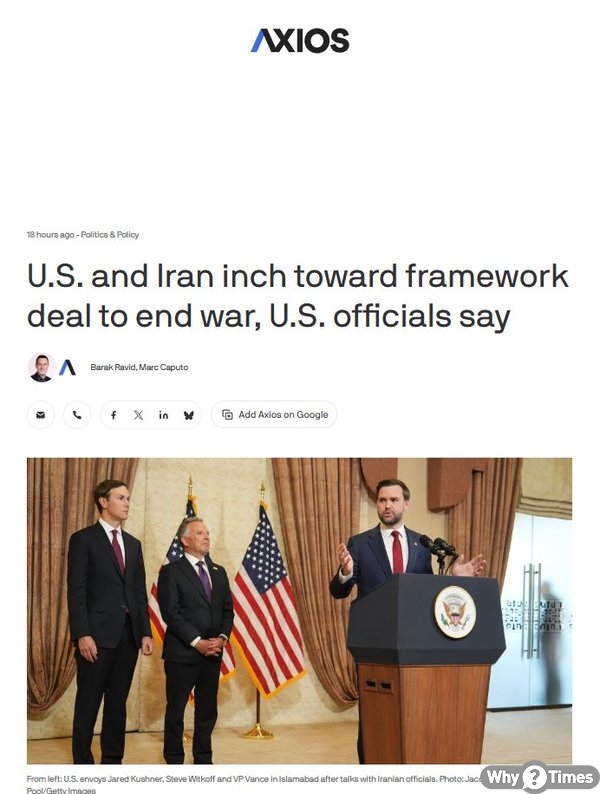
On the 16th, Axios reported that "negotiators from both countries have made meaningful progress toward establishing a fundamental framework for ending the war through continuous draft exchanges and phone consultations." The Trump negotiation team—consisting of Vice President J.D. Vance, White House Special Envoy Steve Witkoff, and Senior Advisor Jared Kushner—has been in constant contact with Iranian officials and mediators.
Axios further noted, "A U.S. official stated that the entire team has been 'glued to their phones,' reaching out to all relevant parties through informal channels to close the gap." On the 16th, a delegation led by General Asim Munir, Pakistan’s Chief of Army Staff, visited Tehran for direct talks. Alongside Egypt and Türkiye, Pakistan has emerged as a key mediator, having secured the current two-week ceasefire just before Trump’s April 7 ultimatum by promising the reopening of the Strait of Hormuz.
While sources familiar with the mediation suggest that face-to-face negotiations are likely to resume within days, specific dates and locations have yet to be finalized.
Regarding the progress, Vice President Vance stated at a Turning Point USA event in Georgia on the 15th, "I believe those sitting across the table also want a deal. I feel very positive about where we are right now."
White House Press Secretary Karoline Leavitt also confirmed the progress, stating, "These conversations are productive. We are optimistic about the possibility of an agreement. It is in Iran’s best interest to accept President Trump’s terms." One U.S. official added, "We want a deal. Parts of the Iranian government want a deal. The key now is getting the entire Iranian government to commit."
[Iranian Economy "Suffocating" Under Blockade, Increasing Likelihood of Return to Negotiations]
As speculation regarding a deal intensifies, the U.S. points to its naval blockade as the most powerful leverage forcing Iran to the table. U.S. officials explained that the Trump administration’s maritime blockade has effectively severed Iran’s crude oil exports, delivering a fatal blow to an already struggling economy. Iran previously earned approximately $140 million per day from exporting 1.5 million barrels of oil. Miad Maleki, a former Treasury Department expert on Iranian sanctions and current senior fellow at the Foundation for Defense of Democracies (FDD), noted, "The blockade turned that revenue to zero overnight."
On the 16th, The Wall Street Journal (WSJ) reported, "During the five-week war, the U.S. and Israel struck at least 17,000 targets, including factories, railways, ports, government buildings, and military facilities." While Iranian state media estimates reconstruction costs at $270 billion, experts believe it is too early to calculate the full scale of the damage given the ripple effects on the broader economy.
The WSJ pointed out that the airstrikes focused on hindering Iran’s long-term recovery by targeting petrochemical plants—a key source of foreign currency—and facilities producing construction materials like steel.
Burcu Ozcelik, a senior research fellow at the Royal United Services Institute (RUSI), warned, "Voices inside Iran are expressing fear over an 'economic catastrophe' if Washington does not provide a path to recovery through sanctions relief. Without a prospect for recovery, the regime will face structural public pressure that threatens its long-term survival."
In fact, the Israeli military targeted eight petrochemical plants in the southwest, including the Bandar Imam complex, Iran’s largest. Major steel facilities, such as the Mobarakeh Steel Company in Isfahan, were also damaged. Petrochemicals accounted for nearly half of Iran’s non-oil exports ($18 billion) in 2023, while the steel industry generated $7 billion annually. Professor Kevan Harris of UCLA analyzed that "these attacks were not random; they precisely targeted sectors capable of earning foreign currency for basic domestic needs."
Following the strikes, Israeli Prime Minister Benjamin Netanyahu declared, "We are systematically dismantling the IRGC’s (Islamic Revolutionary Guard Corps) lifeline." In response, Tehran banned all petrochemical exports to secure domestic supply, but the U.S. naval blockade has further throttled the economy. Maleki (FDD) explained that the blockade is costing Iran approximately $435 million per day in lost revenue.
The labor market is also in a state of collapse. Hadi Kahalzadeh, an economist and former official at Iran’s Social Security Organization, diagnosed that "up to 12 million jobs—nearly half of Iran’s total workforce—are at risk of layoffs or unpaid leave." This includes 5.5 million jobs in the steel sector and 1.2 million in the petrochemical and pharmaceutical fields.
While Iranian authorities claim they can rebuild without foreign labor due to decades of "resistance economy" experience, analysts argue that public distrust is the biggest hurdle. Professor Djavad Salehi-Isfahani of Virginia Tech noted, "The political situation is critical. The Iranian people deeply distrust government promises and are losing hope for the future."
The WSJ warned that if the blockade continues, Iran will hit its land-based storage limits and be forced to shut down oil production entirely, potentially causing irreversible damage to its oil fields. "If Iran, known as an oil giant, becomes a country that cannot produce oil, it will face a situation more dire than Venezuela under Maduro," the journal warned.
[“Assassin of the Skies” Revealed: U.S. Flaunts Stealth Bomber in Defiance of Iranian Radar]
Amidst these tensions, the U.S. Air Force released a press release on the 15th titled "B-21 Raider Accelerates Long-Range Strike Capability," featuring photos showing the top of the aircraft and mid-air refueling scenes. This marks the first time detailed structural elements of the B-21's upper surface—including the refueling port, emergency escape panels, and flush air intakes—have been made public. The exposure of the rear exhaust, a critical component of stealth technology, is considered highly unusual.
General Ken Wilsbach, U.S. Air Force Chief of Staff, stated, "This aircraft will maximize the effectiveness of U.S. military power. This long-range strike bomber will reduce the burden on our tanker fleet and provide the nation with broader operational options and deterrence."
The B-21 Raider is the first new U.S. bomber in 33 years. Dubbed the "Digital Bomber," its stealth capabilities are vastly superior to its predecessor, the B-2 Spirit. While a B-2 appears on radar as the size of a bird, the B-21 is reportedly detected only as the size of a golf ball. It is capable of unmanned operation and can strike targets anywhere in the world starting from the U.S. mainland.
International observers view the timing of this disclosure as a deliberate warning message. By revealing the successor to the B-2—the aircraft once designated for strikes on Iranian nuclear facilities—just before the second round of termination talks, the U.S. is signaling its readiness. Combined with Iran’s economic desperation, the U.S. is using its latest strategic asset to solidify its nuclear deterrence and pressure Tehran at the negotiating table.

- TAG