


추부길 whytimespen1@gmail.com
[U.S.–Iran move toward second round of talks… Islamabad reconsidered as venue]
High-level talks between the United States and Iran held in Islamabad ended without narrowing major differences on key issues, but both sides are now leaning toward resuming negotiations as early as the 16th. Meanwhile, the Iran war has delivered a direct blow to China’s economy, slowing exports while driving up imports, and Iran’s central bank has warned that rebuilding the economy could take up to 12 years—effectively setting the country back to a pre-industrial state.
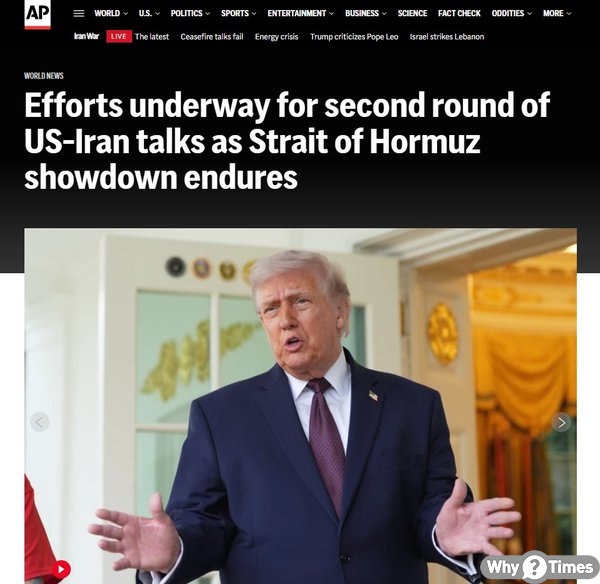
According to the Associated Press on the 14th, “A second round of peace talks between the U.S. and Iran could take place as early as the 16th (local time),” adding that “a diplomat from a mediating country said both sides have already agreed to further face-to-face negotiations.”
The AP noted that “the swift push for a second round comes amid concerns that military conflict in the Middle East could reignite if no agreement is reached before the current two-week ceasefire expires next week.” It added that it remains unclear whether both sides will send delegations of the same high level as in the first round, and the White House has yet to provide an immediate response to media inquiries.
[Vance: “Iranian delegation may have lacked authority”]
The U.S. has also offered its interpretation of why the first round failed. Vice President J.D. Vance, appearing on Fox News’ Special Report, said, “It’s possible that the Iranian delegation sent to Islamabad did not have real authority to finalize an agreement.” This suggests Washington believes Iran’s lack of flexibility stemmed from limited negotiating power, and it also serves as pressure for Tehran to send a more empowered delegation in the next round.
During last weekend’s talks, the U.S. delegation was led by Vice President Vance, alongside Middle East envoy Steve Witkoff and Jared Kushner, son-in-law of President Donald Trump. Iran’s side was headed by Parliament Speaker Mohammad Bagher Ghalibaf and Foreign Minister Abbas Araghchi. Despite more than 21 hours of negotiations, the sides failed to bridge differences over key issues such as Iran’s nuclear program, control of the Strait of Hormuz, and the scope of frozen asset relief.
Following the breakdown, President Trump said on the 13th, “Iran called this morning saying they want a deal.” A U.S. official also confirmed that “contacts between the two sides are ongoing and movement toward an agreement continues.”
Pakistani Prime Minister Shehbaz Sharif emphasized that “all efforts to resolve outstanding issues are still underway,” signaling that mediation momentum remains intact.
If a second round materializes, time pressure will be the key driver. The two-week ceasefire brokered by Pakistan is set to expire next week, and without either a peace agreement or extension, both sides face the risk of renewed conflict that has already claimed thousands of lives over six weeks.
Experts note that the two-week window is far too short for a comprehensive agreement. Iran argues that U.S. demands—including dismantling its nuclear program, reopening the Strait of Hormuz, and restructuring regional security—are excessive, while Washington suspects Tehran of employing delay tactics. Against this backdrop of deep mistrust, the extent of progress in a second round remains the central question.
[China’s export growth slows sharply as Iran war hits economy]
Trade data confirm that the Iran war is delivering a significant shock to China’s economy. Export growth, a key pillar of China’s economic model, slowed sharply in March due to weakening global demand triggered by the conflict.
The Wall Street Journal reported on the 14th that “China’s exports in March rose just 2.5% year-on-year in dollar terms,” a sharp drop from the 22% surge recorded in January and February. The slowdown reflects how geopolitical risks in the Middle East have dampened global consumer sentiment.
Meanwhile, imports surged 28% in March, marking the strongest growth since 2021 and exceeding 20% year-on-year. As a result, China’s trade surplus fell to $51 billion—roughly half of the $103 billion recorded a year earlier.
By trading partner, exports to the United States dropped 26%, highlighting a sharp contraction. Even trade with the Middle East, previously a stable growth area, has turned downward as the war in Iran intensifies.
China has relied heavily on exports in recent years to offset weak domestic demand caused by a prolonged property market slump. However, the global demand slowdown is now making it difficult for manufacturers to fully utilize production capacity.
Although China faces relatively less disruption in energy supply compared to other countries, rising raw material costs due to Middle Eastern supply chain instability are directly hitting corporate profitability. Factory gate prices rose in March for the first time in over three years, signaling mounting cost pressures.
[Iran central bank warns recovery could take at least 12 years]
Amid these developments, Iran’s central bank has issued a grim outlook, warning that restoring the war-damaged economy could take more than a decade.
According to Iran International, citing internal sources, “senior central bank officials recently submitted a report to President Masoud Pezeshkian estimating that recovery from war damage could take up to 12 years.” The report noted that the 40-day conflict with the United States and Israel, combined with pre-existing economic vulnerabilities, has made recovery extremely difficult.
During the conflict, several major airports were damaged, while critical oil facilities, refineries, and petrochemical complexes—key to Iran’s exports—were heavily bombed, effectively paralyzing industrial supply chains. Economists warn that the loss of production capacity could trigger severe inflation in the coming months, potentially reaching as high as 180% if shortages persist.
The labor market is also under strain. With factories, service industries, and small businesses struggling to resume operations, unemployment could rise by around 2 million people. Central bank governor Abdolnaser Hemmati has urged the president to implement urgent stabilization measures, including restoring nationwide internet access and pursuing active diplomatic engagement with the United States.
Economists argue that easing diplomatic tensions and lifting sanctions are the only viable paths to stabilization. Internet shutdowns imposed during the war—ostensibly for cybersecurity—have severely damaged Iran’s digital economy, which accounts for 5–6% of GDP, isolating millions of small businesses and freelancers from customers and payment systems.
Within the presidential office, concerns are growing that economic instability could evolve into a political crisis. Some officials fear that if conditions worsen or fiscal collapse looms, hardliners within the Islamic Revolutionary Guard Corps (IRGC) may shift blame onto President Pezeshkian. Already strained by years of sanctions, inflation, and currency instability, Iran now faces what may be its most severe existential crisis since its founding.
[“Anti-U.S. rhetoric at home, luxury life in America”… deportation of Iranian elites’ families]
The U.S. State Department has begun a sweeping crackdown, revoking permanent residency for family members of current and former Iranian officials living in the United States and initiating deportation proceedings.
U.S. Immigration and Customs Enforcement (ICE) detained Seyed Eisa Hashemi, son of former Iranian Vice President Masoumeh Ebtekar, on the 11th. While Hashemi himself was not accused of wrongdoing, authorities revoked his family’s residency status based on Ebtekar’s past role in the 1979 Tehran hostage crisis, where she acted as a spokesperson for the revolutionaries.
Hashemi and his spouse had been living in a luxury apartment in Agoura Hills while working as professors at the Chicago School in Los Angeles. Activists criticized them for enjoying privileges in the U.S. while remaining silent about their family’s legacy. Secretary of State Marco Rubio stated, “Ebtekar’s family does not deserve the privilege of living in the United States,” adding that “under the Trump administration, America will never be a haven for anti-American terrorists and their families.”
The crackdown is expanding to relatives of other regime figures. Earlier this month, Hamideh Afshar, niece of Qassem Soleimani, and her daughter were detained despite having obtained permanent residency in 2015. Afshar had been living in Los Angeles and showcasing a lavish lifestyle on social media, drawing criticism for perceived hypocrisy given Iran’s strict domestic policies.
Additionally, the daughter of former official Ali Larijani and her spouse also had their residency revoked following Israeli airstrikes that killed Larijani. The U.S. Department of Homeland Security reiterated that permanent residency can be revoked if individuals are deemed a threat to national security, signaling further investigations into those linked to the Iranian regime.

- TAG